





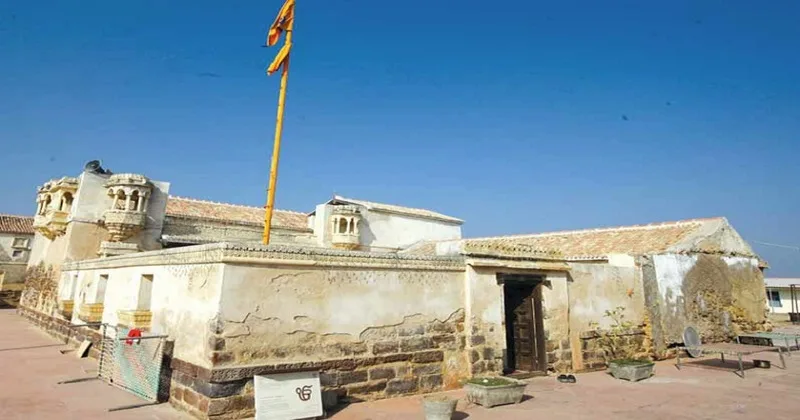
Lakhpat, located in the far northwest corner of Kutch in Gujarat, is a place of both historical and spiritual significance. Facing north over the vast expanse of the Great Rann of Kutch, Lakhpat was once a thriving port city, strategically positioned along key trade routes connecting Gujarat to Sindh and other regions across the Arabian Sea. Its bustling harbours and vibrant trade made it a significant hub during medieval times. However, over the centuries, natural calamities, shifting river courses, and changing trade patterns led to the decline of the city. Today, Lakhpat is largely deserted, its silent streets and crumbling fortifications standing as reminders of its glorious past. Yet amidst its quiet landscape lies a beacon of faith and devotion, the Lakhpat Gurdwara Sahib.
Lakhpat is situated in the far northwest corner of Kutch, facing north over the Great Rann. It was once a major port city, but it has been nearly deserted for about 200 years.
Lakhpat is also important for its religious history. Sri Guru Nanak Dev Ji, the founder of Sikhism, is… pic.twitter.com/rJZpHXXHoJ
— BJP (@BJP4India) November 5, 2025
The Gurdwara holds immense religious significance, particularly for followers of Sikhism. Sri Guru Nanak Dev Ji, the revered founder of Sikhism, is said to have visited Lakhpat during his extensive travels across India. His stay in this remote corner of Kutch left a lasting impression, inspiring the local Sikh community to establish a gurdwara to commemorate his visit. The site became especially sacred as it housed some of Sri Guru Nanak Dev Ji’s personal possessions, making it an important pilgrimage destination for devotees from across the country. Over time, the Lakhpat Gurdwara Sahib became a symbol not just of spiritual devotion but also of the historical and cultural fabric of the region.
The spiritual significance of the Gurdwara faced a grave challenge in 2001 when Kutch was struck by a devastating earthquake. The tremors wreaked havoc across the region, causing widespread destruction, and the historic Lakhpat Gurdwara Sahib was reduced to rubble. For the local community and visiting devotees, the loss was deeply painful, as a site of immense religious importance had been severely damaged. Amidst the ruins, however, emerged a story of resolve, dedication, and compassionate leadership that would ensure the Gurdwara’s restoration.
At that time, Narendra Modi, who was serving as a volunteer in Kutch, witnessed the destruction firsthand. Deeply moved by the devastation and aware of the spiritual importance of the site, he made a personal commitment to restore the Gurdwara. Nine months after the earthquake, Modi became the Chief Minister of Gujarat. On his first visit to Kutch in this new role, he prioritised the rebuilding of Lakhpat Gurdwara Sahib. His vision was not merely to construct a new building, but to restore the Gurdwara to its original form, preserving its historical architecture, design, and sanctity.
The restoration of the Lakhpat Gurdwara Sahib was carried out with meticulous care and attention to detail. Every effort was made to ensure that the rebuilt structure reflected the Gurdwara’s original appearance, honouring both its historical significance and its spiritual essence. Today, the Gurdwara stands as a shining example of heritage preservation, resilience, and devotion. For the Sikh community, it continues to be a sacred place of worship, meditation, and pilgrimage, while also attracting visitors interested in the rich history of Kutch.
The story of Lakhpat Gurdwara Sahib is not only about a building; it is about the enduring power of faith, the responsibility of leadership, and the preservation of cultural heritage. It illustrates how human resolve, when guided by compassion and respect for tradition, can restore what was lost and revive the spirit of a community. On the occasion of Gurunanak Jayanti, the restored Gurdwara in Lakhpat serves as a testament to the enduring legacy of Sri Guru Nanak Dev Ji and to the vision of those committed to preserving spiritual and historical landmarks. In a landscape where time has rendered once-thriving cities nearly empty, the Lakhpat Gurdwara Sahib stands as a beacon of continuity, resilience, and reverence.













Comments