





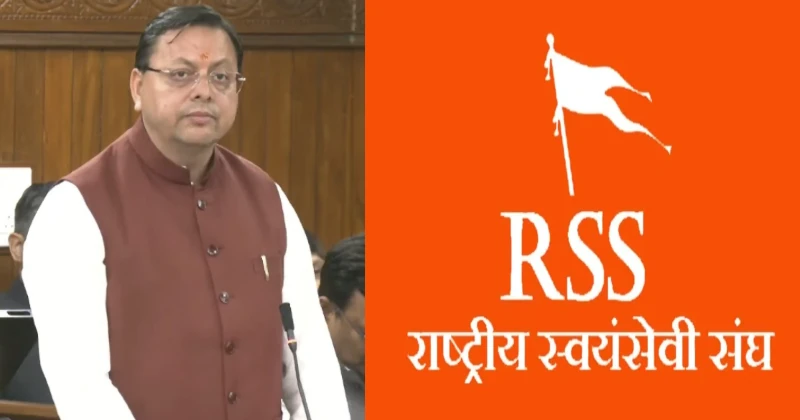
The Uttarakhand Legislative Assembly etched its name in the annals of Indian constitutional history by becoming the first state legislative body in the country to formally acknowledge and record the contribution of the Rashtriya Swayamsevak Sangh (RSS) an organisation that has, for a hundred years, played a defining role in shaping India’s cultural, social, and national consciousness.
The recognition came during a special session of the Assembly convened to mark the silver jubilee of Uttarakhand’s formation, where Chief Minister Pushkar Singh Dhami delivered an emotionally charged address paying tribute to the Sangh’s century-long journey of nation-building and character formation.
“Through its hundred years of ascetic journey, the Rashtriya Swayamsevak Sangh has unleashed such a divine stream of cultural revival, social harmony, self-respect, and patriotic service in India, which has lit the eternal flame of national consciousness in every corner of the country,”
— Chief Minister Pushkar Singh Dhami, Uttarakhand Legislative Assembly.
The Chief Minister’s words delivered in the presence of the Speaker, legislators, and distinguished guests carried both the depth of conviction and the spirit of a historic reaffirmation of India’s civilisational ethos.
By officially recognising the contribution of the Rashtriya Swayamsevak Sangh, the Uttarakhand Assembly has set a precedent for other constitutional bodies to acknowledge the monumental role of the Sangh in nation-building, cultural renaissance, and the awakening of Bharat’s selfhood.
In his speech, Chief Minister Dhami emphasised that India, once burdened by a colonial mindset, today stands tall in self-confidence and cultural pride.
“India, which was once suffering from the mentality of slavery, today takes pride in its cultural values, scientific outlook, and traditions this self-respect is the result of the century-long penance of the Sangh,” Dhami stated emphatically.
This acknowledgment rare within the framework of formal state institutions — symbolically bridges the spiritual and socio-cultural mission of the Sangh with the democratic fabric of modern India, highlighting how cultural identity and governance can coexist in mutual respect and purpose.
Reflecting on Uttarakhand’s own journey, Dhami noted that the Devbhoomi state, born out of the tireless struggles of its people, has faced numerous challenges in the past 25 years. Yet, he underlined, the state has persevered with “unwavering resolve and faith in progress.”
Expressing his vision for the future, the Chief Minister said, “With the blessings of the people and the inspiration drawn from our cultural roots, we will achieve the goal of making Uttarakhand the best state in the country in the coming years.”
The House resonated with a sense of pride, unity, and patriotism as Dhami concluded his historic address with lines from an inspiring Sangh Shakha song, symbolising perseverance and devotion to the national cause:
“This turmoil and wave will not deviate us from our path,
We will keep rowing,
We will reach our destination, we will reach it…”
As the Chief Minister’s words echoed through the Assembly, a profound atmosphere of unity and reverence enveloped the House. Legislators cutting across party lines were visibly moved by the emotional tenor of the moment a moment that encapsulated the spirit of Bharat’s resurgence and the continuity of its timeless values.
Observers described the event as a “historic and transformative step” a formal embrace of the cultural and spiritual forces that have silently shaped India’s national character for the past century.
The Assembly’s resolution stands not merely as a political statement, but as a moral and civilisational affirmation, recognising the RSS’s century-long dedication to discipline, service, and nationhood from disaster relief and social reform to rural upliftment and national integration.















Comments