





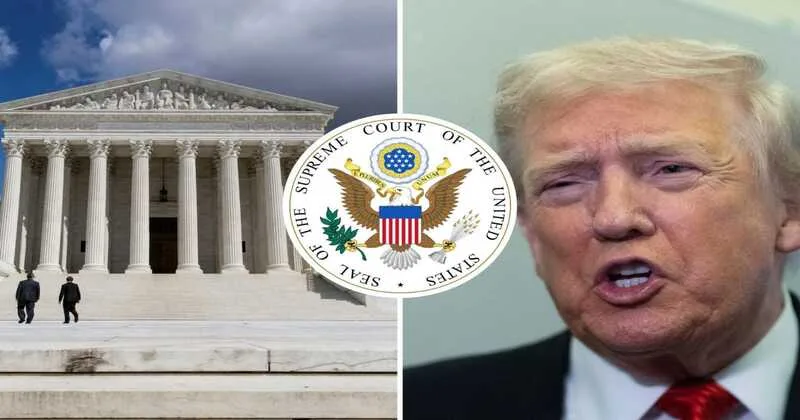
Amid mounting economic turmoil in the US, the Supreme Court has expressed strong reservations about the legality of the sweeping retaliatory tariffs imposed under Trump’s orders, signalling that the controversial measures may be rolled back. Earlier, both the Federal District Court and the Court of Appeals had ruled that Trump’s tariff orders were illegal and amounted to an abuse of presidential powers. Trump is currently appealing those rulings before the Supreme Court, which was expected to issue a verdict yesterday. Instead, the court devoted the day to hearing arguments from the Trump legal team. During the hearing, judges openly questioned whether the tariffs could stand, deepening speculation that the measures would be repealed.
Trump had imposed steep taxes on imports from India, China, Canada, Mexico, Brazil, and other countries, invoking the International Emergency Economic Powers Act (IEEPA) of 1977. His administration argued that it could act without congressional approval. But a broad coalition of US small businesses, import-dependent industries, and even state governments challenged the decision in court, asserting that the president cannot unilaterally impose trade duties by bypassing Congress.
Judges reject Trump’s argument
In court, Trump’s lawyer argued that the tariffs would not burden ordinary Americans and should not be considered taxes. The bench firmly rejected that reasoning. Judges responded by stating that the financial burden of higher import prices ultimately falls on the American people and businesses. They further questioned whether Trump had effectively appropriated powers that constitutionally belong to Congress, and what meaning Congress would have if a president could overrule trade authority at will. Trump’s tariff order imposed a 10 per cent base duty on all US imports and an even heavier 50 per cent tariff on imports from India and Brazil. China faced a 57 per cent tariff, which the government linked to illegal drug trafficking the US. The administration projected that these tariffs would generate $3 trillion for the US government by 2035, with $151 billion already collected, a jump of more than 300 per cent from 2024.
Trump had earlier warned that a repeal of his tariff regime would be a “disaster” and an “embarrassment” for the United States, framing the Supreme Court battle as a life-or-death moment for American economic sovereignty. The hearing lasted two and a half hours, but the court set no timeline for a final verdict. Meanwhile, Trump faces mounting political setbacks that an ongoing government shutdown, the longest in US history, declining public approval, and a “miserable defeat” in multiple local elections, including New York. If the Supreme Court’s ruling also goes against him, analysts say, it would represent one of the most severe legal and political setbacks of his presidency.
Markets surge on repeal speculation
Global stock markets rallied on hopes that the Supreme Court will overturn Trump’s tariff regime. AI-linked companies, which had suffered sharp drops over concerns of overvaluation, rebounded strongly. Bargain buying also lifted market sentiment as investors stepped in to acquire discounted technology shares. Investors expect that a rejection of Trump’s tariffs would be a major boost for global trade and a relief for exporters, particularly in India, which has been hit by additional levies on major commodities. On Wall Street, the Dow Jones Industrial Average climbed 0.48 per cent, while the Nasdaq Composite rose 0.65 per cent. The broader S&P 500 Index advanced 0.37 per cent. Asian markets mirrored the uptrend, Japan’s Nikkei gained 1.14 per cent, Australia’s ASX200 moved up 0.23 per cent, and South Korea’s KOSPI surged 2.5 per cent. In Europe, the FTSE gained 0.64 per cent, and Germany’s DAX rose 0.42 per cent.
Despite broad gains across global markets, US futures slipped into the red early today. S&P 500 futures fell 0.2 per cent, Nasdaq futures 0.3 per cent, and Dow futures 0.1 per cent. Still, Asian and European momentum has raised hopes for a strong opening in the Indian markets. Gift Nifty dropped 60 points during the morning, but analysts expect Sensex and Nifty to open higher on global optimism. Yesterday’s global bloodbath spared Indian investors, since domestic markets were closed for Guru Nanak Jayanti. Improved second-quarter results from large companies such as State Bank of India are likely to offer additional support.
There are also signs that India-US trade talks are moving back on track. In a separate development, Paytm reported a massive 98 per cent drop in consolidated profit for the second quarter, while Sun Pharma reported a 2.6 per cent rise in profit and an 8.6 per cent increase in operating revenue. Airline giant IndiGo moved from a Rs 2,176-crore profit in the previous quarter to a Rs 2,582-crore loss. Major companies announcing results today include Apollo Hospitals, Lupin, LIC, Ola Electric, Aster DM Healthcare, Godrej Properties, Mankind Pharma, Cummins India, and MCX. Meanwhile, unofficial US labour data revealed that 42,000 private-sector jobs were added last month, far above the 28,000 forecast by analysts, giving global markets further support.
Oil and Gold
International crude oil prices continued their downward slide. Even though OPEC+ has backed away from an earlier decision to increase production, prices have failed to recover. WTI dropped to $59 per barrel, while Brent touched $63.54. The fall is a positive development for India, which relies on imports for 90% of its oil consumption. Cheaper crude could strengthen the rupee and support the domestic stock market. Gold prices were volatile. Early trading saw a jump of $31 per ounce, taking international spot gold to $3,982.3. Safe-haven demand has strengthened as fluctuations in global markets continue, pushed by a stronger US dollar index and marginal declines in US Treasury yields.
With economic setbacks piling up, the Trump administration is under intensifying domestic and international scrutiny. If the Supreme Court upholds earlier rulings and strikes down Trump’s tariff powers, it will be a decisive moment in US trade history, marking not only a major legal defeat for the administration, but a dramatic realignment of global market expectations.














Comments