





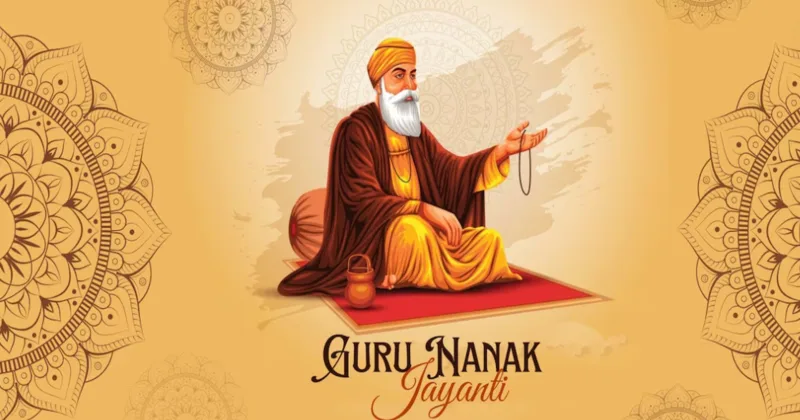
Guru Nanak Jayanti, celebrated with deep devotion across India and the world, marks the birth anniversary of Guru Nanak Dev Ji, the founder of Sikhism and one of the most luminous spiritual teachers in human history. Born in 1469 in Talwandi, now called Nankana Sahib, Guru Nanak emerged in a time when society was fractured by caste, ritualism, and moral decline. His divine mission was to reawaken humanity to the eternal truth of oneness, compassion, and devotion. Far from creating a new religion, Guru Nanak revived and reaffirmed the timeless essence of Sanatan Dharma, and especially of Vaishnavism, the path of loving devotion to the One Supreme Lord. His life, his hymns, and his actions all reveal that Sikhism is an organic continuation of the Vaishnav bhakti tradition—rooted in the worship of the one Lord, Hari, known by countless names such as Govind, Gopal, Krishna, and Ram.
Guru Nanak’s compositions in the Guru Granth Sahib speak of a Supreme Being who is formless yet immanent, transcendent yet intimate, a Being of pure love and truth. The sacred Mool Mantar, beginning with “Ik Onkar Satnam Kartapurakh Nirbhau Nirvair Akaal Moorat Ajooni Saibhang Gurprasad,” declares the same eternal truth expounded in the Upanishads and the Vaishnav scriptures—that there is only One, timeless, all-pervading Reality, who creates, sustains, and guides the cosmos. This principle is echoed in the Vaishnav conception of the Divine as Ekam eva advitiyam, the One without a second. Guru Nanak did not preach exclusivity but universality, describing the Lord as the source of all creation and the object of all love. In his Japji Sahib, he sings, “Sochai soch na hova-ee je sochi lakh vaar, chupai chup na hova-ee je laae rahaa liv taar,” meaning that intellectual silence or ritual cannot purify one’s mind; only living remembrance of the Lord does. This is identical in spirit to the Vaishnav bhakti teaching that liberation is attained not through austerities but through unbroken love and remembrance of the Lord’s Name.
In many of his hymns, Guru Nanak invokes the Divine using Vaishnav names—“Govind,” “Gopal,” “Madhav,” “Hari,” and “Ram.” In one Shabad, he sings, “Har Har naam japahu mere mit, Har bin avar na koi,”—“Chant the Name of the Lord, O my friends; there is no other besides Him.” This centrality of Naam Simran, or remembrance of the Divine Name, is the heart of both Sikhism and Vaishnavism. The Bhagavad Gita teaches the same truth when Lord Krishna says, “Man-mana bhava mad-bhakto”—fix your mind on Me, be devoted to Me. Guru Nanak’s message was precisely that—constant remembrance of the Lord through His Name, which alone frees the soul from bondage.
During his travels across Bharat, Guru Nanak met saints, seekers, and devotees of every region, engaging in dialogue and divine song. One of the most spiritually significant encounters was with Sri Chaitanya Mahaprabhu, the great Vaishnav saint of Bengal who spread the ecstatic chanting of the Lord’s Name—Hare Krishna Hare Rama. It is said that when Guru Nanak met Chaitanya Mahaprabhu at Puri, they both recognized the same flame of divine love burning in each other’s hearts. They sang together the glories of Hari, celebrating that the Lord is one though His devotees may come from different paths. Deeply moved by the bhakti and kirtan of the devotees who sang with tears in their eyes, Guru Nanak composed a magnificent Aarti—a hymn of cosmic worship—which remains one of the most beautiful examples of universal devotion ever sung.
In that Aarti, Guru Nanak transformed the traditional ritual of waving lamps before an idol into a vision of the entire universe as the temple of God. He sang, “Gagan mai thaal rav chand deepak bane, tarika mandal janak moti, dhoop malanlo pavan chavro kare, sagal banraai phoolant joti.” Here, the sky becomes the platter, the sun and moon the lamps, the stars the pearls, the wind the incense, and all of creation offers flowers of light in the worship of the Divine. This sublime vision mirrors the Vaishnav understanding of Vishvarupa, the Cosmic Form of Krishna described in the Bhagavad Gita, where the entire universe is seen as His divine body. Guru Nanak’s Aarti thus reveals his realization of the same truth—that every act of nature, every breath of wind, every shining star participates in the eternal worship of the Lord.
In another of his Shabads, Guru Nanak declares, “Ram nam ur mai gahiyo, jan Nanak eh tan deh,”—“I have grasped the Name of Ram in my heart; O Lord, this body is Yours.” His surrender to the Lord through Naam is indistinguishable from the devotion expressed by Vaishnav saints like Tulsidas and Surdas. Similarly, in Soohee Mahalla Pehla, he says, “Hari jio tu sada sada daata, tu sada sada daan dey,”—“O Lord, You are the eternal giver, You always bestow gifts upon us.” The humility of this devotion, the acknowledgment of the Lord as the eternal benefactor, and the expression of gratitude all flow from the same river of bhakti that nourished the Vaishnav tradition through ages.
Guru Nanak’s teachings on equality and service too resonate deeply with Vaishnav ideals. The principle of seva—selfless service—is central to both paths. Just as Vaishnav saints fed and served all beings as manifestations of the Lord, Guru Nanak established Langar, where all people, regardless of caste or status, could share food as equals in the presence of God. His teaching “Naam japo, kirat karo, vand chakko”—meditate on the Name, earn through honest labor, and share what you have—embodies the essence of dharma as lived devotion, a principle long upheld by the bhakti saints. His rejection of ritual without love was not a rejection of Sanatan Dharma but a return to its purest essence—the same essence Chaitanya Mahaprabhu expressed in his ecstatic kirtans, and which countless Vaishnav saints before and after him lived by.
Guru Nanak’s songs are filled with the fragrance of the Lord’s names and qualities, always urging the soul toward humility and love. In Dhanasri Mahalla Pehla, he sings, “Gur satgur ka jo sikh akhaye, so bhalke uth Har naam dhiaave,”—“He who calls himself a disciple of the True Guru should rise early and meditate on the Name of the Lord.” This echoes the Vaishnav instruction of rising before dawn to chant the Lord’s names. His emphasis on living righteously, on seeing God in all, and on renouncing ego mirrors the spirit of Vaishnav surrender—sharanagati—where the devotee places all faith in the mercy of the Lord.
Through every hymn, Guru Nanak proclaimed the unity of God and the oneness of humanity. His heart knew no division between sects or scriptures; he saw the Divine everywhere and in everyone. The spiritual continuity between Vaishnavism and Sikhism is undeniable: both spring from the same eternal fountain of bhakti, the loving remembrance of the Supreme Being. While later interpretations sometimes seek to isolate Sikhism as separate, the essence of Guru Nanak’s message remains firmly planted in the soil of Sanatan Dharma. Both Hindus and Sikhs have always been bound by shared reverence for the Divine Name, shared ethics, and shared love for righteousness.
In our own times, some divisive forces attempt to create a false rift between Hindus and Sikhs, portraying them as separate identities. Yet, history and philosophy both testify that they are two branches of the same eternal tree. Sikhism arose from the heart of Sanatan Dharma, enriching it with renewed vitality and social vision. Guru Nanak Dev Ji was not a breaker of tradition but its purifier, its restorer, and its living embodiment. When we celebrate Guru Nanak Jayanti, we are not merely honoring a historical figure but venerating the eternal light of dharma that has illuminated Bharat for millennia. As Guru Nanak declared, “Ek pita ekas ke hum baarik,”—“There is one Father, and we are all His children.” That single truth remains the unbreakable bond between Hindus and Sikhs, two limbs of the same divine body, united forever in the love of the One Lord.
















Comments