





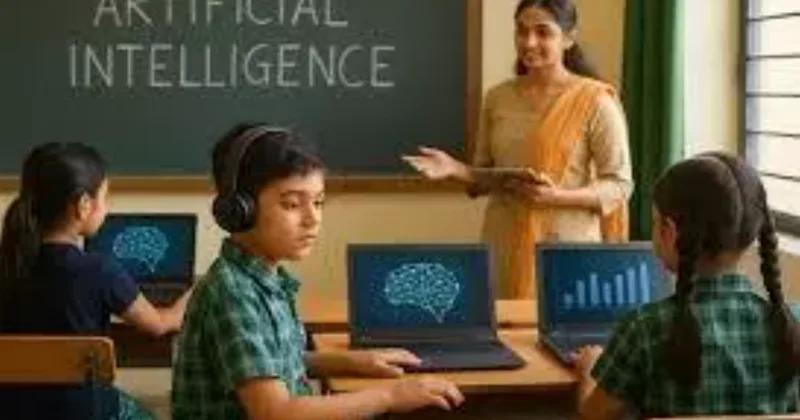
In a transformative move to prepare India’s young minds for the technological future, the Ministry of Education has announced the introduction of Artificial Intelligence (AI) and Computational Thinking (CT) as part of the school curriculum from Class 3 onwards. The initiative aims to foster a culture of analytical thinking, creativity, and problem-solving among students from an early age, aligning with India’s vision of becoming a global leader in digital innovation and ethical AI usage.
The decision marks a significant milestone under the Department of School Education & Literacy (DoSEL), which reaffirmed its commitment to advancing AI and CT as integral components of future-ready education. The move is part of a broader effort to make students not only digitally literate but also capable of using technology responsibly and intelligently to contribute to the concept of “AI for Public Good.”
The Ministry of Education emphasized that AI and CT will not be limited to advanced or technical students but will be organically embedded in the curriculum from the foundational level. Beginning in Grade 3, students will gradually be introduced to concepts such as logic, pattern recognition, problem-solving, and responsible AI usage in simple and engaging ways.
According to the Ministry, the curriculum will expand across all grades, reinforcing the concept of learning, thinking, and teaching through an AI-driven approach. The vision behind this step is to ensure that children understand technology as a tool for creativity, social good, and innovation, rather than mere automation.
The initiative is part of the National Curriculum Framework for School Education (NCF-SE) 2023, which envisions education that is inclusive, future-oriented, and aligned with the needs of the rapidly changing global landscape. The Department of School Education & Literacy (DoSEL) is working in collaboration with CBSE, NCERT, Kendriya Vidyalaya Sangathan (KVS), Navodaya Vidyalaya Samiti (NVS), and IIT Madras, as well as State and Union Territory representatives, to design an AI and CT curriculum that caters to India’s diverse educational environment.
A key step towards this goal was the stakeholder consultation held on October 29, 2025, where experts from various educational and technological institutions discussed the structure and implementation of the upcoming curriculum.
The Central Board of Secondary Education (CBSE) has formed an expert committee chaired by Prof. Karthik Raman from IIT Madras to develop the AI and CT modules. The committee will oversee curriculum design, resource creation, and integration of AI learning materials into existing syllabi.
During the consultation, Sanjay Kumar, Secretary of the Department of School Education & Literacy (DoSEL), laid the importance of introducing AI as a basic universal skill linked to “The World Around Us.” He said that AI is no longer a specialized subject but a foundational skill necessary for navigating the modern world.
“Education in Artificial Intelligence must be treated as a basic universal skill linked to the world around us. The curriculum must be broad, inclusive, and aligned with the NCF-SE 2023, ensuring that every child’s distinct potential is our priority,” said Shri Kumar.
He also emphasised on regularly updating the curriculum to match new technological changes. He said policymakers should set a basic standard for AI learning and keep reviewing it as global trends evolve.
What sets this initiative apart is its emphasis on ethical AI education. Rather than teaching AI merely as a technical subject, the curriculum will focus on its responsible and human-centered use. Students will learn how AI can be applied for the public good, addressing challenges such as healthcare, education, climate change, and sustainable development.
By introducing the subject early, the Indian government wants students to learn about AI ethics, data privacy, and social responsibility. The program will help them develop critical thinking, empathy, and a sense of responsibility in using technology in daily life.
To ensure the effective rollout of this ambitious program, the government is prioritizing teacher training and resource development. The Ministry has planned to leverage NISHTHA’s teacher training modules and video-based learning resources to equip educators with the necessary skills to teach AI and CT concepts.












Comments