





Guru Nanak Dev Ji’s name is immortal in the history of Indian culture, spirituality, and humanity. He was born at a time when religious fanaticism, superstition, casteism, and social discrimination were at their peak. He offered a new vision to humanity, one in which love, equality, and truth were paramount. In today’s age, when the crisis of values and moral decline is increasing with modernity, Guru Nanak Dev Ji’s teachings can prove to be extremely inspiring and guiding for the youth.
Guru Nanak Dev Ji was born in 1469 AD in Talwandi (now Nankana Sahib, Pakistan), on the banks of the Ravi River. His father’s name was Mehta Kalu Chand and his mother’s name was Tripta Devi. From childhood, he possessed extraordinary intelligence, sensitivity, and spiritual inclination. Instead of seeking truth in worldly splendour, wealth, and rituals, he found joy in the name of God and in serving humanity.
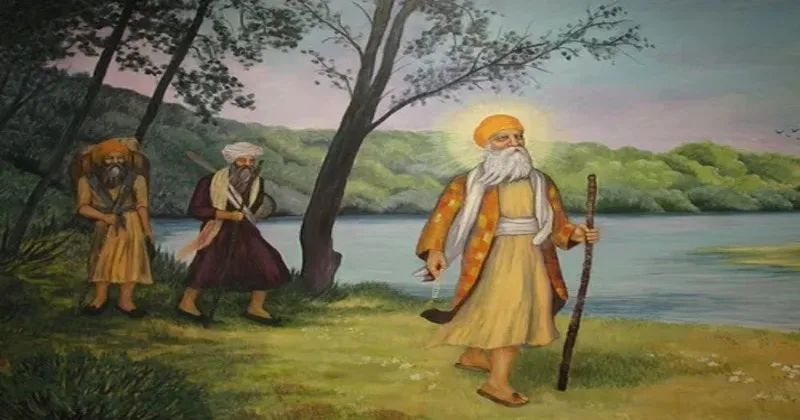
Through his life, Guru Nanak Dev Ji worked to dispel many misconceptions prevalent in society. He travelled (Udaasi) in all four directions with his disciple Bhai Mardana ji, spreading the message of love, unity, and compassion.
Guru Nanak Dev Ji, considering the social situation, linked the symbol of the Upanayana ceremony with spirituality as well as social responsibility, so that through virtuous conduct, all forms of discrimination could be eliminated from society.
da-i-aa kapaah santokh soot jat gandhee sat vat.
ayhu janay-oo jee-a kaa ha-ee ta paaday ghat.
naa ayhu tutai naa mal lagai naa ayhu jalai na jaa-ay.
Guru Nanak Dev Ji’s philosophy was profoundly broad and humanitarian. His teachings can be summed up in the following points:
Naam Simran (Remembrance of God)
Guru Nanak Dev Ji taught that human life is meaningful only when one remembers God at every moment. ‘Naam Simran’ means experiencing God’s presence in one’s thoughts, actions, and behaviour. This purifies one’s mind and destroys ego.
Based on the Rigveda verse, “Ekam Sat Vipra Bahudha Vadanti,” Guruji often used to say,
“Ek Noor Te Sab Jag Upjaya, Kaun Bhale Ko Mandey.” (All sects, religions, and denominations are part of the same light that helps humanity reach its pinnacle. There is no harm in any sect or denomination. All, from their own ideological foundations, are moving towards attaining the same ultimate truth)
Kirat Karo (Work Honestly)
He said that every person should earn a living through hard work and honesty. No work is small or big; true hard work is worship of God.
Vand Chhako (Share)
Guru Nanak Dev Ji instilled a sense of equality and mutual cooperation in society. He said that whatever you earn, share it with the needy. This is the true form of service.
Equality and Brotherhood
He opposed casteism, discrimination, gender discrimination, etc., and considered everyone equal. According to him, no one is high or low in God’s court.
Respect for Women
Guru Nanak Dev Ji said, “So kyo manda aakhiye jit jamme rajan”, (How can a woman from whose womb even kings are born be called low? This statement is a great declaration of respect for women.)
6. Service and Humility:
He considered selfless service a part of religion. The tradition of ‘Langar‘ (a place where people sit together and share food) is also a result of Guru Nanak Dev Ji’s teachings, where everyone eats together.
The Contemporary Age and the Relevance of Guru Nanak Dev Ji
Today is an era of technological advancement. However, along with this modernity, the youth is becoming increasingly afflicted with mental stress, competition, materialism, and valuelessness. In such times, Guru Nanak Dev Ji’s teachings are capable of instilling self-confidence, morality, and a sense of responsibility towards society. Disconnection from religion, separation from family, and a self-centered lifestyle are prevalent among the youth today. Guru Nanak Dev Ji taught us that life is not just about material achievements, but a means to spiritual peace and collective upliftment.
Guru Nanak Dev Ji was the only saint of the Bhakti movement who reflected on social conditions along with spiritual and religious elements. Guru Nanak Dev Ji was the first to write about the Mughal atrocities prevalent in contemporary society:
khuraasaan khasmaanaa kee-aa hindusataan daraa-i-aa.
aapai dos na day-ee kartaa jam kar mugal charhaa-i-aa.
aytee maar pa-ee karlaanay taiN kee darad na aa-i-aa. (Having attacked Khuraasaan, Baabar terrified Hindustan. The Creator himself does not take the blame, but has sent the Mugal as the messenger of death. There was so much slaughter that the people screamed. Didn’t You feel compassion, Lord?)
Guru Nanak Dev Ji’s Message and Youth:
1. Positive Life Outlook: Nanak Ji’s teachings uplift youth from despair and make them active.
2. Social Responsibility: Today, when selfishness and division are increasing in society, Nanak Ji’s principle of “Vand Chhako” inspires us to serve the society.
3.Religious tolerance: He explained that true religion is one that unites everyone. This idea develops a global perspective and a spirit of coexistence among youth.
4. Importance of honesty and hard work: The principle of “Kirat Karo” inspires youth to work hard and be self-reliant.
Contemporary challenges and Guru Nanak’s
Today’s youth face many problems, including the cyber world, consumerism, drug addiction, and unemployment. The solution to all these lies in the teachings of Guru Nanak Dev Ji. Mental peace can be achieved through ‘Naam Simran,’ self-respect through ‘Kirat Karo’, and social balance through ‘Vand Chhako.’
Guru Nanak Ji’s ideology is not merely religious, but a practical philosophy that leads both individuals and society on the path of progress. His teachings transcend time, society, and generations. His message will remain relevant in every era because it is connected to the fundamental spirit of humanity. If today’s youth adopt his teachings, they can not only uplift themselves but also establish morality, equality, and love in society. Thus, Guru Nanak Dev Ji’s teachings are a great source of guidance for modern youth, making them spiritually empowered, socially responsible, and morally strong.












Comments