





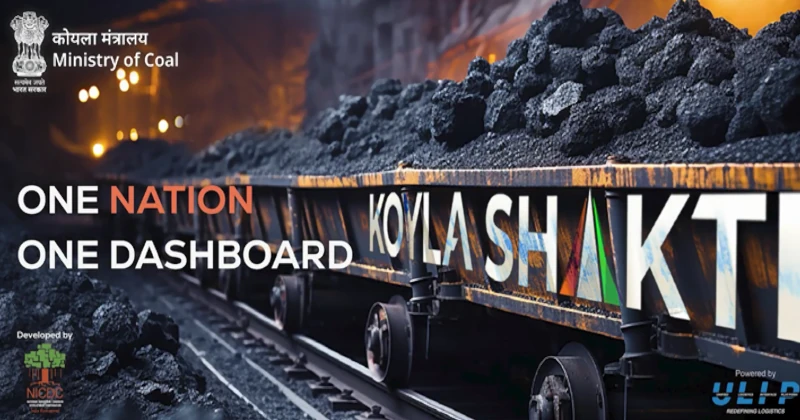
The coal sector has long served as the backbone of the energy ecosystem in India, powering almost 70% of the nation electricity generation and acting as a very crucial input to industries from steel to cement. For decades, this industry functioned through fragmented information systems, delayed reporting and logistical inefficiencies. Recognizing the structural flaws, the Government of India has announced “Koyla Shakti”, a Smart Coal Analytics Dashboard (SCAD) developed by the Ministry of Coal, marking a strong step toward complete digital integration and real-time decision-making in coal governance.
Why the Reform Was Needed
The entire coal value chain of India-from mining and transport to consumption-involves a large number of stakeholders, including state-owned coal producers, private miners, railways, ports and power utilities. This traditional way resulted in each player maintaining its own sets of data, which most often caused mismatched records, duplication of efforts and delays in coordination at different levels. Without a unified monitoring system, policymakers and administrators could not get a clear view of the day-to-day scenario of the sector.
India despite being the second largest coal producer in the world, suffered from inefficiencies related to coal evacuation, stock management and demand forecasting. These delays in data sharing between coal companies and power plants often resulted in supply mismatches, which then burdened utilities to rely on expensive emergency imports, when overall domestic stock is sufficient. In fact, studies conducted by NITI Aayog and the Ministry of Power estimates that approximately 10 per cent to12 per cent of the dispatch-related losses in some regions were attributed to fragmented data systems and gaps in communication.
It was against this backdrop that Koyla Shakti was born, a single-window, central digital interface to integrate production, logistics and consumption data in one place for assured real-time visibility across the entire coal ecosystem. This reform isn’t strictly technological in nature but it represents a shift toward data-driven governance, whereby every tonne of coal mined, moved and utilized could be tracked. So, less corruption and time saving can be done.
Digital Leap Forward towards Enhancing Transparency and Accountability
Initiated by the Ministry of Coal, Koyla Shakti integrates inputs from various sources like Coal India Ltd., Singareni Collieries Company Ltd., private miners and other online platforms which includes e-Khanij maintained by various states. It also syncs data points from the ministries of Power, Railways, Ports, Finance and Road Transport on a single platform for effective inter-ministerial coordination.
Real-time dashboard view of Koyla Shakti
This dashboard monitors coal production, dispatches, log flow and demand-supply patterns in real time. Advanced data visualization and AI-based analytics tools enable decision-makers to track the development of trends, predict impending shortages and undertake logistics planning accordingly. Its scalable architecture will allow easy integration of future data sets-satellite-based mine monitoring, carbon tracking and emission analytics-in keeping with overall energy transition and sustainable development goals.
For many years, the coal sector was criticized for being opaque, whether in its allocation of resources, priority in dispatch or adherence to environmental requirements. Koyla Shakti aims to change that impression by bringing complete transparent in every operational parameter. Every stakeholder from the Ministry to State utilities has access to standardized data in real-time.
This transparency ensures that at one glance, the mining companies, port terminals and transport corridors show their performance metrics, thus encouraging accountability. It also minimizes manual intervention, hence reducing human error and the possibility of data manipulation. Thus in effect, Koyla Shakti brings coal governance into the digital sunlight a crucial factor in restoring public trust and improving investor confidence.
Policy Planning and Predictive Governance
Besides monitoring Koyla Shakti will also play a crucial role in policy formulation and long-term energy planning. Analysing the production trends, consumption patterns and stockpiling on a dashboard, making policymakers to better align domestic coal production with national energy demand. The forecasting functionality on the dashboard helps in anticipating regional shortages and ensures evidence-based policy intervention.
The predictive capability assumes greater significance in view of India’s energy diversification goals under the National Coal Policy and the Energy Transition Roadmap 2030. Precise coal demand forecasting, as renewables expand, will ensure grid stability with reduced import dependence. According to the projections made by the Ministry of Coal, integrated monitoring has potential to bring down annual import expenditure by up to ₹12,000 crore thereby strengthening Bharat’s aatmanirbharta in energy.
Operational Efficiency and Cost Optimization
The benefit of Koyla Shakti is the potential that will smoothen logistics and cost cutting. Coal transportation makes up almost 30 per cent to 35 per cent of the total expenditure in the sector. Real-time visibility through the dashboard on rail and road dispatches, bottlenecks on routes and congestion at ports, allows dynamic optimization of supply chains.
Data on the platform could reroute shipments in case of railway delays or congestion at ports to ensure timely supply to power plants. In Longer term, this could improve logistical efficiency by 10% to 15%, according to internal estimates by the Ministry of Coal. The reduction in idle stock and turnaround time will improve the financial health of coal companies and reduces operational cost for end-users.
Empowerment of States and Private Players
National-level coordination is important, for the success of the coal economy, as it rests on proper implementation at the state level. Odisha, Chhattisgarh and Jharkhand are states with very extensive mining but generally do not have detailed information on extraction and dispatch quantities. This gap is bridged by Koyla Shakti through integration with state e-Khanij portals, where state governments can monitor production and royalty flows in real time.
Private miners benefit significantly as well. The integrated data platform puts them on an equal part with others in access to demand forecasts and key logistics performance indicators in real time, which were not available earlier. This could lead to increased private investments in coal infrastructure, transport corridors act as an enabler for the government Aatmanirbhar Bharat vision in the energy sector.
Supporting Energy Security and Sustainability
Even while diversifying the energy mix, coal remains of prime importance for ensuring baseload energy security in India. The Ministry of Coal has made it crystal clear that efficient and transparent management of this resource is essential for a stable transition. Koyla Shakti contributes in its way toward this objective by enabling data-based tracking of sustainability by monitoring overburden removal, reclamation progress and emission levels from mining operations.
Linked with environmental compliance systems, this platform will enable the regulators to ensure that coal extraction is kept within the permissible limits set on ecological grounds. This also falls in line with the government overall thrust on controlling environmental degradation caused by mining through drone surveys and remote sensing tools being promoted by the Ministry of Environment, Forest and Climate Change.
Integrating with Digital India and Gati Shakti
Koyla Shakti forms part of a larger digital reform ecosystem driven by the Prime Minister vision of Digital India and the PM Gati Shakti National Master Plan. The interoperability of the platform has been ensured so that data from the coal dashboard can feed into national logistics portals and power grid monitoring systems, thus enabling cross-sector optimization.
The effort shows how governance has evolved from just manual oversight to intelligent, automated systems by digitizing one of the most complex natural resource sectors in India. The modular architecture of the dashboard ensures that additional modules, such as mine safety analytics or real-time emission monitoring can be integrated without restructuring the platform.
Success for Koyla Shakti is really a matter of how regularly the data is updated, the adoption by users and integration with policies. The Ministry of Coal further intends to extend its utility by linking it with blockchain-enabled transaction systems and integrating satellite imagery for mine inspection. These shall turn it into a predictive governance tool and help shape investment decisions, compliance audits and climate-related reporting.
This dashboard is a foundation for an intelligent coal economy by fusing data, technology and governance into Koyla Shakti. It reflects India’s determination to bring modernization to its traditional industries with full transparency, efficiency and sustainability. Leading this digital transformation, the Ministry of Coal sends a clear message that India’s energy future will be as smart as it is self-reliant.
















Comments