





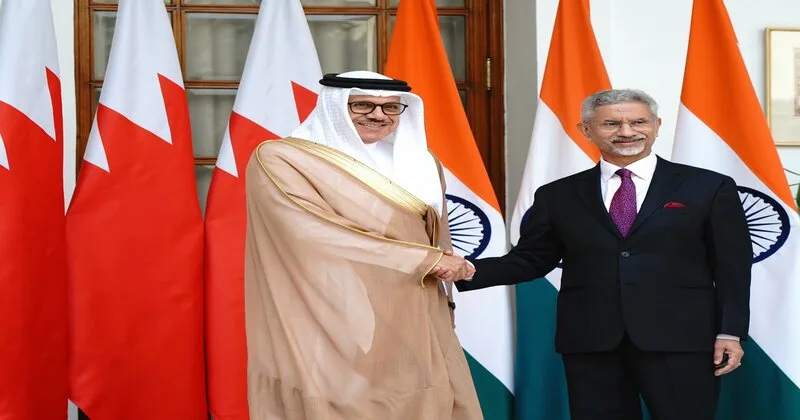
The deepening of ties between India and Bahrain marks not merely a diplomatic courtesy but a transformative strategic endeavour from India’s perspective. As External Affairs Minister S. Jaishankar highlighted during the 5th India-Bahrain High Joint Commission meeting in New Delhi, the two nations share “centuries-old ties… underpinned by trade linkages and strong people-to-people ties.” Building on that historic foundation, India now sees Bahrain as a gateway for new frontiers of cooperation, especially in space, fintech and technology. This is a crucial moment when India seeks to diversify its strategic partnerships and strengthen its role in the Gulf region.
What makes this moment especially relevant for India is a confluence of shifting global and regional dynamics. The Gulf, historically important for energy and Indian diaspora links, is now evolving into a tech-driven investment and innovation hub. Bahrain, with its advanced financial services infrastructure and openness to technological collaboration, presents a compact and agile partner for India’s vision of upgraded ties. Meanwhile, India’s strategic interests in the Gulf including ensuring sea-lines, protecting its diaspora and accessing investment, calls for a stronger engagement. Bahrain’s upcoming presidency of the Gulf Cooperation Council (GCC) Summit and its role in regional security dialogues such as the Manama Dialogue also position it as an influential ally for India’s Gulf strategy.
The new arenas that India is prioritising with Bahrain are illustrative of this shift. Defence, security, trade, health and culture have long featured in the bilateral relationship and continue to deepen. But as EAM Jaishankar emphasised, “there are new areas such as space, fintech and technology that hold considerable promise for our partnership.” In space cooperation, India’s prowess in satellite launch, remote sensing and navigation offers an attractive proposition for Bahrain to tap into India’s capabilities. In fintech, India’s experience with digital public infrastructure and payment systems can be exported or adapted in Bahrain and beyond. These are not just abstract ambitions: Indian and Bahraini space agencies are making progress in partnership, while electronic visa systems and institutional investment frameworks are already under discussion.
From India’s vantage point, the leverage gained through stronger bilateral ties with Bahrain is multifaceted. Economically, by encouraging Bahraini investors to explore opportunities in India and working towards a bilateral investment treaty and a joint working group on trade and investment, India opens another stream of capital, technology transfer and market access. Strategically, enhanced cooperation with Bahrain underpins India’s outreach to the Gulf and reinforcing maritime security ties, for example, the Indian Navy’s visit of three ships to Bahrain in September 2025. Technologically, participation in Bahraini-led innovation ecosystems gives Indian companies, start-ups and the public sector new corridors for growth and diversification. Politically, a strengthened India-Bahrain axis signals India’s readiness to be a deeper partner in Gulf dynamics and a counterbalance to shifting powers and a reinforcement of India’s global role.
The impact of this evolving bilateral relationship is likely to ripple across sectors. For the Indian diaspora in Bahrain, a community of over 300,000— improved welfare measures, digital connectivity, cultural linkage and economic mobility will follow. In industry and innovation, Indian firms will gain access to Gulf capital, joint ventures in space, fintech exports and a platform for regional expansion. For India’s global standing, deepened ties with Bahrain yield visibility as a trusted partner in a region undergoing rapid transformation, enhancing New Delhi’s diplomatic and strategic footprint beyond Asia. Simultaneously, Bahrain benefits from Indian technology, investment, human resource engagement and a strong partner supportive of regional stability.
India’s commitment to this deepening partnership is explicit and actionable. Not content with rhetoric, New Delhi is moving towards a bilateral investment treaty, setting up institutional working groups, expanding health- and space-agency collaboration, and improving connectivity via electronic visa systems for Bahraini nationals. As EAM Jaishankar reaffirmed India’s support for the Gaza Peace Plan while discussing Bahrain ties, it underscores India’s readiness to engage not just economically but diplomatically in shared regional security concerns.
In essence, India’s engagement with Bahrain is no longer just about preserving a friendly neighbourly bond but about crafting a forward-looking strategic partnership. By leveraging Bahrain’s role, innovation ambition and Gulf positioning, India broadens its horizons, economically, technologically and geopolitically. For India, the time is ripe to convert historic friendship into a dynamic multi-sector partnership that supports its ambitions for growth, global influence and regional stability in the years ahead. By anchoring the relationship in shared commitment to regional peace, including the Gaza Peace Plan, India underscores that growth and stability are linked. In a rapidly evolving Gulf and global order, this partnership offers India a distinct pathway to growth, influence and stability.













Comments