





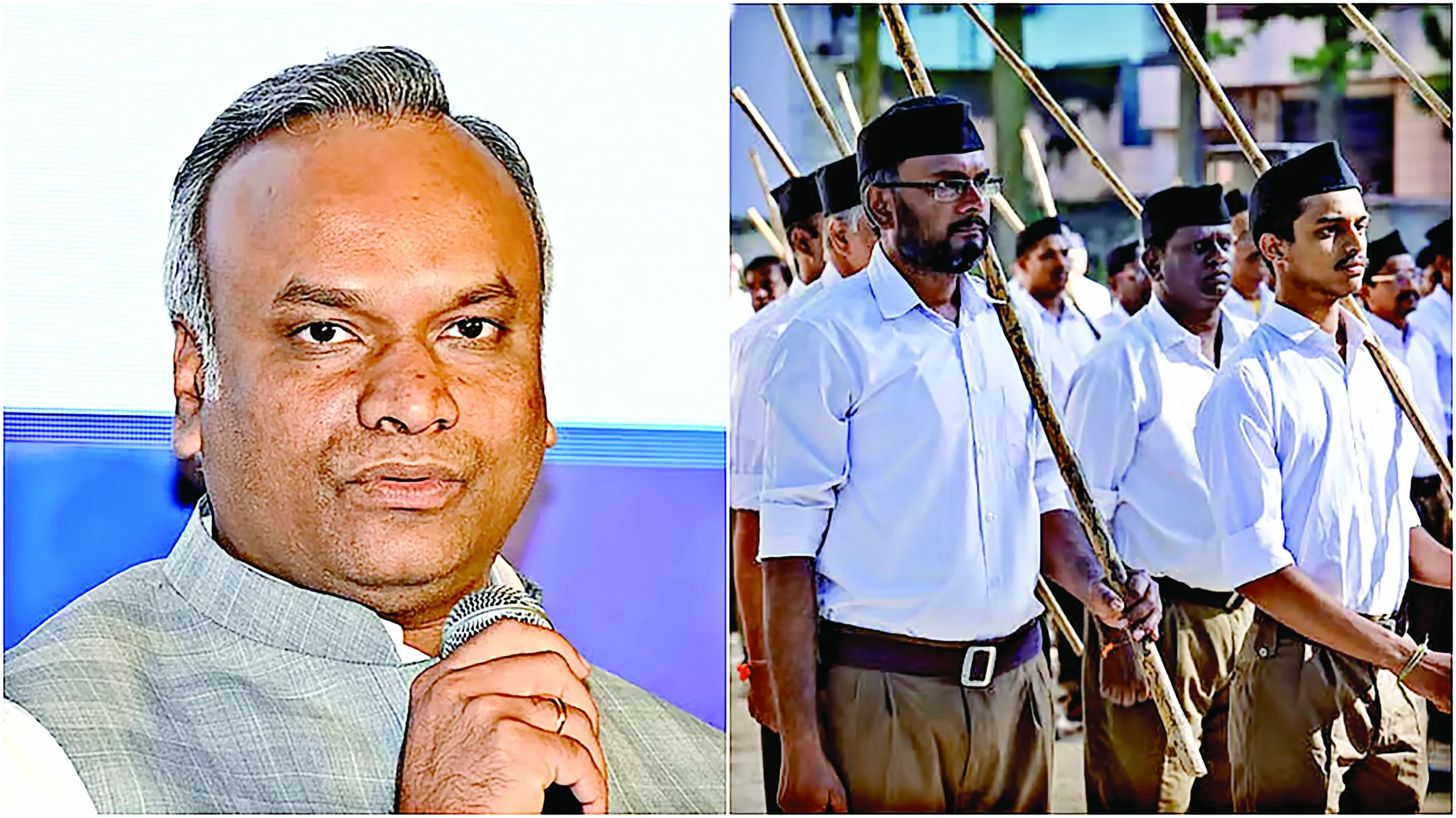
Karnataka has increasingly become the epicentre of political theatrics – policies designed more to distract than to deliver. The State’s newest political spectacle comes from Priyank Kharge, who recently sought to restrict RSS activities near Government schools and take action against State employees attending Path Sanchalans during Vijayadashami. The move, couched as an ideological stance, echoes Congress’s familiar anti-Sangh narrative. It’s a convenient strategy that keeps debates alive while masking the party’s governance shortcomings. Yet, this attempt to reignite old ideological fires may say less about principles and more about ambition.
Priyank: New Loyalist to Gandhi Family
For Priyank, son of Mallikarjun Kharge, it appears to be a calculated bid to position himself as the Gandhi camp’s loyalist in Karnataka’s fractured Congress ecosystem.
As the Government crosses its mid term mark, Karnataka’s political landscape remains clouded by uncertainty. The tug-of-war between Chief Minister Siddaramaiah and his Deputy DK Shivakumar has paralysed administrative cohesion. Power equations shift weekly, and whispers of a leadership change refuse to die down. Congress’s internal strife has created a leadership vacuum that ambitious younger leaders are eager to fill. In this flux, Priyank Kharge sees an opportunity to carve a niche as the ideological face of the party in the State. His aggressive anti-RSS stance offers a differentiator from Siddaramaiah’s corruption-tainted image and Shivakumar’s ambiguous flirtation with soft Hindutva. But it also exposes him to backlash from both within and outside the party.
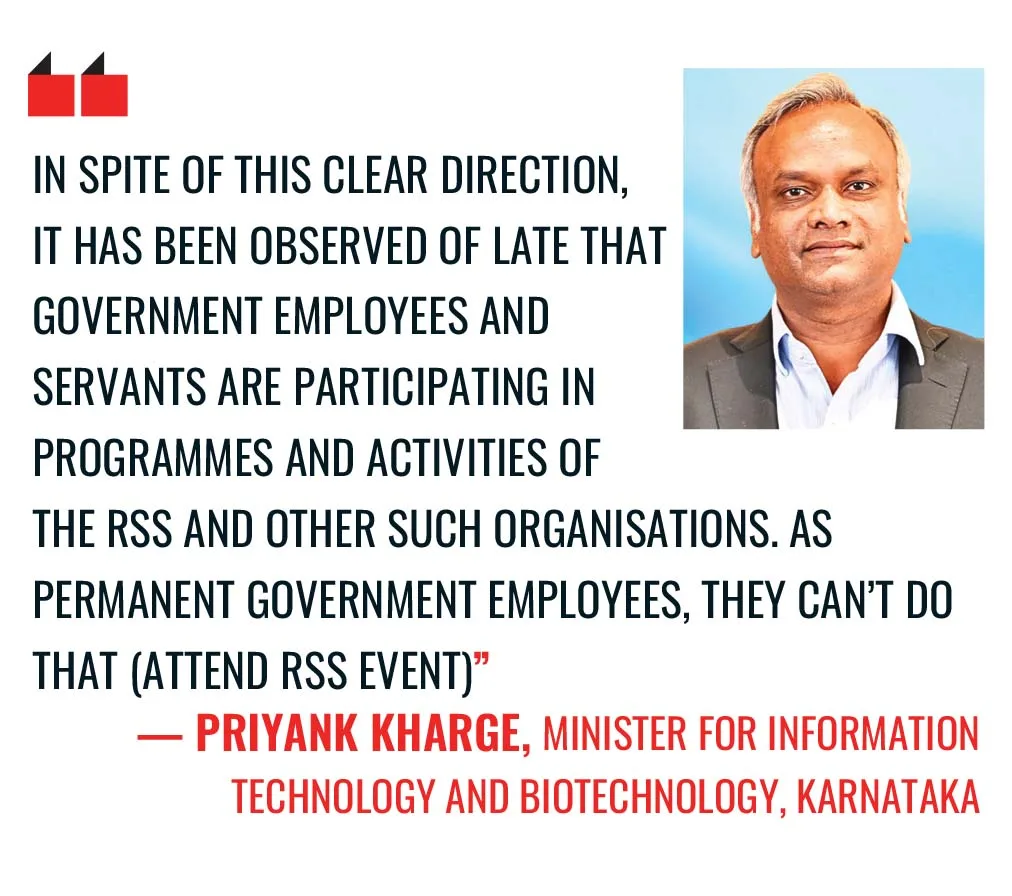
Kharge’s recent directive against RSS gatherings was intended as a bold assertion of ideological clarity. Instead, it backfired spectacularly. Public outrage was swift, and even within Congress, murmurs of dissent surfaced. The Karnataka High Court’s decision to stay the Government order, which required prior permission for public gatherings of more than ten people, underscored the legal and political overreach. What was meant to project Kharge as a fearless ideological warrior has instead reinforced perceptions of political immaturity. His attempt to capture the anti-Sangh mantle, long a loyalty marker for those courting the Gandhi family, has revealed its limits in a state where ideological polarisation is no longer a vote-winner. Karnataka’s voters are more concerned about jobs and infrastructure than rhetorical crusades.
Kharge Jr’s Ideological Theatre
Priyank Kharge’s troubles extend beyond ideological theatrics. As the IT and BT Minister, his track record invites uncomfortable scrutiny. Karnataka, once India’s undisputed tech hub, has watched major investments drift elsewhere. Google’s $15 billion commitment to Andhra Pradesh’s Vizag for an AI and data centre, and the decision of semiconductor firms to prefer Gujarat and Assam, have sparked questions about Bengaluru’s diminishing appeal. Instead of drawing investment headlines, Priyank now finds himself in controversy – his remarks dismissing Assam’s youth talent triggered backlash nationwide. His loud ideological posturing appears to serve as a cover for weak administrative results. For a minister expected to champion innovation and industry, the optics of antagonising both investors and ideological opponents have not helped his standing within the Government or the party.
Priyank Kharge’s anti-RSS rhetoric may achieve neither ideological clarity nor political gain. It exposes a deeper malaise within Karnataka Congress – a reliance on symbolism over substance, and narrative over governance. His attempt to channel Rahul Gandhi’s ideological line might win temporary favour in Delhi, but it offers little relief to a state weary of political gimmickry and policy paralysis. As the Government’s halfway mark passes, the electorate’s patience wears thin. If Congress continues to trade real progress for performative politics, even its most ambitious heirs may find themselves out of step with the people they claim to represent.

Congress’s 2023 electoral victory in Karnataka was built on its much-hyped “five guarantees” – a populist formula that promised relief but delivered fiscal strain. The scheme’s success in securing votes inspired the party to replicate it nationally, only to watch the model collapse elsewhere. Even within Karnataka, these guarantees have turned from triumph to burden. The promises drained State coffers, leaving little room for developmental spending. Ministers and MLAs now grapple with the consequences of populism without progress. Instead of course correction, the Congress Government in Karnataka has leaned into distractions – targeting religious institutions and Hindu leaders under the guise of accountability. From the politically motivated SIT probe into the Dharmasthala case to attacks on figures like Dr Prabhakar Bhat, the State’s narrative has shifted from governance to grievance.
Historical conflict with RSS
Since Independence, the Congress regarded the RSS as its principal ideological and organisational challenge. In the aftermath of the Gandhi assassination, the Congress Government banned the Sangh in 1948, despite commissions later clearing the Sangh of involvement, illustrating how the Congress leadership equated the Sangh with a threat to its control of the new state. Though the ban was lifted in 1949, yet the antagonistic relationship endured: the Sangh’s grassroots presence and independent social network remained a constant corrective to Congress’s dominance.
Congress’s confrontation with Sangh intensified during Emergency
During that phase, the Congress government sought to suppress not only political opponents but civil society networks, including the Sangh, which the Congress perceived as a bulwark opposing its centralising and authoritarian impulses. Meanwhile the Sangh, by its account, portrayed itself as defender of democratic norms and national identity, and in the decades since it has moved from the fringes to substantial societal acceptance, among urban elites, grassroots villagers and remote rural areas alike. In this context, internal Congress manoeuvres, such as Priyank Kharge’s alignment with Rahul Gandhi, are being analysed by observers as signs of a party repositioning around its first-family narrative in response to the Sangh-driven societal shift. This can also be viewed as Priyank Kharge seeking to project himself as part of a new loyal cohort, filling the space left vacant as the senior and older leadership fades away.














Comments