





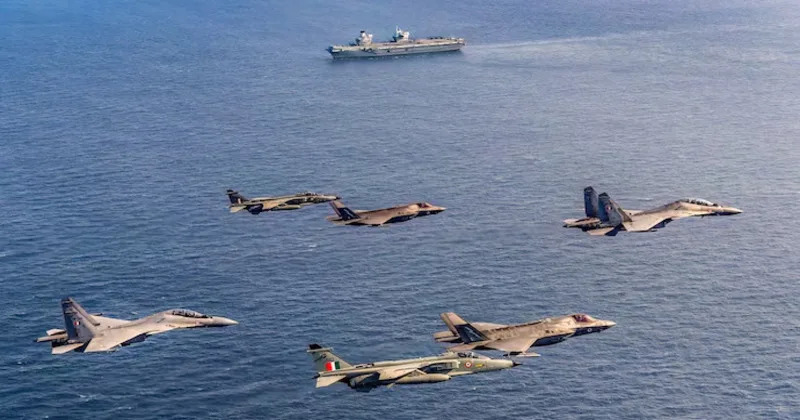
‘Trishul’, a strategic military manoeuvre unleashed by India at the border of Pakistan. The tri-service military exercise is being conducted in the Pakistan border across the states of Rajasthan and Gujarat and will continue till November 10, in a phased manner. The highlight of the 12-daymilitary exercise ‘Trishul’ is that it is the maiden tri-service military exercise unravelled by India across the borders of Pakistan, post Operation Sindoor.
During Operation Sindoor, India with its stellar military capabilities achieved a sharp and solid strategic edge and decisively defeated the enemy atrocities, thereby gave a befitting reply to the inhuman Pahalgam terror attack committed by the Pakistani state. Six months later, India has launched ‘Trishul’ military exercise on the Pakistan border, thus establishing a firm strategic message to the enemy side, regarding India’s military and strategic potential.
At the outset, the motto and agenda behind the ‘Trishul’ tri-service military manoeuvring is to boost the operational readiness and calibrate the combat potential of the three services. It also aims to boost the synergy and cooperation among the Indian Army, Indian Navy and the Indian Airforce across the sensitive region of Sir Creek, in case of any unforeseen circumstances that threaten the national national security architecture of India.
Sir Creek and the surroundings: Strategic ground for ‘Trishul’ exercise
The most pivotal aspect in the Trishul military exercise is that the tactical manoeuvring is not conducted in the Kashmir region, but in the vicinity of Sir Creek and in the larger Kutch region in the states of Gujarat and Rajasthan. The military ground selected to conduct the exercise thus signals a strong message regarding India’s strategic foresightedness and vigilance.
Recently, Pakistan had irrationally stirred the issue of Sir Creek and apparently had spoken about attacking India through the region. Lately, then Chief of the Pakistan Navy Karambir Singh had claimed that Pakistan has been training the members of the JeM terror outfit for an underwater attack. Even during India’s Operation Sindoor, Pakistan attacked India from Siachen to Sir Creek, i.e. from the state of Kashmir to Gujarat, across the western frontier. This multi-front and simultaneous attack is indeed a strategic challenge. Ofcourse, India thwarted this atrocity with incredible decisiveness during the defensive operation.
As per the intelligence sources, Pakistan recently is piling up military infrastructure around the Sir Creek region. This includes, construction of bunkers, radars, forward operating bases that can be potential ground for launching drones and other military weapons. In the previous week, Pakistan Navy Chief Admiral Naveed Ashraf made a surprise visit to the forward posts in Sir Creek and has uttered provocative statements in the name of protecting the maritime borders of Pakistan.
In this backdrop, to counter such enemy horror in future and to send a message of readiness and deterrence India has unveiled Exercise Trishul in the Kutch, the region which can inevitably emerge as a strategic battleground. Through this exercise India also seeks to balance security and sovereignty across the western frontier, beyond Jammu & Kashmir, thus ensuring comprehensive preparedness and vigilance across the western frontier.
Indigenous prowess and manpower in Exercise Trishul
As a part of the Exercise Trishul in the Kutch region, large-scale strategic military weapons systems have been deployed. This includes, warships, battle tanks, aircrafts including Rafale and the Sukhoi Su-30. Even thousands of Special Forces Commandos are deployed in the region to bolster India’s operational readiness for unforeseen combat circumstances.
Indigenous military technologies especially, BrahMos missile system that was hailed as the game-changer during Operation Sindoor and Akash NG surface-to-air missile is also being inducted in the Exercise Trishul. Thus, the military manoeuvring not just aims to strengthen the military capabilities of the Indian Armed Forces but also symbolizes the country’s incredible indigenous defence capabilities.
T-90 battle tanks of the Indian Army, Sea Guardian and Heron drones of the Indian Airforce are also participating in the exercise. With respect to the Indian Navy, Kolkata class destroyers and Nilgiri-class frigates are deployed for the military exercise. Kolkata class destroyers refers to a series of stealth-guided missile destroyers. It includes three warships, INS Kolkata, INS Kochi and INS Chennai. They comprise the largest warships of the Indian Navy capable of being operational from surface, anti-submarine and anti-air. They are equipped with advanced electronic warfare mechanisms including cutting-edge radars and sensors. Similarly, Nilgiri class frigates are the new generation stealth guided-missile frigates built with advanced stealth capabilities and state-of-the-art weapons, sensors and radars, that predominantly houses indigenous technological components.
With regard to military manpower participating in Exercise Trishul, Para-Special Forces Battalion of the Indian Army’s Parachute Regiment will take part. Indian Navy’s Marine Commandos-MARCOS will participate, which is considered as an elite unit of the Indian Navy who is capable of operating from both land and sea and who are specialized in amphibious warfare and counter-terrorism operations. Garud unit from the Indian Airforce will also participate in the mega military exercise.
India’s bold manoeuvre stimulates Pakistan to shut its airspace
As an impact of India’s military exercise ‘Trishul’ in the western border, Islamabad has shut its airspace in many domains. The aviation authorities of Pakistan issued a NOTAM(Notice to Airmen), thus restricting air traffic in the central and southern air routes of Pakistan. The NOTAM issued by Pakistan exhibits the strategic caution taken by Islamabad as India escalates its military muscle.
Recently, Defence Minister Rajnath Singh had also warned that any misadventure by Pakistan around the Sir Creek will inevitably alter the “history and geography” of Pakistan. The latest military exercise ‘Trishul’, in its maiden edition post Operation Sindoor, thus not just consolidates India’s military preparedness, but also circulates a bold and firm strategic message to Pakistan regarding the fact that New Delhi will not compromise on its sovereignty, national security, territorial integrity and strategic autonomy. This message, will indeed create tremors in Islamabad and Rawalpindi, as India stands firm on its strategic capabilities and has the overarching potential to defeat the enemy despite multiple and repeated illicit motives and misadventures since decades.
















Comments