





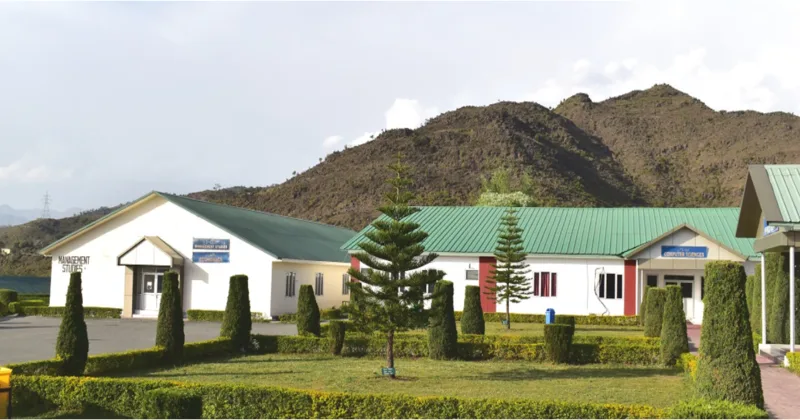
JAMMU: The Baba Ghulam Shah Badshah University (BGSBU) in Rajouri is facing a serious financial strain, with the J&K government confirming a salary deficit of Rs 13.48 crore for the ongoing fiscal year 2025–26. During the current financial year, its total expenses have been estimated at Rs 45 crore and revenue less than Rs 32 crore.
According to official data tabled in the assembly, the university’s total grant-in-aid from the J&K government has increased from Rs 22.99 crore in 2022–23 to Rs 34.95 crore in 2024–25, with an additional Rs 21.80 crore released up to September 2025. However, the rising salary expenditure, estimated at Rs 48.48 crore this fiscal, has left the institution struggling to meet its financial obligations.
One major reason for the troubles of this university set up with much fanfare in 2002 is the uncontrolled and unplanned manner in which too many subjects were added. It has some departments where there is zero/nil enrolment but there are buildings, teachers as also non-teaching staff in these departments. This means that there is zero revenue by way of fees but massive outflow on account of payment of salaries to the employees. Then there are departments which were planned for very large number of students but there are no admissions.
Vacant Seats
Overall, in all the teaching departments of the university, there are over 4,800 seats (4,810 to be exact) but only 2,304 admissions. This means that at least 2,506 seats are lying vacant across the entire spectrum leading to this situation. For example, in MA Arabic course, there are 20 seats and zero admissions. Initially, the Arabic language was being taught later Persian and Islamic Studies were added. Now, there are no students, but the additional teachers and non-teaching staff exist.
In its engineering courses, more than 60 per cent seats across all departments are lying vacant. In Mechanical Engineering Department, there are 198 seats for the B Tech course, but the intake is only 29 students with 169 seats lying vacant. The very poor enrolment and too many people on the staff in many departments means these departments were added thoughtlessly, are unviable and were not needed to be there in the first place.
In the Hindi Department, there are 20 seats for MA course but zero students. For Hindi Honours course, there are 25 seats but zero students. The condition in the Sanskrit Department is no different.
Some teachers from the university, who spoke on the condition of anonymity, said that a large number of appointments were made on political considerations. Even many teaching departments and their intake was decided under political influence and not viability or need for these courses. They said that if this state of affairs continues, the university may collapse under its own weight.
Blaming Waqf
The university, which also receives CAPEX grants for development projects, was allocated Rs 4.22 crore in 2022–23, Rs 1.83 crore in 2023–24, and Rs 2.14 crore in 2024–25. For the current year, the CAPEX grant stands at Rs 95 lakh. Despite these allocations, the institution’s finances show recurring shortfalls, with internal resources contributing Rs 79.33 crore in 2022–23 but declining sharply to Rs 7.06 crore in 2024–25.
In its reply, the government said the university had repeatedly requested the Waqf Board for its annual contribution of Rs 2 crore, but no payment has been received since October 2019. The absence of this support, along with limited internal revenue, has worsened the university’s financial stability. But the point is that even if the contribution from Waqf is managed somehow, the university’s financial health will remain in doldrums.
For 2025–26, the government has sanctioned Rs 35 crore as grant-in-aid for salaries of permanent employees. Yet, with salary expenditure projected to touch Rs 48.48 crore, the deficit remains significant. The university also lacks separate budgetary support for filling vacant teaching and non-teaching posts or for covering operational and maintenance costs, forcing it to rely on what it termed “meagre internal resources”.
The internal resources and their mobilisation have been on a steady decline for the last few years. The internal resources we are referring to here is usually the fees and sale of prospectuses etc. In 2022-23 fiscal, the mobilisation from internal resources stood at Rs 20 crore, going down to Rs 15 crore in 2024-25 and it has declined sharply to only Rs 7 crore.
Way Out?
The university’s annual income for 2024–25 stood at Rs 28.87 crore, against an expenditure of Rs 51.99 crore, resulting in a shortfall of Rs 21.92 crore. Even in earlier years, BGSBU reported consistent deficits—Rs 6.18 crore in 2023–24 and Rs 2.11 crore in 2022–23.
Officials have urged the government to enhance the grant-in-aid allocation, citing the need to maintain academic operations and pay salaries on time. Despite its financial troubles, the university continues to run several academic departments, including engineering, sciences, humanities, and nursing, across its Rajouri, Jammu, and Kishtwar campuses.
The Minister in charge of Higher Education said the government is aware of the financial distress at BGSBU and is examining measures to ensure stable funding for the university’s operations. But if truth be told, and admitted by officials and politicians, the university offers too many teaching programmmes in Business Management, Social Sciences, Bio Sciences, Computer Sciences, Information Technology, Arabic, Mathematics, Nursing, Tourism, Education, Languages and B.Tech Diploma in Engineering and Doctoral Programmes. Many of these programmes are a steady and permanent burden. Unless these are shut, cutting down the recurring expenses the university bears, future doesn’t look bright for it.














Comments