





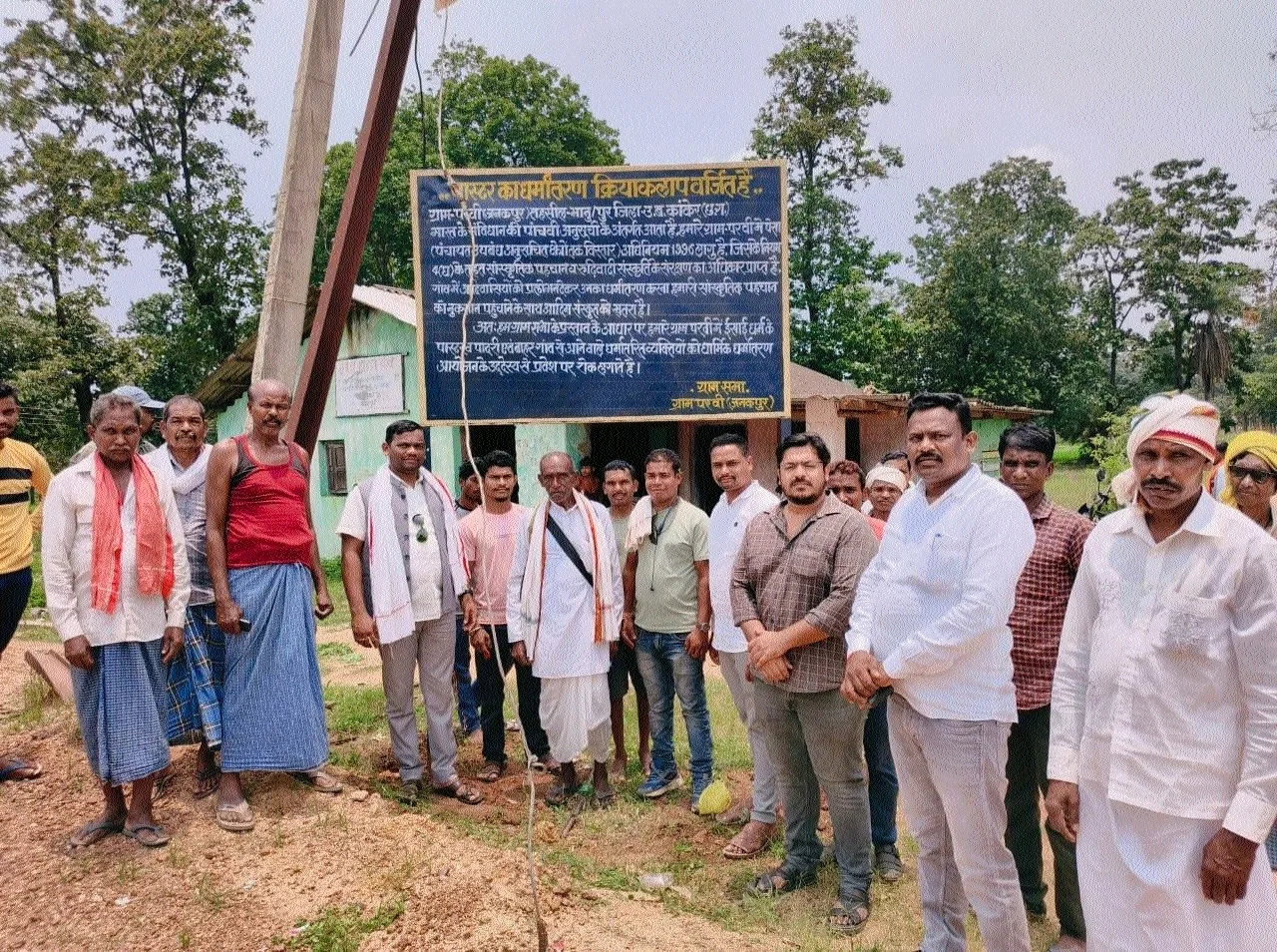
The Chhattisgarh High Court has dismissed a public interest litigation (PIL) challenging the installation of hoardings in tribal villages prohibiting the entry of Christian pastors and “converted Christians.” The division bench of Chief Justice Ramesh Sinha and Justice Bibhu Datta Guru held that such hoardings, erected by Gram Sabhas in the Kanker district, were not unconstitutional so long as they were intended to prevent forcible religious conversions “by way of allurement or fraudulent means.”
The ruling, delivered on October 28, 2025, upheld the Gram Sabhas’ right under the Panchayat (Extension to Scheduled Areas) Act, 1996 (PESA) to safeguard tribal culture and heritage, while cautioning that their actions must remain within the framework of law.
Petition alleged discrimination against Christians
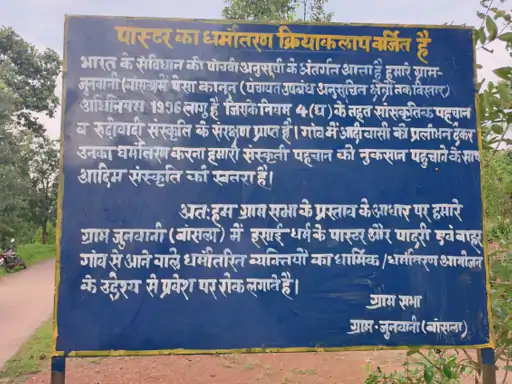
The petition was filed by Digbal Tandi, a resident of Kanker district, who alleged that several Gram Sabhas, under instructions from the Panchayat Department, had installed hoardings in at least eight villages declaring a ban on the entry of Christian pastors and “converted Christians.”
The banners, displayed prominently at the entrances of villages, reportedly carried messages aligned with the slogan “Hamari Parampara, Hamari Virasat” (“Our Tradition, Our Heritage”), a government-backed campaign encouraging tribal communities to preserve their indigenous practices.
Tandi’s petition claimed that the move “segregates members of the Christian community and their religious leaders from the mainstream village society”, thereby violating their fundamental rights to equality, faith, and personal liberty under Articles 14, 19, 21, and 25 of the Constitution.
He further alleged that the Panchayat Department had misused provisions of the PESA Act by instructing subordinate bodies like the Zila Panchayat and Janpad Panchayat to direct Gram Sabhas to pass resolutions banning Christian activities. According to him, this misuse amounted to an attempt to “spread religious hatred” against the Christian minority in Scheduled Areas.
Villages cited fear of illegal conversions
At least eight villages in Kanker district, including Partappur, Chhote Bethiya, and Amabeda, had erected hoardings that read in local dialects: “No entry for pastors or converted Christians engaged in conversion activities.”
Local tribal groups reportedly supported these moves, claiming that a surge in conversion-related disputes in recent years had caused tensions between traditional and converted tribal families, leading to clashes and social boycotts.
The petitioner, however, argued that the blanket ban imposed by these hoardings created an atmosphere of fear among Christians, discouraging them from entering villages they once visited regularly.
He urged the court to direct the state government to remove the hoardings immediately and take action against officials responsible for encouraging such resolutions.
Government’s defence: Protection of tribal culture under PESA
Appearing on behalf of the state, Additional Advocate General (AAG) Y.S. Thakur defended the Gram Sabhas’ decision, arguing that the hoardings were “precautionary measures” taken under the powers conferred by the PESA Act, 1996, which allows tribal self-governance in Scheduled Areas.
Thakur stated that PESA rules empower Gram Sabhas to protect traditional institutions, such as gotuls (youth dormitories), devgudis (sacred groves), and dhumkudias (communal halls), along with the local system of worship and social practices from “destructive influences.”
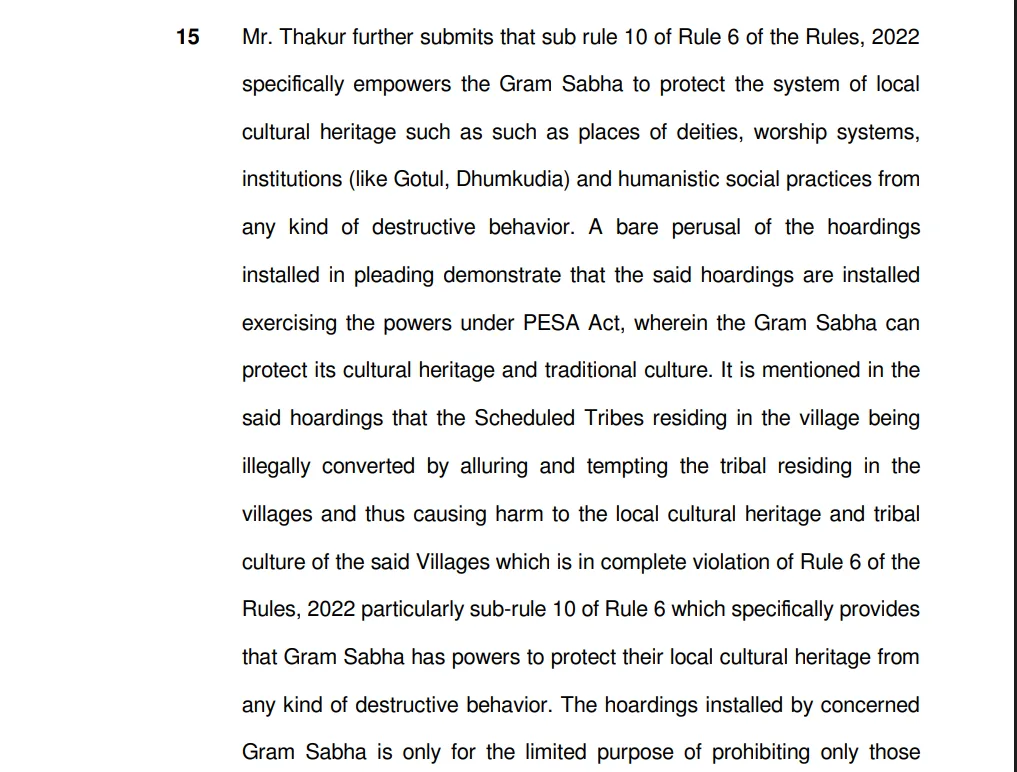
“The hoardings installed by the concerned Gram Sabha are only for the limited purpose of prohibiting pastors belonging to other villages who are entering the village for the purpose of illegal conversion of the tribal peoples,” Thakur argued.
He added that the banners specifically mentioned conversion by “allurement” or “fraudulent means”, which is prohibited under Section 3 of the Chhattisgarh Freedom of Religion Act, 1968 (as amended).
The state counsel also reminded the bench of past law and order problems, including the 2023 Narayanpur incident, where violent clashes erupted between converted and non-converted tribals. A mob had attacked a church, injuring several policemen, including the Superintendent of Police.
“Given such a background, the Gram Sabhas are acting within their rights to protect peace and cultural identity,” Thakur said, stressing that no official order was passed to target any particular faith.
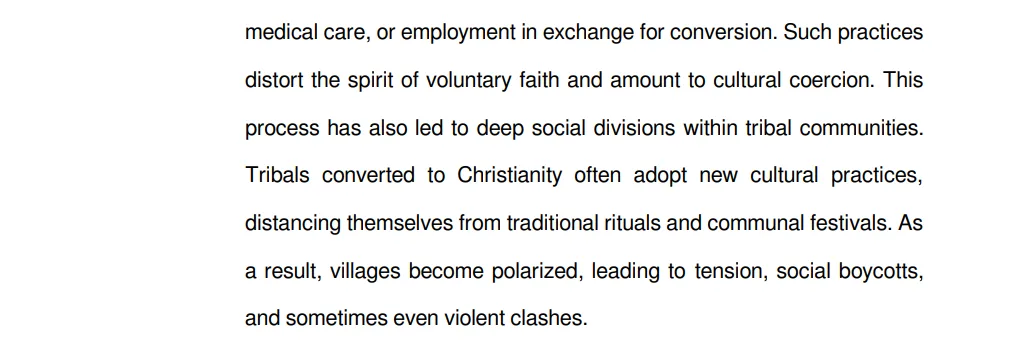
Court’s observations: Hoardings not unconstitutional
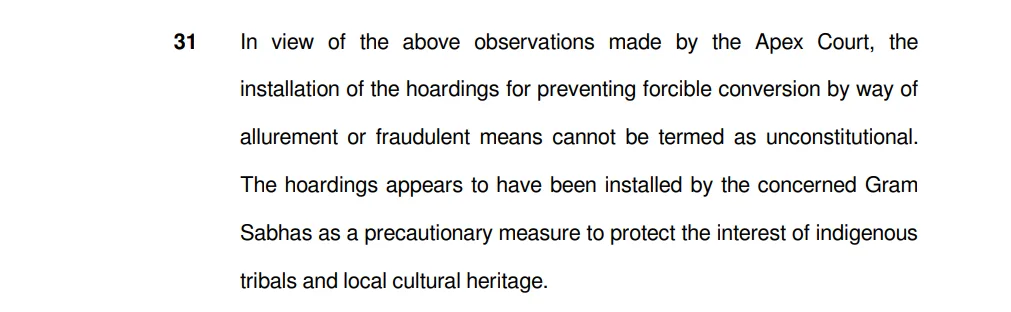
After hearing both sides, the High Court ruled that the installation of hoardings intended to prevent forced conversions could not be deemed unconstitutional.
In its 10-page order, the division bench noted: “The hoardings appear to have been installed by the concerned Gram Sabhas as a precautionary measure to protect the interests of indigenous tribes and local cultural heritage.”
The bench cited earlier Supreme Court judgments upholding the right of communities to preserve their distinct social and cultural identities, provided that such measures did not violate any individual’s fundamental rights or statutory protections.
The court noted that India’s legal framework already prohibits conversion by coercion, inducement, or deceit, and therefore, the villagers’ attempt to caution outsiders against such activities did not prima facie amount to discrimination or hate speech.
“Installation of the hoardings for preventing forcible conversion by way of allurement or fraudulent means cannot be termed as unconstitutional,” the court stated in its order.
The bench also took note of a procedural lapse on the petitioner’s part, observing that he had not exhausted available statutory remedies before filing the PIL.
Quoting judicial precedent, the court said: “A party must first avail of the statutory alternative remedy before approaching the High Court seeking redressal of any grievance.”
The judges pointed out that under the Panchayat Raj framework and PESA rules, disputes over Gram Sabha resolutions can be addressed through administrative appeal mechanisms before higher panchayat bodies or the district collector, rather than directly invoking writ jurisdiction.
As such, the court held that the petition was premature and disposed it of without issuing directions for the removal of the hoardings.
Rising tensions over conversions in Chhattisgarh
The order comes amid rising tensions in several tribal belts of Bastar, Kondagaon, Narayanpur, and Kanker districts, where local Gram Sabhas have increasingly asserted their rights under PESA to regulate religious activities.
Since 2022, multiple villages have passed resolutions restricting outside religious preachers from entering their territories without prior permission. These resolutions cite concerns of “cultural erosion” and loss of tribal traditions due to conversion activities allegedly carried out through inducements.
While Christian organisations have denounced these resolutions as “discriminatory and unconstitutional”, tribal advocacy groups like the Sarva Adivasi Samaj argue that they are legitimate acts of cultural preservation.
A senior official from the Kanker district administration told Swarajya that most hoardings were installed after village meetings passed formal resolutions, and “none of them explicitly barred peaceful visits or personal religious freedom.”
“The core concern was to stop organised conversion drives targeting uneducated and poor tribals through gifts and money. The villages only sought to send a message, not to attack anyone,” the official said.
What PESA empowers tribes to do
The Panchayat (Extension to the Scheduled Areas) Act, 1996 (PESA) was enacted to extend the provisions of the 73rd Constitutional Amendment to tribal regions listed under Schedule V of the Constitution. It recognises Gram Sabhas as the basic unit of self-governance in Scheduled Areas.
Under Section 4(d) and 4(m) of PESA, Gram Sabhas are empowered to “safeguard and preserve the traditions and customs of the people, their cultural identity, and community resources.”
Chhattisgarh adopted its own PESA Rules in 2022, granting further autonomy to Gram Sabhas to regulate social, cultural, and economic activities in tribal villages.
Many say this ruling further cements the legal weight of Gram Sabha decisions concerning cultural protection, provided they do not cross into the domain of religious persecution or fundamental rights violations.
Past incidents and national relevance
The issue of forced or induced conversions has been a long-standing flashpoint in Chhattisgarh. Several districts have witnessed clashes between newly converted Christian groups and non-converted tribals who accuse missionaries of undermining traditional beliefs.
In January 2023, violence in Narayanpur left multiple people injured, including police officers, after protests erupted against alleged illegal conversions.
The state government has since taken a dual approach, strengthening law enforcement under the Freedom of Religion Act while promoting awareness campaigns encouraging cultural pride among tribal groups.
The Chhattisgarh High Court’s latest order adds judicial backing to this policy direction by validating precautionary measures that discourage forced conversions but stop short of endorsing any blanket religious restrictions.
Following the order, both tribal organizations and Christian groups have reacted cautiously.
Sarva Adivasi Samaj president Sukhram Kashyap welcomed the judgment, calling it “a recognition of the Gram Sabha’s power and the tribal community’s right to protect its heritage.”
“For years, missionaries have misused poverty to convert tribals. The court has stood with the villagers’ right to defend their culture peacefully,” he said.
By holding that hoardings against forced conversions are not unconstitutional per se, the bench reaffirmed that the law distinguishes between genuine evangelism and coercive conversion efforts, allowing tribal communities to guard against the latter without infringing upon the former.
The order is expected to serve as a precedent for similar disputes across tribal-dominated states such as Jharkhand, Odisha, and Madhya Pradesh, where local Gram Sabhas have raised parallel concerns.
As the debate over conversions in tribal regions continues, the High Court’s message is clear: Preserving culture and preventing exploitation are valid goals but they must coexist within the constitutional promise of religious freedom and social harmony.
















Comments