





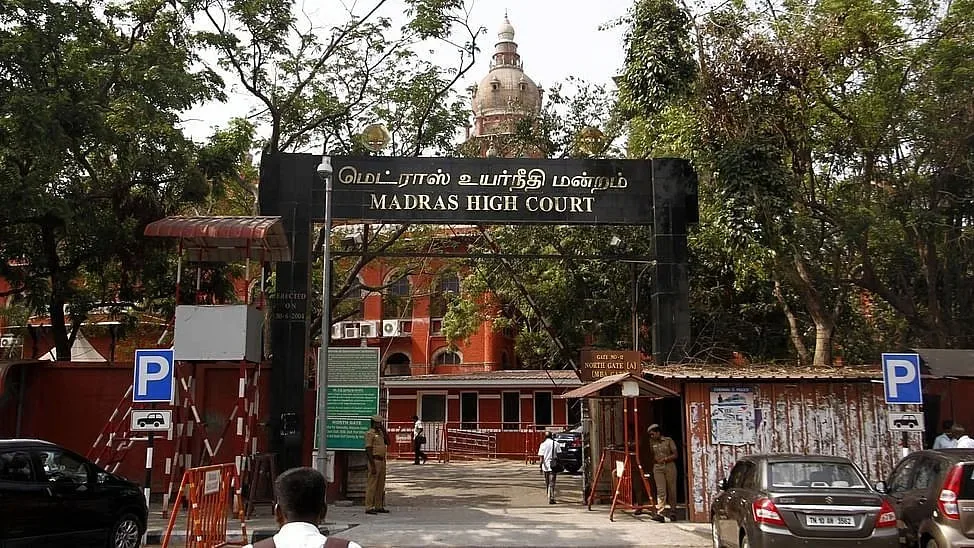
In a latest judemenet, the Madras High Court has permitted the conduct of Annadhanam (free food distribution) during the upcoming Kumbabishekam (temple consecration ceremony) at Kaliyamman Temple in N.Panchampatti village of Dindigul district, Chennai, which was opposed by Church groups claiming that that land belongs to them.
The order, delivered in W.P.(MD) No. 30834 of 2025 by Justice G.R. Swaminathan, quashed the rejection of permission by the Tahsildar, Athur Taluk, who had denied the request citing potential “law and order issues” and allotted a public road instead as an alternative venue. The Court termed the refusal “unconstitutional, discriminatory, and violative of Article 15 and Article 25 of the Constitution of India.”
Background of the case
The petitioner, a resident of N.Panchampatti village, had sought permission to conduct Annadhanam on November 3, 2025, during the temple’s Kumbabishekam ceremony. The event was to be held on a common ground bearing Survey No.202/3, a space locally known as Sunkasavadi Ground.
However, on October 24, 2025, the Tahsildar of Athur Taluk rejected the plea and instead allotted a public road (N.Panchampatti-Munnilaikottai Road) for the event. The petitioner challenged this order, asserting that conducting Annadhanam on a public road was impractical and unsafe.
Christian community opposed the event
Appearing for the fourth respondent representing the local Christian community, counsel A. John Vincent argued that a portion of the same ground contained a century-old Pascha Stage, built for Easter celebrations, and had been traditionally used for Christian religious gatherings and plays.
He referred to the Tahsildar’s proceedings of August 1912 to claim historical continuity of Christian use and cited a 2017 peace committee resolution, which had barred the organisation of any new events not part of the century-old tradition.

The community maintained that Hindus had never used the site for religious activities, arguing that allowing the Annadhanam would disturb the established communal balance.
‘A public ground belongs to the state, not a single faith’: Court
Justice Swaminathan, after reviewing the records and hearing all sides, held that the open space, classified as “vacant site/grama natham” was government property, not belonging to any religious community.
Quoting the 2021 Division Bench order in K. Rajasekar vs. District Collector, Dindigul, the Court reiterated that “no construction shall be put up on S.No.202/3” and affirmed that it remained a public ground.
In a strongly worded observation, the Court stated: “When the land in question is not a patta land but belongs to the Government, it should be available to all sections irrespective of religious or communal background.”
The Court further added: “A public ground should be available for use of all communities or none. I cannot accept the submission that while Christians can use the ground on Easter but Hindus cannot conduct Annadhanam in the very same place.”
‘Pre-constitutional practices cannot override constitutional ethos’
Rejecting the 1912 precedent cited by the Christian group, the Court declared that any pre-Constitutional arrangement contrary to the spirit of equality and secularism cannot stand in independent India.
“We are a secular, democratic republic. Any pre-constitutional arrangement that is not in accord with constitutional provisions and ethos cannot be allowed to continue,” the Judge observed.
He clarified that the Christian community may continue to use the ground during Easter, but other communities cannot be barred from using it at other times when it remains free.
The Court came down heavily on the administration for citing potential “law and order issues” as a reason to deny permission.
Drawing from the Madras High Court’s 2025 ruling in W.A.(MD) No.694 of 2020, it stated that: “The right under Articles 25 and 26 of the Constitution of India cannot be denied or taken away on a mere objection or apprehension of law and order.”
Justice Swaminathan added that maintaining order is the duty of the administration, not an excuse to suppress lawful activity: “The police should not choose the easy option of stifling fundamental rights. If any law and order problem arises, it must be dealt with appropriately.”
‘Annadhanam is a religious observance, rooted in dharma’
The Court recognised Annadhanam as not merely an act of charity but an intrinsic part of Hindu religious observance. Citing Annamalai Ayee Chatram v. Authorised Officer, Thanjavur (1986 SCC OnLine Mad 191) and Thangavelu Udayar v. Avudaiyarkoil Annachathram (1982), the judgment recalled that: “Performing Dharmam, especially Annadhanam, is to seek salvation, in other words, Moksham. Hindu tradition does not draw a distinction between religion and charity; charity is regarded as part of religious observance.”
Thus, the Court concluded that the petitioner’s right to hold Annadhanam falls under Article 25 of the Constitution, which protects freedom of religion.
Justice Quotes 1926 Ruling
In a rare historical reflection, Justice Swaminathan invoked a 1926 Madras High Court judgment (Venkata Subbaya v. Muhammad Falauddin Khaji) to criticise the administration’s reluctance to ensure peace.
Quoting the century-old verdict, he observed: “To state that authorities are not prepared to prevent the infraction of law and restrain law-breakers from interfering with lawful rights is practically to abdicate all authority.”
The Judge emphasised that government officials must protect lawful rights, not deny them due to fear of unrest.
‘Hindus outnumbered, but…’
Justice Swaminathan noted that the village has 2,500 Christian families and only 400 Hindu families, but clarified that minority in numbers does not mean minority in rights.
He remarked that using communal demographics to justify denial of rights was antithetical to India’s constitutional morality: “It is a very sorry state of affairs. In every religious event, there must be participation from other religionists also. Such cultural interactions alone will ensure inter-religious harmony.”
He reminisced on India’s syncretic culture, recalling personal experiences of interfaith friendship and shared traditions, stating that such gestures embody “the true beauty of our civilisation.”

Permission granted
Concluding the order, Justice Swaminathan set aside the Tahsildar’s October 24 order and directed authorities to permit the petitioner to conduct Annadhanam at the Kaliyamman Temple ground.
He further instructed the petitioner to ensure that the ground is restored to its original condition after the event and directed the Superintendent of Police, Dindigul, to provide security and ensure the event proceeds peacefully.
“The ground belongs to the State; by holding the event there, the rights of third parties will not be affected. The petitioner is permitted to hold Annadhanam, and the administration shall ensure peace and order.”

This judgment stands as a reaffirmation of India’s secular values and the constitutional guarantee of equality before law. By declaring that a public ground cannot belong to one faith, the Court not only ensured justice in one village but also set a powerful precedent against communal exclusion and administrative fear.
As Justice Swaminathan eloquently concluded through the spirit of the order, in a democracy, the right to worship, celebrate, and serve food in faith cannot be dictated by numbers or religious dominance, but by the Constitution itself.














Comments