





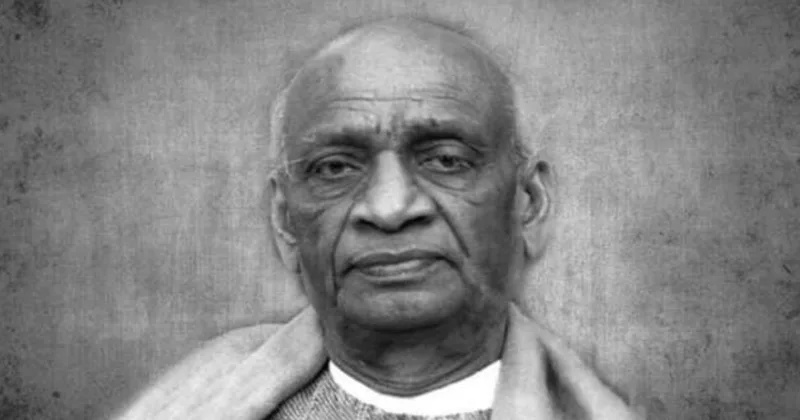
History often trembles with possibilities contained in a single word-“if.” In the story of modern India, one such question continues to echo across generations i.e. What happened if Sardar Vallabhbhai Patel had been the first Prime Minister of independent India?
This is not a flight of imagination but a serious reflection on an alternate course history might have taken , a course that could have reshaped India’s destiny and direction.
Sardar Vallabhbhai Patel, the architect of iron resolve, was among those towering figures of India’s freedom movement who rebuilt the nation’s geography and consciousness not through force, but through the power of organization, firm will, and unmatched administrative acumen. His title, “The Iron Man of India,” symbolized not mere rigidity but disciplined conduct and decisive leadership. By integrating 562 princely states into the Indian Union, Patel proved that when political will is inspired by national purpose, the impossible becomes achievable.
Had Sardar Patel led the government as the first Prime Minister, India’s federal structure might have evolved into a far more balanced and resilient system. The manner in which he resolved the complex issues of Hyderabad, Junagadh, and Kashmir as Home Minister demonstrated his clarity and firmness of approach. With the same foresight, he would likely have framed strong and realistic policies towards Pakistan, Tibet, and the northeastern frontiers at an early stage. The subsequent friction between the Centre and the States might have been far less severe, and governance would have reflected a rare blend of discipline and accountability.
Patel was, in essence, the most pragmatic administrator of his time. His foresight led to the creation of the Indian Administrative Service (IAS) and the Indian Police Service (IPS)- institutions meant to ensure a professional, impartial, and nation-oriented bureaucracy for a newly independent India. As Prime Minister, he would have placed “discipline of duty” at the core of governance. Policy decisions would have been swift yet thoughtful, and administration would have embodied the ideal of “Fewer plans, greater results.”
On the international front, Patel’s worldview was guided not by abstract idealism but by the realism of national security and self-respect. As early as 1949, he had warned Jawaharlal Nehru in a letter that “trusting China’s policy will prove costly in the future.” If he had been Prime Minister, India’s foreign policy might have been built on the principle of “India First.” Instead of prioritizing abstract ideals like Panchsheel, he would have emphasized strategic preparedness and border protection. The 1962 war with China might have been prevented or fought from a position of much greater military strength.
Being the son of a farmer, Patel deeply understood that the soul of India resides in its villages. Under his leadership, agricultural reform and rural self-reliance would have formed the backbone of national economic policy. He would have sought a balance between private enterprise and cooperative development, promoting people’s participation rather than centralized planning. The concept of “Atmanirbhar Bharat” (Self-Reliant India) might have taken root as early as the 1950s, becoming the philosophical core of economic growth.
Patel’s political thought was marked by clarity and realism. During the Constituent Assembly debates, he championed a vision of democracy not merely as a system of rights but as a duty-based governance model. As Prime Minister, he would have ensured ideological discipline within political parties and upheld national interest above factional or personal ambitions. This could have prevented early political instability and ensured continuity in national policies.
His idea of secularism too was deeply rooted in Indian cultural harmony. For Patel, secularism meant unity through spiritual inclusiveness, not separation through indifference. He respected all faiths but would never have tolerated divisive or extremist tendencies in the name of religion. Under his leadership, India’s secularism would have rested on cultural synthesis, rather than on the borrowed Western notion of mere neutrality.
It remains one of history’s great ironies that India was denied the leadership of Sardar Patel – a statesman whose life embodied discipline, unity, and devotion to duty. Had he been the first Prime Minister, India’s foundations would have been stronger, its borders safer, its governance more disciplined, and its economy more self-reliant.
History cannot be rewritten, but it can illuminate the path ahead. As India moves forward on its journey toward becoming a developed nation, Patel’s message continues to guide us i.e.“Unity is strength and nothing stands above the interest of the nation.”













Comments