




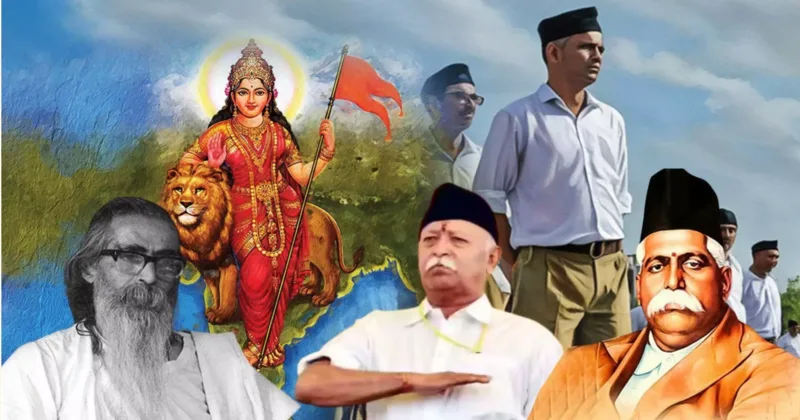
On Vijaya Dashami of 1925, Dr. Keshav Baliram Hedgewar founded the Rashtriya Swayamsevak Sangh (RSS) with the conviction that Bharat could only regain her rightful place in the world once the Hindu society was awakened, disciplined, and united. The task before him was not merely political; it was civilisational. Foreign policy in the Sangh worldview is never an isolated game of statesmanship or diplomacy but the natural extension of a civilisation’s self-confidence. As Dr. Hedgewar repeatedly stressed, “A strong and united society is the first condition of a strong and respected nation.”
Dr. Hedgewar: Organising the Nation Before Facing the World
Dr. Hedgewar was not a foreign policy strategist in the conventional sense. His arena was the shakha, where he infused discipline, self-respect, and national consciousness into young men. Yet in doing so, he was laying the very foundations of foreign policy. For him, Bharat’s weakness lay not in lack of resources or geography but in disunity. Without an organised Hindu society, he argued, Bharat could never face her neighbours with confidence.
In his speeches, Hedgewar often invoked invasions from the northwest and warned against the vulnerabilities of a divided Bharat. His stress was that national honour comes first, diplomacy follows later. This was not isolationism but realism: unless Bharat was united, any talk of alliances or global standing would be superficial.
Golwalkar: Cultural Nationhood and Lessons from the World
Madhav Sadashiv Golwalkar, or “Guruji,” the second Sarsanghchalak, gave the Sangh’s foreign policy thought its philosophical clarity. In We, or Our Nationhood Defined (1939), he emphasised that a nation is not a mechanical collection of people, but a cultural entity bound by a shared sense of identity. Foreign policy, therefore, must be an instrument to preserve and project this identity.
Guruji was deeply interested in how other nations protected their cultural integrity. He admired the Jewish people for maintaining their distinctiveness against centuries of persecution. In a 1948 lecture, he observed: “The Jews kept their traditions alive, their faith intact, and when the time came, they carved a nation for themselves.” For the Sangh, Israel thus became a symbol of resilience, a small nation surviving in a hostile neighbourhood through unity and determination.
This admiration was not about mimicry but learning. Golwalkar insisted that Bharat must be “true to her genius” and not imitate Western or Soviet models of diplomacy. His call was for a self-respecting nation that does not bend under foreign pressure but deals with the world on the strength of its culture.
Balasaheb Deoras: The Global Turn
By the time Balasaheb Deoras became the third Sarsanghchalak in 1973, the Sangh had matured into a pan-Bharat movement with growing overseas connections. Deoras encouraged the formation of the Hindu Swayamsevak Sangh (HSS) abroad, recognising the diaspora as an instrument of Bharat’s civilisational outreach.
Balasaheb Deoras repeatedly reminded swayamsevaks that the world respects a nation that respects itself. His era coincided with India’s opening to Israel and a more visible Tibetan presence in Bharat. Under his leadership, the Sangh spoke more openly about Tibet as a natural civilisational neighbour, drawing attention to Bharat’s moral responsibility towards the Dalai Lama and the Tibetan people.
Tibet and the Dalai Lama: Civilisational Solidarity
The Sangh’s engagement with the Dalai Lama reflects its civilisational lens. The Tibetan leader’s exile in Bharat is not seen merely as a political refuge but as a spiritual and cultural bond. RSS leaders, including present Sarsanghchalak Mohan Bhagwat, have often met the Dalai Lama and underlined the shared dharmic heritage of Bharat and Tibet.
For the Sangh, Tibet is not just a buffer state; it is part of the broader Indic civilisation whose spiritual heart beats in the Himalayas. Thus, support for Tibet is both strategic and cultural — an affirmation that Bharat cannot be indifferent to the fate of neighbouring civilisations.
China: Realism without Illusion
If Tibet represents cultural kinship, China represents civilisational contest. Sangh thinkers have long cautioned against naïve assumptions about Chinese friendship. Guruji himself warned that Communist China was expansionist in ideology and appetite. Later Sangh leaders have consistently urged vigilance on the borders, coupled with self-reliance in defence.
Yet, the Sangh does not advocate hostility for its own sake. The principle is clear: engage with China but without sacrificing sovereignty or civilisational dignity. As Mohan Bhagwat remarked in a 2017 lecture: “Dialogue is necessary, but strength must be the basis of dialogue.”
Israel: A Model of Identity and Security
The Sangh’s positive view of Israel deserves emphasis. Even before diplomatic relations were formalised in 1992, Sangh publications had highlighted Israel’s achievements in agriculture, water management, and defence. More importantly, Israel was admired for its refusal to let go of its civilisational identity.
The parallel with Bharat was obvious: both are ancient civilisations facing hostile environments, yet determined to survive and thrive. Cooperation with Israel in defence and technology thus appears to the Sangh as natural, rooted in mutual respect.
Neighbourhood as Cultural Responsibility
Another distinct Sangh perspective is its understanding of Bharat’s neighbourhood. Dr. Hedgewar and Guruji Golwalkar both emphasised that Nepal, Bhutan, Sri Lanka, and even Myanmar were not just neighbouring states but part of Bharat’s natural cultural sphere. This is not political expansionism but a recognition of civilisational unity.
In this sense, the Sangh’s outlook is akin to a “Hindutva Monroe Doctrine”: Bharat has a special responsibility for the cultural security of its neighbourhood. Protecting dharmic traditions in Nepal, supporting Tamils in Sri Lanka, or respecting Buddhist heritage across the region are seen as extensions of Bharat’s civilisational duty.
Soft Power: Dharma as Diplomacy
Long before the term “soft power” became fashionable, Sangh thinkers emphasised Dharma as a tool of global engagement. Guruji often spoke of the universal appeal of Hindu philosophy, Yoga, and Vedanta. Today, when Bharat’s Yoga Day is celebrated in 170 countries, it is the practical fulfilment of a Sangh conviction: that Bharat influences not through domination but through Dharma.
The promotion of Ayurveda, Sanskrit, and the Ramayana circuit in Southeast Asia is similarly seen as strategic. As Golwalkar put it: “The world looks to Bharat for light. Let us not fail in our duty.”
Diaspora as the Second Line of Defence
Through the HSS, the VHP, and other affiliates, the Sangh has nurtured a global network of Hindus who carry Bharat’s culture abroad. These diaspora communities have become informal ambassadors, projecting Bharat’s soft power and standing up for Bharat’s interests in foreign lands.
From organising international Yoga events to lobbying against anti-Bharat propaganda, these groups embody a Sangh insight: that the strength of a civilisation abroad amplifies the strength of the state at home.
Towards a Dharma-Based Foreign Policy
The RSS does not claim to design state policy. Yet, its century-long thinking offers a compass for Bharat’s engagement with the world. That compass has three points:
Civilisational Primacy — Bharat must never lose sight of its Hindu identity in dealing with the world.
Strength before Sympathy — Organisation and self-respect are the basis of credible diplomacy.
Dharma as Strategy — Unlike Western realpolitik or Chinese expansionism, Bharat’s foreign policy must be rooted in Dharma — balance, justice, and universal well-being.
As the Sangh celebrates its centenary, its voice on foreign policy is clear: Bharat is destined to be a Vishwaguru, not by conquest but by guidance. As Guruji said in 1966: “The world does not expect from Bharat armies or gold. It expects from Bharat a vision of Dharma, a way to live in harmony.”
It is this conviction — that Bharat’s rise must be civilisational — that makes the RSS’s contribution to foreign policy unique, enduring, and profoundly relevant in the twenty-first century.
















Comments