





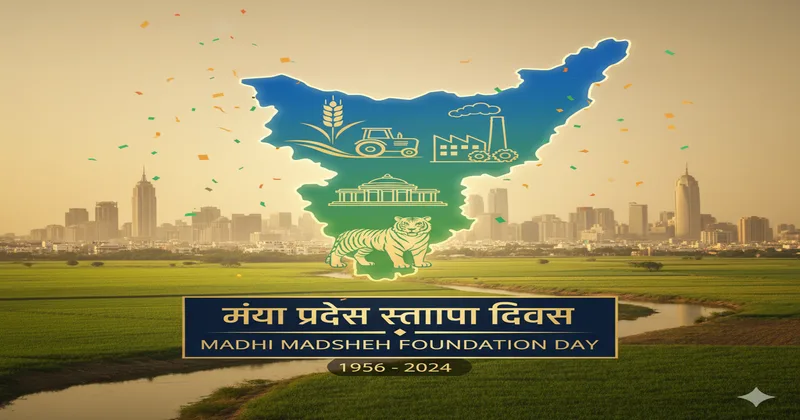
NEW DELHI: As Madhya Pradesh celebrates its 70th Foundation Day on November 1, the state stands as a remarkable example of post-Independence India’s steady transformation. From its modest beginnings in 1956 — when the state’s per capita income was merely Rs 261 — Madhya Pradesh has grown into one of India’s largest and most economically active states, with a current per capita income of Rs 1.52 lakh, marking a 584-fold increase. Over these seven decades, MP has evolved from an agrarian heartland into a rapidly developing hub of industry, infrastructure, and governance innovation, even as its population has grown 2.78 times.
Prime Minister Narendra Modi extended heartfelt greetings to the people of Madhya Pradesh on the occasion of the state’s Foundation Day.
Taking to X, the Prime Minister said, “Heartfelt greetings to all my family members in Madhya Pradesh, the state that cherishes its glorious history and cultural heritage, on the occasion of the state’s Foundation Day.”
He further added, “Our province, nestled in the heart of the country, is today infusing a new pace of progress in every sector by prioritising the aspirations of every individual. I am confident that the talented and hardworking people of this land will play an invaluable role in the fulfilment of the resolve for a developed India.”
Prime Minister Narendra Modi (@narendramodi) posts, "गौरवशाली इतिहास और सांस्कृतिक धरोहर को संजोने वाले मध्य प्रदेश के अपने सभी परिवारजनों को राज्य के स्थापना दिवस की ढेरों शुभकामनाएं। देश के हृदय में बसा हमारा यह प्रदेश जन-जन की आकांक्षाओं को आगे रखकर आज हर क्षेत्र में प्रगति की… pic.twitter.com/jZdxt3RAYz
— Press Trust of India (@PTI_News) November 1, 2025
The Genesis: Birth of a Heartland State
Madhya Pradesh was formed on November 1, 1956, following the recommendations of the States Reorganisation Commission, chaired by Justice Fazal Ali, with H.N. Kunzru and Vallabh Madhav Panikkar as members. The commission, constituted on December 29, 1953, was tasked with reorganising India’s states along linguistic and administrative lines.
After extensive deliberations, the commission’s report, submitted on September 30, 1955, led to the States Reorganisation Act of 1956, which took effect on November 1 the same year. As a result, the Marathi-speaking districts of Central Provinces and Berar were merged into Maharashtra, while 43 districts came together to form the new state of Madhya Pradesh — envisioned as a land rich in agriculture, minerals, and cultural heritage.
At its inception, the commission noted that MP would be “a prosperous agricultural state,” blessed with fertile land producing wheat and rice. Ironically, in 2000, the rice-bowl region of Chhattisgarh was carved out as a separate state, reducing MP’s geographical expanse but not its developmental momentum.
Early Leadership and Vision
When the new state came into existence at midnight on October 31–November 1, 1956, its first Chief Minister, Pandit Ravishankar Shukla, declared that Madhya Pradesh would become “an inexhaustible source of strength for the nation.” His successor, Kailash Nath Katju, echoed this sentiment, saying that nature had been “exceedingly generous” to the people of this land.
Seventy years later, both statements resonate strongly as the state continues to fulfill that vision — emerging as a powerhouse in agriculture, infrastructure, and social welfare.
Economic Growth: From Agrarian State to Emerging Industrial Hub
The state’s economic trajectory over the past seven decades paints an impressive picture. The per capita income, which stood at just ₹261 in 1956, has now risen to Rs 1.52 lakh, reflecting a combination of agricultural innovation, industrial development, and service sector expansion.
The state budget, too, has multiplied manifold — from Rs 1.06 lakh crore in 2000–01 to an estimated Rs 3.26 lakh crore in 2024–25, underscoring the scale of fiscal and infrastructural growth.
Agricultural Achievements: Powerhouse of Productivity
Madhya Pradesh has achieved remarkable success in agriculture, a sector that remains central to its economy. The state is among India’s top three producers of wheat and has earned the Krishi Karman Award — India’s highest recognition for agricultural excellence — seven consecutive times, a feat unmatched by any other state.
It also leads the nation in pulse (dal) production, ranks fifth in cotton output, and has made steady strides in horticulture and allied sectors. These achievements have turned MP into one of India’s agricultural powerhouses, balancing traditional farming with modern agritech innovations.
Health, Infrastructure, and Human Development
In terms of healthcare, Madhya Pradesh has expanded its reach significantly, serving over 7.26 crore people through a vast network of primary, community, and sub-health centres across its 3.08 lakh sq km area. Notably, around 97.5 per cent of this coverage extends to rural regions, ensuring access to medical care in even the most remote tribal districts.
In infrastructure, the state has focused on connectivity, urban expansion, and industrial corridors, positioning itself as an investment-friendly destination. With over 8,500 bank branches — two-thirds of which operate in urban areas — and a strong network of cooperative banks and agricultural credit societies, financial inclusion has reached unprecedented levels.
Industrial Growth and Investment Opportunities
Madhya Pradesh has actively diversified beyond agriculture to attract industrial investment and promote entrepreneurship. Through initiatives like Invest Madhya Pradesh and regular Global Investors Summits, the government has opened new avenues for domestic and international investors.
Key focus sectors include manufacturing, pharmaceuticals, renewable energy, textiles, food processing, and tourism. Industrial zones and economic corridors have been developed to facilitate ease of doing business, while employment-generation programs continue to empower the state’s youth.
Chief Minister-led investment drives and infrastructure projects have also transformed cities like Indore, Bhopal, and Jabalpur into modern economic hubs.
Education, Tourism, and Social Progress
In education, MP has made significant advances in both school enrollment and higher education infrastructure. The state’s universities, engineering colleges, and professional institutions have become regional centers of learning.
Tourism, too, has emerged as a vital growth engine, with destinations like Khajuraho, Mandu, Sanchi, Pachmarhi, and Kanha National Park attracting global visitors. The government’s focus on heritage tourism and eco-tourism has also contributed to the sector’s rise.
Sustaining Growth, Empowering the Future
Madhya Pradesh’s journey from a newly carved agrarian state to a dynamic economy has not been without challenges — from population growth and resource pressure to climatic adversities. Yet, the state’s focus on inclusive development and sustainable growth has ensured that progress reaches all sections of society.
The vision of early leaders — to make MP a “source of strength for the nation” — continues to guide its modern trajectory. As it completes 70 years of formation, the state is preparing for its Diamond Jubilee in 2030, setting its sights on further advancements in digital governance, clean energy, rural transformation, and industrial modernization.
From Rs 261 to Rs 1.52 lakh per person, Madhya Pradesh’s story is one of resilience, ambition, and determination — a testament to how a landlocked state at India’s center became one of its strongest pillars of national growth.














Comments