





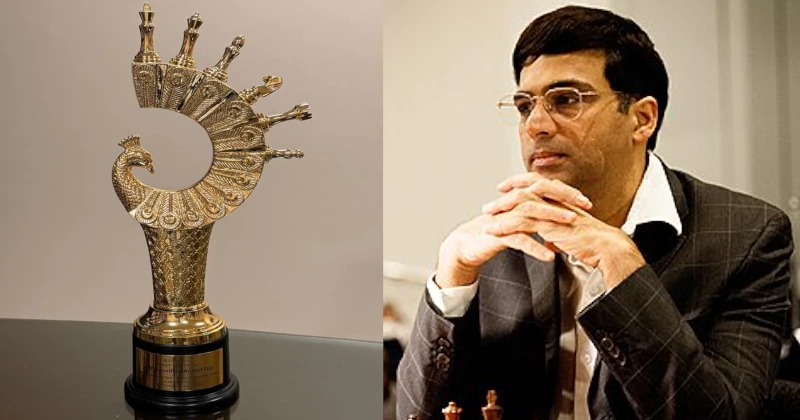
The FIDE World Chess Cup trophy has been officially christened the Viswanathan Anand Trophy, paying tribute to the five-time World Champion who transformed India into a global chess powerhouse. The move marks a powerful acknowledgement of Anand’s unparalleled influence on the sport and his role in inspiring generations of players who have since carried India to the forefront of the international chess arena.
The announcement was made on October 31, at a grand opening ceremony in Panjim, Goa, ahead of the FIDE World Cup 2025, which runs from October 31 to November 27. The event saw the presence of Union Sports Minister Mansukh Mandaviya, Goa Chief Minister Pramod Sawant, and FIDE President Arkady Dvorkovich, alongside a host of dignitaries and chess luminaries.
Unveiled to thunderous applause, the Viswanathan Anand Trophy stands as a symbol of India’s ascent in the world of chess a journey Anand himself began when he became the country’s first Grandmaster in 1988. The All India Chess Federation (AICF) President Nitin Narang officially announced the renaming, describing it as a “moment of pride and gratitude” for the Indian chess fraternity.
“Extremely proud and delighted to announce the Viswanathan Anand Cup, the FIDE World Cup (Open) Winner’s Running Trophy, instituted in honour of the King of Chess and India’s first Grandmaster, Shri Viswanathan Anand,” Narang wrote on X, calling the trophy “majestic, magnificent and deeply symbolic.”
Extremely proud and delighted to announce the Viswanathan Anand Cup, the FIDE World Cup (Open) Winner’s Running Trophy, instituted in honour of the King of Chess and India’s first Grandmaster, Shri Viswanathan Anand.
This running trophy stands as an emblem of the great strides… pic.twitter.com/tbUQsbhnvv
— Nitin Narang (@narangnitin) October 31, 2025
Designed to embody India’s rich cultural and artistic heritage, the trophy features a peacock India’s national bird frozen in a dancing pose, representing grace, focus, and timeless beauty. Its design has been described as “a vision so striking that it evokes the eternal rhythm of the game itself.”
The USD 2 million tournament features 206 elite players from 80 countries, including India’s brightest stars, competing across eight knockout rounds of classical chess. The event will determine three qualifiers for the 2026 Candidates Tournament, the gateway to the next World Championship match.
World Women’s Chess Cup champion Divya Deshmukh had the honour of conducting the draw of lots, setting the tone for what promises to be one of the most competitive editions in recent memory. All odd-numbered players in Round 1 will start with the black pieces.
For India, this edition carries extraordinary significance. With chess enjoying an unprecedented boom since D. Gukesh’s historic World Championship triumph last year, the spotlight now turns to R. Praggnanandhaa, Arjun Erigaisi, and Vidit Gujrathi, who are seen as the torchbearers of Anand’s legacy.
Each is vying not only for a place in the Candidates Tournament but also for national pride. The pressure of performing on home soil adds an extra layer of expectation, with the players aware that their success would further cement India’s dominance in the modern chess world.
Despite mixed results in recent international tournaments Arjun Erigaisi finishing sixth at the Grand Swiss in Samarkand, Praggnanandhaa ranking 35th, and Vidit Gujrathi struggling with form the World Cup presents an opportunity for resurgence.
The World Cup’s single-elimination format, inspired by tennis, demands consistency and mental resilience. The event begins with preliminary byes before progressing to two-game classical matches in each round, with rapid tiebreakers deciding tied results.
Since 2005, when FIDE transitioned the event to its knockout format, the World Cup has evolved into one of chess’s most intense battlegrounds a blend of endurance, calculation, and psychological warfare. Critics argue the format’s grueling pace can cause fatigue, but supporters hail it as the ultimate test of adaptability and nerve.












Comments