






A revolutionary movement happening in India classrooms, training institutes and online platforms silently. It is not so much about coding or being proficient on the digital platform, it is about readying a generation for a world driven by artificial intelligence. The Skilling for AI Readiness (SOAR) program, initiated by the Ministry of Skill Development and Entrepreneurship (MSDE) in July 2025, represents a move toward building India’s education and workforce systems to meet the demands of the AI-based global economy.
This year is 10th anniversary of the Skill India Mission, SOAR is not yet another stand-alone initiative, it is a product of a decade of skilling experience initiated in 2015 and now grown up to adopt the technologies of tomorrow. By taking AI literacy to schools, vocational schools and communities, the program enacts the vision of a Viksit Bharat by 2047 and works toward making India not only a player but a leader in the Fourth Industrial Revolution.
Why AI Literacy Matters
Artificial Intelligence emerges from the research laboratory and entered the world of everyday life from medical diagnosis to financial analysis for smart manufacturing and government administration. AI and automation will change more than 60 per cent of jobs worldwide in the next decade, as predicted by World Economic Forum report. For a country like India with 65 per cent of its population below the age of 35, the opportunity is great but the challenge is tremendous too.
Government statistics indicate that India may grow its GDP by as much as $967 billion with AI adoption by 2030. To achieve this India needs a workforce that is skilled in AI, data analytics and machine learning.
SOAR Core Mission: Empowering the Future
The SOAR mission is easy yet has effective objectives:
· Encourage AI Literacy: Taking AI literacy to school level and educating teachers to educate it properly.
· Facilitate Economic Independence: Empowering the youth with skills applicable in developing industries as part of Aatmanirbhar Bharat.
· Develop a Tech-Enabled India: Establishing a strong ecosystem of AI-literate professionals who can facilitate innovation and entrepreneurship.
As per the mission, students in schools get exposed to AI basics like pattern recognition, data visualization and ethical AI. For educators, the program offers hands-on modules to incorporate AI into current subjects thus transforming classrooms into collaborative discovery labs.
As per the Ministry 2025-26 plan, over 2 lakh teachers are likely to be trained with AI-integrated training by 2026. This is reflective of the larger NEP 2020 vision which suggests that contemporary subjects such as AI be taught at the right stages to develop problem-solving and creative thinking abilities.
AI in Education: From Chalkboards to Chipsets
The revolution in Indian education goes beyond introducing AI as a subject. It is a paradigm shift from learning by rote to digital discovery. The Central Board of Secondary Education (CBSE) already led the way. From Class IX in 2019 and Class XI in 2020, AI has been included as a regular elective subject in all CBSE-society schools. The curriculum focuses on project-based learning, where a student can apply AI to tackle real-world problems ranging from waste management to optimizing agriculture.
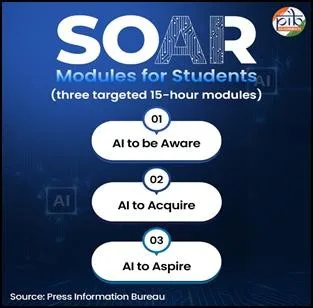
The government is also establishing a Centre for AI Excellence, an incubator for developing AI uses in Indian languages and contextual learning. The phrase chalkboards to chipsets captures the nation initiative to substitute passive learning with engaging technology-enabled teaching.
All India Council for Technical Education (AICTE) has suggested that AI should be made an elective in higher education so that students of engineering and management can be introduced to machine learning, data analytics and AI ethics at an early stage. Few of the IITs and NITs have already incorporated specialized modules such as Deep Learning and Predictive Data Analytics into the curriculum which is an indication of aligning academics with industry need.
Integration with Skill India Mission
The Skill India Mission (SIM), initiated in 2015 has already imparted skills to more than 1.4 crore youth every year through different schemes. The leveraging of AI using SOAR provides this mission with a cutting-edge future perspective. SOAR is the digital bridge that merges India conventional skill model with the technologies of the future.
Major pillars of such integration are:
• PMKVY 4.0 (Pradhan Mantri Kaushal Vikas Yojana): The flagship skilling programme now places emphasis on short-term training in AI, upgradation and reskilling to suit industry requirements.
• NAPS (National Apprenticeship Promotion Scheme): Its second phase NAPS 2.0, promotes apprenticeships in AI-driven jobs in the areas of IT, automotive and manufacturing industries.
• Skill India Digital Hub (SIDH): A digital spine linking learners, trainers and employers. SIDH now features AI literacy courses available in a variety of Indian languages, making digital inclusion a reality for rural learners.
• Industrial Training Institutes (ITIs) and NSTIs: These are being reoriented with AI-enabled labs and online simulators to provide hands-on exposure to new-age technologies.
Bridging the Digital Divide: Inclusion as a Priority
One of the strongest points of SOAR is reflected in its program and inclusiveness focus. Through Skill India Digital Hub, the program ensures that learning AI is brought to district schools, tribal belts and aspirational blocks. Vernacular content for AI is accompanied by online modules, with which non-English-speaking students can learn complex concepts instinctively.
Based on 2025 data from MSDE, over 1,200 Indian training centers have adopted AI-based curricula and nearly 40% of the trainees are female, a significant move toward gender neutrality in tech education. By 2027, the government aims to reach AI skilling to every district and upskill youth there to become players in India’s growing digital economy.
Economic Vision: AI and Aatmanirbhar Bharat
SOAR impact goes beyond the classroom, it contributes directly to Atmanirbhar Bharat by empowering Indian workforce for future tech-enabled sectors. India AI market could reach $17 billion by 2027, growing at a CAGR of more than 30% as per a NASSCOM 2024 report.
The government agenda is straightforward build AI-powered job opportunities in fields like healthcare diagnostics, fintech, logistics automation and precision agriculture. AI start-ups in India have grown by 35% from 2022 to 2025, employing more than 50,000 professionals, several trained through government-sponsored skilling initiatives.
AI integration into the public sector from crop predictive analytics to smart governance boards generates new fields of work that demand expertise. SOAR therefore serves as India technological self-reliance human capital pillar.
Constructing a Future-Ready Workforce
One of the most important outcomes that SOAR is meant to deliver is the development of a national AI talent pipeline. According to NITI Aayog’s “AI for All” vision, India requires 20 lakh AI and data analytics professionals by 2030. SOAR modular curriculum is aimed at fuelling this pipeline from schools, through ITIs and up to higher education.
The applied nature of the initiative through project-based problems, hackathons and simulations with real-world applications which will enables students to apply abstract knowledge into practical skills that can be used at work. Public-private partnerships are also being promoted, with technology giants Microsoft, Google and Intel joining hands with the government in creating AI curriculum guidelines and digital libraries.
The Skill India Digital Hub also adds to this ecosystem by linking trained youth to employment portals and start-up ecosystems. The platform analytics dashboard viewed in one of the pictures in the SOAR report also shows real-time information about AI course enrollments, geographic participation and placement results, enabling transparency and accountability.
Challenges and the Road Ahead for SOAR in the Future
Despite its futuristic planning, the deployment of AI education nationwide also raises some challenges. Availability of online infrastructure, especially in rural areas, remains spotty. The Digital India 2.0 program of the government, launched in 2024, would fill this gap by connecting rural India with high-speed broadband and 5G connectivity.
Teacher readiness is yet another area that requires ongoing attention. Professional development training under SOAR aims to develop not only that teachers teach AI principles but also prepare them to adapt evolving technologies.
Ethical AI use protection of data, algorithmic bias and responsibility is a built-in aspect of the curriculum. With AI finding its way into all walks of society, promoting responsible innovation will be as important as technical proficiency.
The Skilling for AI Readiness (SOAR) is more than a policy program it is a national vision in motion. It captures the spirit of Skill India, the essence of Digital India and the pursuit of innovation of Viksit Bharat @2047.
By integrating AI literacy in education and vocational training, India is constructing a foundation for a digitally empowered society that is digitally literate but not limited to it. The focus of the program on inclusivity, accessibility and ethical usage ensures that technological progress does not get restricted to cities but extends to each student, village and classroom.
















Comments