





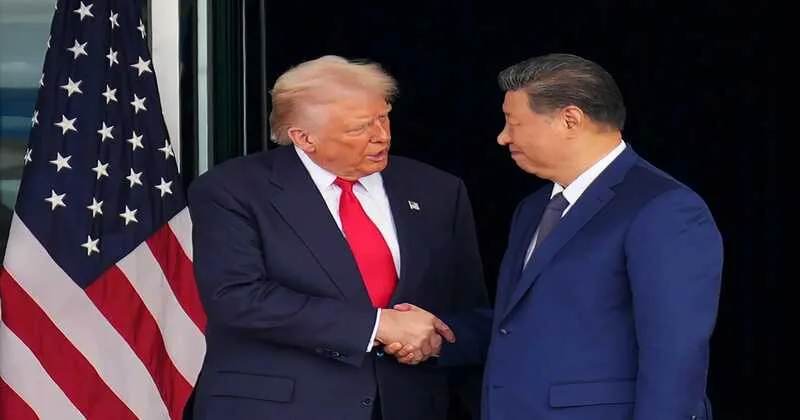
In a display of carefully choreographed diplomacy, Chinese President Xi Jinping and US President Donald Trump met on Thursday at a South Korean air base in Busan, marking their first in-person encounter since 2019. The meeting, lasting just under two hours, represented both a symbolic and substantive attempt to cool tensions between the world’s two largest economies after months of trade and geopolitical friction.
Xi’s arrival in South Korea was confirmed only a day before the summit, underscoring Beijing’s preference for tight control and strategic timing. The setting itself, a military base where Xi was landing and Trump was departing, reflected the transient, almost transactional nature of the encounter. The two leaders exchanged a brief handshake, with Xi characteristically composed and unflinching as Trump leaned in to whisper a few words. The meeting concluded with Trump accompanying Xi to his vehicle, after which the Chinese leader was quickly surrounded by his security personnel, leaving Trump momentarily isolated as he searched for his own car.
The Busan meeting was the final stop in Trump’s week-long diplomatic tour of Asia and came after a notable absence of face-to-face contact between the two leaders for six years. Since Trump’s return to the White House, communication between Washington and Beijing had been limited to a single phone conversation in September, which focused narrowly on the sale of TikTok’s US operations.
Xi has landed in Busan just minutes after Trump’s arrival for the APEC Economic Leaders’ Meeting where he’s expected to meet Trump for the first time since 2019
Meanwhile Trump ORDERS the Department of War to start testing US nuclear weapons "immediately."
Typical Trump: Odd… pic.twitter.com/nTORn68EM1
— Megh Updates 🚨™ (@MeghUpdates) October 30, 2025
A temporary truce
In the weeks leading up to the Busan meeting, relations had deteriorated sharply. Early in October, Beijing had announced new export controls on rare earth elements, critical to global technology production, prompting Trump to threaten a sweeping 100% tariff increase starting November 1. The escalation raised fears of another full-scale trade war.
However, signs of de-escalation emerged over the past weekend when negotiators from both countries met in Malaysia. That meeting paved the way for a series of reciprocal concessions unveiled in Busan. Beijing agreed to suspend its rare earth export controls for one year and to resume large-scale purchases of American soybeans. This marked a significant reversal, as China, traditionally the largest importer of US soybeans, had refrained from any such purchases throughout the year.
In return, Washington committed to halting the expansion of its blacklist of Chinese companies barred from doing business with American firms. The United States also announced a reduction in tariffs linked to the fentanyl trade, lowering duties from 20% to 10% on Chinese exports related to precursor chemicals used in synthetic drug production. For its part, China pledged to tighten oversight of these chemical exports, addressing a long-standing US concern over fentanyl trafficking through Mexican cartels. The overall effect of these changes will see the average US tariff on Chinese goods drop from 57% to 47%.
The two leaders further agreed on a tentative framework for future diplomatic engagement. Trump confirmed his intention to visit China in April next year, followed by a reciprocal visit by Xi Jinping to the United States, a move aimed at institutionalising this momentary thaw in relations.
Unresolved disputes
Despite the conciliatory tone of the Busan summit, several contentious issues were left untouched. Chief among them was the ongoing US embargo on advanced semiconductor exports to China, a policy that has strained the technological relationship between the two nations since 2022. Before the meeting, Trump had hinted that he might raise the matter of Nvidia’s cutting-edge Blackwell chips, but after the talks, he clarified aboard Air Force One that semiconductors had not been discussed.
The ambiguity surrounding semiconductor policy reflects a broader split within Washington’s strategic thinking. One camp insists that restricting access to high-end chips is essential to national security, preventing their use in China’s military and surveillance sectors. This continuity of policy from the previous administration maintains a hard line on technology control. Another faction, represented by prominent industry leaders such as Nvidia CEO Jensen Huang, advocates a more liberal export regime. Their argument holds that allowing China continued access to American technologies would ensure long-term dependence on US standards and innovation, thus strengthening Washington’s strategic leverage. The Trump administration’s vacillation suggests that this internal debate remains unresolved.
Sensitive topics avoided
Both sides also steered clear of thorny geopolitical subjects. Notably, there was no discussion of China’s continued purchase of Russian oil, despite Washington’s recent decision to impose sanctions on Russian energy exports. Similarly, the delicate question of Taiwan was absent from the agenda. Reports in late September indicated that Beijing wanted an explicit US statement rejecting Taiwan’s independence, but Washington’s official stance remains that it “does not support” independence rather than explicitly opposing it.
Secretary of State Marco Rubio, addressing reporters over the weekend, ruled out any linkage between trade negotiations and US policy on Taiwan, closing the door on speculation that Washington might trade economic concessions for geopolitical compromises. As Trump concluded his Asian tour and Xi departed Busan, the two leaders managed to halt an immediate spiral of confrontation, but without resolving the deeper structural tensions that define US–China relations.











Comments