





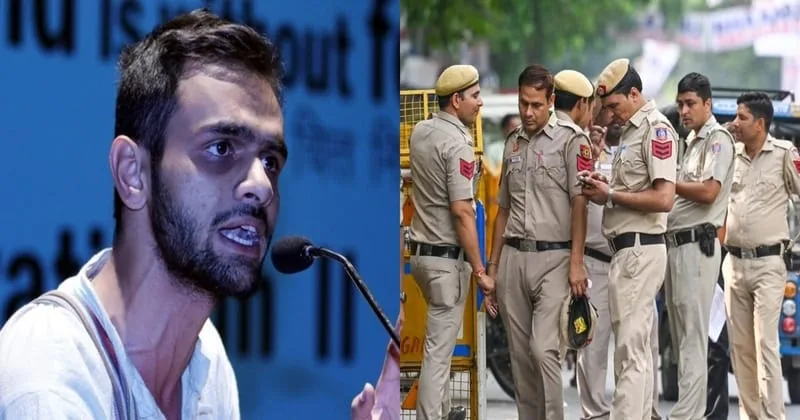
After the Supreme Court flagged the delay in responding to the bail pleas of Umar Khalid, Sharjeel Imam, and others in the Delhi Riots conspiracy case, the Delhi Police has submitted a 389-page affidavit outlining reasons why bail should be denied. The police have cited “ocular and irrefutable documentary as well as technical evidence” pointing to a conspiracy aimed at inciting “nationwide riots along communal lines.”
The affidavit also draws heavily on the recent Delhi High Court judgment in Tasleem Ahmed v. State Govt. of NCT of Delhi, in which the court held that delays in the trial, caused by the accused being granted bail, adversely affected those still in custody. Below are the eight grounds on which the Delhi Police has opposed the bail pleas.
Regime change operation, plan to kill non-Muslims: Delhi Police oppose bail to Umar Khalid, others in Supreme Courthttps://t.co/bJz1J4cIgY
— Bar and Bench (@barandbench) October 30, 2025
Conspiracy as a Pan-India “Regime Change Operation”
The petitioner is alleged to have hatched, nurtured, and executed a conspiracy aimed at striking at the core of the country’s sovereignty and integrity by disrupting communal harmony. The plan was to incite crowds not only to disturb public order but to provoke them toward armed rebellion.
Recent international theories describe such organised and sponsored activities as “Regime Change Operations.” Evidence on record indicates that this conspiracy was intended to be replicated and carried out across the country, on a pan-India scale.
Accused responsible for delay in trial
Both the High Court and the Special Court have repeatedly observed that the petitioners, acting in concert, obstructed the framing of charges in this case. It was only through the intervention of the appellate courts that the Section 207 proceedings, furnishing of the police report to the accused, were eventually completed, and that too with significant difficulty. Despite orders for daily hearings, the petitioners continued to impede the Special Court from framing charges, resulting in a trial delay exceeding two years. Additionally, the petitioners appear to have attempted to withhold the Tasleem Ahmed v. State Govt. of NCT of Delhi judgment from the Supreme Court, which contains clear findings confirming that the accused deliberately prevented the trial from proceeding.
Actual number of witnesses much lower than claimed
The claim that the trial will be prolonged due to 900 witnesses is both premature and misleading, appearing to be a tactic to secure bail. A review of the witness list reveals approximately 155 public witnesses, of whom 58 have already recorded their statements under oath. Of these, 47 witnesses have been granted protected status; 38 of them have provided statements under Section 164 CrPC, while the remaining statements were recorded under Section 161 CrPC.
Strategic protests during Trump’s visit
The evidence on record, including chat messages referencing US President Donald Trump, clearly indicates that the conspiracy was premeditated to coincide with the President’s official visit to India. This timing was intended to attract international media attention and elevate the Citizenship Amendment Act (CAA) issue to a global platform, portraying it as an act of persecution against the Muslim community. The CAA was deliberately chosen as a “radicalising catalyst,” disguised under the pretence of a “peaceful protest.”
Bail exceptions for UAPA offences
For offences under the Unlawful Activities (Prevention) Act (UAPA), which threaten the very integrity of India, the principle is generally “jail, not bail.” The allegations against the petitioner are prima facie valid, and the burden of disproving these claims lies with the petitioner, a burden they have failed to meet. Given the extreme gravity of the alleged offences, bail cannot be granted solely on the ground of procedural delay.
Chakka Jaam: Intent to harm and incite communal violence
The disruptive Chakka-Jaam protests were allegedly aimed at killing and injuring police personnel and non-Muslims on a large scale, as well as damaging government and private property by orchestrating communal riots. Notably, Sharjeel Imam’s thesis on riots demonstrates his knowledge of mobilising critical mass to engineer unrest, a strategy reflected in his speeches and reinforced by the communal undertones of his rhetoric.
Use of WhatsApp groups and meetings for conspiracy
To further their objectives, the JCC WhatsApp group was created using a mobile number obtained with falsified documents, indicating the covert and illicit intent behind its use. Additionally, a communal WhatsApp group titled “Muslim Students of JNU” was established under the direction of Umar Khalid. Testimony from witness BOND, recorded under oath, highlighted the distinction between a peaceful Dharna and the violent Chakka Jaam, illustrating the deliberate orchestration of the latter.
Umar Khalid has withdrawn his bail plea before the Supreme Court
Since Umar Khalid withdrew his petition before the Supreme Court in February 2024, the findings of the High Court have attained finality. The Court should not allow the accused to file successive bail applications to circumvent or reopen issues that have already been conclusively decided.













Comments