





Maritime discourses indeed have a multi-vectoral impact on the geopolitical and security landscape of the 21st century. From mobilising trade and connectivity to materialising the economic and national security paradigm, oceans are the ancient yet emerging critical junctures that are imperative to herald global sustainability and prosperity. In this direction, it is detrimental to foster global maritime cooperation especially in an era of soaring great power competition with strategic maritime zones acting as theatres of geopolitical contestation and conflicting choke points.
Sagarmanthan 2025: The Great Oceans Dialogue is envisioned and articulated in this backdrop. It is India’s premium forum to furnish incredible ideas and solutions with the core agenda of securing a sustainable and self-sufficient ecosystem with oceans as its epicentre. The flagship ocean dialogue, co-hosted by the Ministry of Ports, Shipping and Waterways and Observer Research Foundation was held in the port city of Mumbai from October 27-29. It attracted delegates, subject experts and government authorities from more than 85 countries who delivered key credentials in the path of crafting resilient ocean ecosystems and converging credible maritime paradigms.
From anchoring pathways to building mutually beneficial maritime corridors to countering geopolitical uncertainties encircling the oceans. From espousing state-of-the-art initiatives to carve ocean infrastructure to indulging in traditional and civilisation methods rooted in ancient wisdom in order to unleash the ocean potential. From thwarting hegemonic ambitions across oceans to building bonhomie and benevolence for a shared and secure future, ‘Sagarmantha 2025’ ultimately had one apex agenda.
It is championing an open, inclusive, sustainable, rule-based and mutually beneficial maritime domain for the sake of global benefit. The premium forum resolved to navigate the geopolitical and geoeconomic conundrums emanating across oceans and upholding the vision of collaborative pathways. Ofcourse with India as a credible, resilient and trustworthy partner in this voyage of securing oceans and ocean economies. Intellects pledged to configure the potential of blue skills and blue jobs that ultimately consolidates in a solid and sound blue economy.
Enlightening the indigenous prowess and looking beyond horizons
Speaking at a session in the ‘Sagarmanthan’, Sanjeev Sanyal, Member of Prime Minister’s Economic Advisory Council(PM-EAC) reiterated to unleash the humungous indigenous potential with respect to championing India’s path in maritime discourses. 95 per cent of India’s maritime trade is anchored on foreign-made ships. Thus, Sanjeev Sanyal asserted to seek self-reliance in the shipping industry.
India indeed has a strategic advantage in terms of crafting a strong indigenous maritime trade ecosystem. Given its strategic location in the epicentre of the Indian Ocean and in the periphery of the Indo-Pacific, India is a key stakeholder in securing maritime safety and prosperity. Apart from geographical merit, India also has a huge skilled youth force. India is also the second largest producer of steel in the globe. By converging all these strategic merits India should harvest a solid ship building industry that not just adds for the self-reliance vision of India but moulds the nation as a key ship manufacturing hub. Thus, its high-time India assures a momental ship building economy by harnessing the indigenous prowess.
Sanjeev Sanyal also highlighted the initiatives unlocked by the Government of India to foster a sound indigenous ship building ecosystem. The government has upgraded the ships to the status of infrastructure and has fuelled an initial investment of Rs. 70, 000 crore. New Delhi has thus successfully transformed the narrative, financial structure and policy ecosystem that has strengthened maritime vision and viability.
Sanjeev Sanyal also asserted to look beyond the horizon to score on credible maritime partners. India might be geographically encircled with sceptic countries in South Asia. But there is always potential to look beyond. Our true partners to engage are the countries of Southeast Asia, Australia etc. While we have to ensure a strategic deterrence in immediate periphery it is prudent to engage with the extended maritime neighbourhood. Sanjeev Sanyal hence gave a unique perspective for India in seeking credible maritime partners to restore balance of power across the oceans.
Solidifying smart docks, penetrating paperless ports
The port and shipping industry is the oldest and most prudent sector that has etched civilisations and economies across the globe. Despite being in business for centuries, the shipping domain is the least upgraded sector with emerging technologies. Unfortunately, only 4.2 per cent of the global ports are automated. Paperless ports are a mere dream even in the most advanced economies of Europe and the USA, opined the experts addressing Sagarmanthan.
Making the port ecosystem smart and sustainable, penetrating a paperless port administration is thus pivotal in India and beyond. Digitisation of ports will also enhance efficiency and dismantle the high cost of operation. Marching in the path from mechanisation to digitisation of ports not just helps in ease-of-doing business but will champion decarbonisation, thus helps overcoming climate catastrophes. As digitisation leads to optimisation of vessel movement with speedy and timely docking and undocking, carbon emissions will be drastically reduced. In this direction, single-window maritime digital platforms, automated invoice generation, IoT and AI-based ports will be a revolutionary endeavour.
Calibrating cross continental confluence
The forum of ‘Sagarmanthan’ emerged as a strong advocate for maritime partnerships that aim to seal win-win situations in an era of spiking geopolitical upheavals, weaponisation of strategic maritime routes. Dignitaries from the Arctic, Mediterranean, African and Middle East region echoed for a credible and trust-based long-term cross continental maritime infrastructure collaboration. Members from Africa and the Arctic invited like-minded partners such as India to invest in the maritime projects to cherish the fruits of shared maritime prosperity and holistic economic development.
Experts also highlighted the prominence of cross continental convergence in order to cherish the full potential of critical minerals that are deemed as a game-changer in the fourth industrial revolution and associated economic prosperity. Industry experts and leaders reflected on the vitality of integrating economies in terms of infrastructure development, exchange of skill power for ensuring a sustainable and inclusive use of critical minerals, in an era where ‘mineral diplomacy’ is deliberately dubbed as ‘mineral weaponisation’ to seek hegemonic ambitions.
Bolstering blue skills and blue jobs
The potential of the maritime sector can be completely unleashed when the youth of the nation are rigorously involved in it. Employability in the maritime sector is a prospective domain. To realize this goal youth has to be equipped with industry-oriented maritime skills. In this direction, Malini Shankar, Vice Chancellor of the Indian Maritime University asserted that the curriculum ingrained in our education system has to be upgraded with the latest geopolitical and economic changes. Partnership with the industries has to be forged to instill practical training to the youth.
Malini Shankar also exclaimed that in search of modernisation, the cultural and aboriginal roots of the coastal communities should not be derailed. Modernisation and preservation of civilisational knowledge should go hand-in-hand. Next generation of the primitive coastal communities should be brought to mainstream university education to assure better maritime skills and opportunities.
Navigating climate challenges with traditional knowledge ecosystem
With respect to navigating the challenges arising from the climate catastrophes, the traditional knowledge system and ancient wisdom is indeed a boon. In this direction, Jodie Kuntzsch, Chief Executive of Moananui, New Zealand affirmed that coastal communities are co-creators in seeking climate resilience. Climate action is a configuration of cultural, ecological and economic aspects. Similarly, dignitaries from Lithuania, Tobago also reciprocated the same agenda and ascertained that ancient wisdom and aboriginal knowledge are catalysts to seek climate resilience.
Deepak Shetty, Former Secretary to the Government of India, hailed India’s achievements in nurturing climate resilience by harnessing traditional knowledge systems. He opined that youth of the next generation from the coastal communities should be upskilled in their inherent profession to suit present-day needs, instead of uprooting them from their ecosystem.
Deepak Shetty also hailed the decentralised administration mechanisms echoed by the Government of India such as self-help groups, cooperative societies, Mangrove Mishti scheme to uplift the coastal population. Visionary policies of the government are thus inflicting the prosperity of the coastal population.
Seeking gender parity and women empowerment in maritime matrix
The sessions of Sagarmanthan emerged as a strong voice of women empowerment and seeking gender parity in the maritime sector. Marianne Sivertsen Naess, Minister of Fisheries and Ocean Policy, Norway echoed efforts to achieve gender parity in the maritime domain. She asserted that the floor has to be set to attract more women into the maritime workforce.
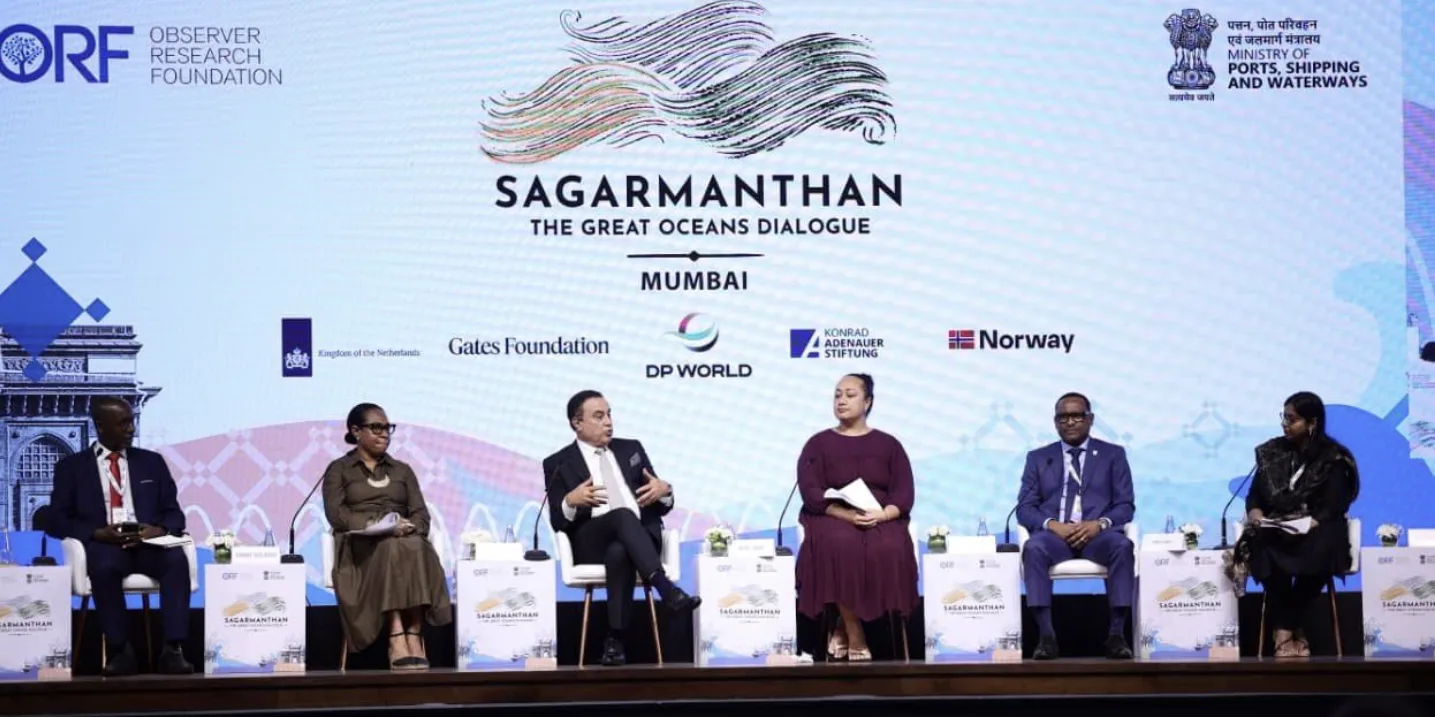
Similarly, Malini Shankar, Vice Chancellor, Indian Maritime University echoed the vision of gender parity and creating opportunities for women in blue jobs. She also highlighted the vitality of rendering vocational training to the women of coastal communities who apparently play a key role in ensuring coastal health and sustainability.
Sagarmanthan: Voice of SIDS and Global South
Sagarmanthan also transfigured as a solid advocate of the future and prosperity of Small Island Developing States(SIDS) and other primitive economies of Global South, who are most vulnerable to the climate catastrophes. Neena Malhotra, Secretary(South), Ministry of External Affairs put spotlight on India’s initiatives in ensuring the sustainability and secured future of the states littoral to Indian Ocean or the Indo-pacific.
Representatives from Mauritius, Bahamas, Tunisia, Comoros, Papua New Guinea reflected on their consistent challenges and expressed confidence and solidarity with India as a credible partner in navigating challenges and fuelling mutual development prospects.
Sagarmanthan 2025: The Great Oceans Dialogue, hence, was a cross continental convergence to navigate maritime challenges, build capabilities beyond horizons, cementing long-lasting partnerships devoid of geographical constraints and ultimately orchestrating a new chapter in ocean ecosystem. Sagarmanthan acted as a global platform to ink a maritime manifesto, by vanquishing geographical and geopolitical bottlenecks and overarching responsibilities for a healthy, secure and prosperous mankind and beyond.
Nancy Karigithu, Special Envoy and Advisor, Maritime and Blue Economy, Executive Office of the President, Kenya
“The session was very rich, relevant and valid in terms of decarbonisation, green transition and carving new critical mineral routes. The young people of India, you are very special, from you I can envision the future of India, particularly the maritime future is in very safe hands”.
Yeghia Tashjian, Issam Fares Institute for Public Policy and International Affairs, Armenia
“Sessions on the maritime economic corridor were insightful. With respect to India-Armenia partnership, Armenia is part of the INSTC corridor and hopes to see the bilateral strategic partnership in a great momentum in future. India has the capability to engage in a more pro-active diplomacy in the Middle East given the turbulent phase of the region, because India has good relations with all the sides”.
Lieutenant Commander Dilna K, Women officer who completed Navika Sagar Parikrama
“The Indian maritime sector has come a long way and has an ocean of opportunities. The government is giving opportunity to the women under the vision of Nari Shakti. The support from the Government of India was massive during the circumnavigation journey. Senior officials including the Raksha Mantri motivated and supported us”.










Comments