





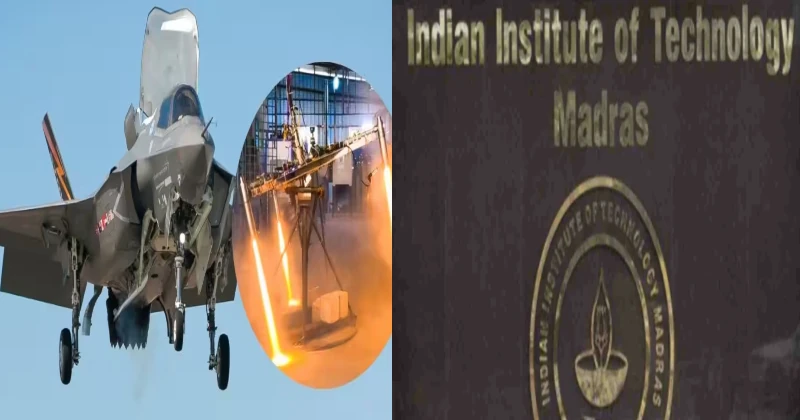
In a major advancement for India’s aerospace ambitions, researchers at the Indian Institute of Technology Madras (IIT Madras) have successfully demonstrated a Vertical Take-off and Landing (VTOL) system powered by Hybrid Rocket Thrusters, marking a crucial step toward next-generation aircraft and unmanned aerial vehicle (UAV) development.
Using a hardware-in-the-loop simulation (HILS) approach a cost-effective, flexible, and real-time testing method the IIT Madras team combined a live hybrid rocket thruster with a virtual flight simulation environment. The experiment achieved the required velocity for a “soft landing”, a critical feature in vertical landing systems used in both planetary exploration modules and terrestrial VTOL platforms.
The study, authored by Prof. P. A. Ramakrishna, Dr. Joel George Manathara, and Anandu Bhadran from the Department of Aerospace Engineering, was recently published in the International Journal of Aeronautical and Space Sciences.
Explaining the importance of the development, Prof. P. A. Ramakrishna said VTOL technology could redefine air mobility by eliminating the need for long runways.
“Vertical take-off and landing will allow aircraft to operate from confined or remote areas where long runways are impractical,” he said. “Currently, helicopters are the only option in such terrains, but they are limited in speed, range, and efficiency compared to fixed-wing aircraft.”
Prof. Ramakrishna noted that once VTOL systems reach the Technology Readiness Level (TRL) for commercial use, the technology will revolutionise both civil and military aviation by enabling decentralised air operations.
“This study is a precursor to a hybrid rocket-powered VTOL platform. Once matured, it could enable multiple small-scale airbases instead of one centralised airport, offering strategic and operational advantages,” he added.
The IIT Madras research team explored hybrid rocket motors as a propulsion source for VTOL because they combine the safety of solid propellants with the control and throttling capabilities of liquid engines. Unlike conventional rocket engines, hybrid systems can dynamically adjust thrust output, making them suitable for precision-controlled vertical landings.
Anandu Bhadran, one of the researchers, said, “Hybrid rocket motors have regained global attention in recent years due to their reliable throttling characteristics. In our study, the motor successfully responded to varying thrust demands generated by the guidance system. Even with a basic control algorithm, the system achieved stable and reliable thrust modulation.”
In the hot flow test, the researchers achieved a touchdown velocity of 0.66 m/s, confirming the feasibility of a controlled soft landing using compressed air as the oxidiser a safer and more practical option for integration with aerospace vehicles.
The IIT Madras team employed a cutting-edge hardware-in-the-loop simulation framework, which merges physical rocket hardware with virtual test environments. This approach allowed the researchers to conduct both cold and hot flow tests within a simulated VTOL setup, enabling precise control and analysis of performance parameters.
Dr. Joel George Manathara, Associate Professor, Aerospace Engineering, highlighted the novelty of the experiment, “Our use of hybrid rocket thrusters for VTOL is a unique and pioneering aspect of this research. Integrating a real, live-firing rocket motor directly into a HILS loop is rarely attempted, and it allows us to achieve near-real testing accuracy.”
He added that the HILS framework significantly reduces development costs and time, accelerating the transition from laboratory research to real-world applications.
Building on these promising results, the researchers are now developing an experimental landing platform with multiple degrees of freedom to test attitude stabilisation — a key requirement for any operational VTOL system.
“Once the platform achieves attitude stabilisation, a hardware-in-the-loop simulation without assuming stabilised conditions will be conducted,” said Prof. Ramakrishna. “This will take us one step closer to a fully functional VTOL platform powered by hybrid rocket thrusters.”
The long-term vision is to integrate this technology into fixed-wing UAVs, enabling high-speed vertical mobility for civil logistics, defence operations, and planetary exploration missions.
The study’s landing algorithm was designed using a velocity-tracking method governed by a proportional–integral–derivative (PID) controller, ensuring seamless control during descent. The three-segmented velocity profile used in the algorithm allowed adaptability for varying landing conditions.
Cold flow and numerical simulations confirmed that a safe touchdown below 1 m/s was achievable, validating the hybrid thruster’s response capabilities and reinforcing its potential for precision-controlled aerospace systems.
















Comments