





India’s homegrown digital payments innovation, the Unified Payments Interface (UPI), continues to power the nation’s financial transformation, registering a remarkable 35 percent year on year (YoY) surge in transaction volume to 106.36 billion in the first half (H1) of 2025. According to Worldline’s India Digital Payments Report (1H 2025), released on Wednesday (October 29), the total value of UPI transactions reached an astounding Rs 143.34 lakh crore, a clear indicator that digital payments are no longer a luxury but a way of life for millions of Indians.
What began as a government-backed project under the Made in India and Digital India initiatives has now become one of the most successful public digital infrastructures in the world. UPI’s exponential growth reflects India’s journey toward a less-cash, more-inclusive economy, bridging the gap between urban convenience and rural opportunity.
Shift toward small-value daily transactions
While the sheer size of UPI’s transaction volume is impressive, what stands out is the behavioural transformation it represents. The report notes that the average UPI transaction size fell from Rs 1,478 in H1 2024 to Rs 1,348 in H1 2025. This decline, rather than a sign of slowdown, signals UPI’s deep penetration into India’s grassroots economy.
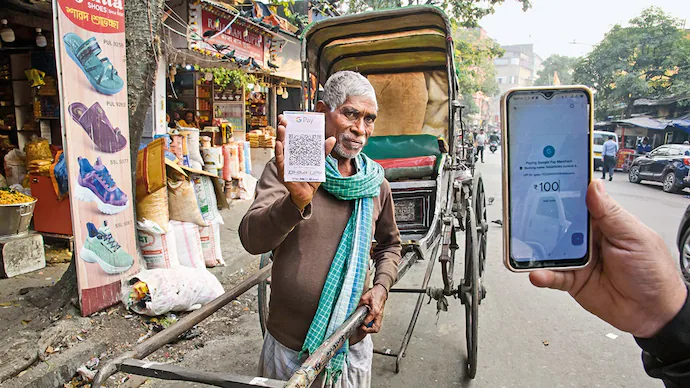
Today, digital payments are no longer confined to big-ticket purchases or tech-savvy consumers. They have become part of the daily rhythm used to pay for chai at roadside stalls, groceries at local kirana stores, and vegetables from neighbourhood vendors. The falling average transaction value shows that India’s digital revolution has truly gone “mass market.”
Small shops driving big growth
According to the report, much of UPI’s growth can be attributed to what Worldline calls the “Kirana Effect,” a reference to the surge in person-to-merchant (P2M) transactions driven by small and micro businesses.
P2M transactions grew 37 percent to 67.01 billion in the first half of 2025, underscoring how kirana owners, fruit sellers, and small entrepreneurs have become central to India’s digital commerce network. The once cash heavy retail economy has evolved into a dynamic digital ecosystem where even the smallest vendors now accept QR-based payments.
This adoption was facilitated by simplified onboarding processes, minimal transaction costs, and the trust that comes with interoperability across payment platforms like PhonePe, Paytm, Google Pay, and BHIM.
The Kirana Effect has done more than boost digital payments, it has democratized finance. Millions of small traders are now part of the formal economy, creating traceable financial records that help them access credit, insurance, and government benefits.
QR and PoS network expands at record pace
India’s QR-based payment network has also witnessed phenomenal growth, positioning the country as a global leader in merchant digitisation. The number of QR codes deployed across India doubled to 678 million by June 2025, marking a 111% increase since January 2024.
Alongside, the number of Point of Sale (PoS) terminals rose 29 percent to 11.2 million, while Bharat QR deployments reached 6.72 million.
Together, these systems have given India the world’s largest merchant acceptance network, powered by small-business participation and policy support under initiatives like Digital India, PM Vishwakarma Yojana, and RBI’s Payments Vision 2025.
Experts believe this growth is key to India’s target of becoming a $5 trillion digital economy. As Worldline India’s analysts note, “The pace of merchant digitisation in India outstrips most developed markets. UPI has made digital acceptance not just convenient but essential for survival in a competitive retail environment.”
Credit cards turn premium
While UPI dominates everyday transactions, the report highlights a shift in consumer behaviour across card payments.
The number of active credit cards grew 23 percent between January 2024 and June 2025, with monthly spends surpassing Rs 2.2 trillion. Although the average transaction size fell by 6 percent, credit cards are increasingly being used for regular purchases like food delivery, online subscriptions, and retail shopping, a trend earlier reserved for UPI and wallets.
In contrast, debit card usage at PoS terminals fell nearly 8 percent, suggesting that UPI has effectively replaced debit cards as the go-to payment method for small and medium transactions.
This shift reinforces how UPI has not just supplemented but fundamentally reshaped India’s payment hierarchy, blurring the line between “digital convenience” and “financial necessity.”
Mobile payments lead the digital march
Another highlight of the Worldline report is the growing dominance of mobile-based payments, which recorded a 30% year-on-year rise to 98.9 billion transactions, valued at a staggering Rs 209.7 trillion.
The data underscores a crucial trend, India’s digital payments revolution is being driven by mobility. Smartphones, affordable data, and real-time interoperability have transformed the phone into the nation’s most powerful financial instrument.
UPI’s mobile-first design and integration into everyday apps, from messaging platforms to banking interfaces, have made it effortless for users to transact, whether they’re sending money home, paying a utility bill, or tipping a delivery agent.
Made in India shines
Beyond domestic success, UPI’s international footprint continues to expand. The platform has already been integrated in countries like Singapore, France, Nepal, and the UAE, allowing Indian travellers and expatriates to use UPI abroad. Bilateral partnerships under the RBI-NPCI International Payments Framework are paving the way for cross-border interoperability, making UPI a global model for affordable, real-time digital payments.
This “Made in India” innovation is now being studied and replicated worldwide. From African fintech startups to Southeast Asian payment ecosystems, countries are exploring how to adapt the UPI model to local needs, proving that India’s technological leadership extends far beyond its borders.
UPI as the great equaliser
The Worldline India Digital Payments Report (1H 2025) makes one thing clear, UPI is not merely a success story in financial technology; it is a story of inclusion, trust, and national innovation.
By bridging the urban-rural divide, enabling small traders, and simplifying digital access, UPI has become more than a payments system, it is the financial heartbeat of a new India.
As the nation moves toward a fully digital future, UPI stands as the shining symbol of what “Made in India” truly means, technology built by India, for India, now powering the world.













Comments