





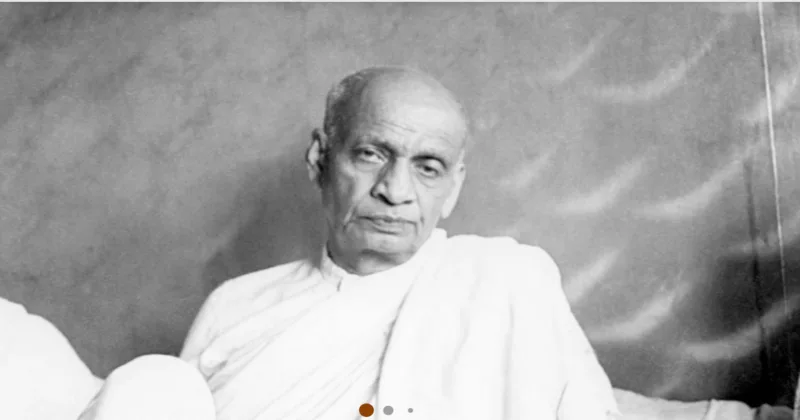
Jhaverbhai and Ladba Patel welcomed Sardar Vallabhbhai Patel into the world on October 31, 1875, in Nadiad, Gujarat. Diksha was taken from the Pushtimarg sect by Patel, who adhered to the Vaishnavite tradition. At the age of 36, he traveled to England and finished a legal school at the Middle Temple after putting in a lot of effort and saving money. After returning, Patel started a career in public service and rose to prominence as an Ahmedabad barrister.
He shown his exceptional organizing abilities during the devastating floods in Gujarat in 1927. In his capacity as Municipality President, he organized a volunteer army and started a fund-raising campaign to transport supplies to the impacted districts. He provided help to the populace long before official aid could be provided, which was unnecessary when it did arrive. For Bharat, an organization run by and for Bharatiyas, it was a true first.
In 1930, he was initially taken into custody and imprisoned. He was incarcerated for almost half of the next 16 years. He actively participated in planning and negotiating the route to independence with Gandhiji and other leaders in the last years of the liberation fight.
As Bharat’s first Deputy Prime Minister and Home Minister, he made a masterpiece by persuading and uniting approximately 560 princely entities and colonial provinces into the states that make up modern-day Bharat. His firm action persuaded the Nizam of Hyderabad to join the Union of Bharat and stopped Junagadh from joining Pakistan. In order to preserve the status quo in the short term, Hyderabad’s Nizam Mir Usman Ali Khan Bahadur and the Bharatiya government signed a Standstill Agreement. But Patel’s move was driven by violence and communal tensions in the State. As part of Operation Polo, the Bharatiya Army advanced into Hyderabad. Hyderabad became a part of Bharat after the Nizam declared a truce on September 17, 1948.
The history of accession was marked by both historic accomplishments and unique difficulties. Following multiple meetings and discussions, Jodhpur acceded to Bharat in June 1947 after attempting to negotiate better conditions with Pakistan. Travancore had subsequently declared in July 1947 that it would exercise its right to independence. In the end, Patel’s statesmanship and diplomacy won over the Raja of Travancore. The rulers of other states who had previously wavered on the accession issue were greatly impacted by this decision. Despite strong opposition from the state’s citizens, the Nawab of Junagadh made the decision to join Pakistan. Sardar Patel’s persistent efforts led to Junagadh’s eventual integration into Bharat. In a historic plebiscite held in February 1948, the vast majority of Junagadh residents voted in favor of staying in Bharat.
Kashmir’s Raja Hari Singh had been unsure about joining. But when Pakistan attacked Kashmir in October 1947, the Raja turned to Bharat for immediate support. The Raja signed the Instrument of Accession in exchange for the assistance. While the Constituent Assembly was establishing the Bharatiya Constitution, from October 1947 to November 26, 1949, the terms of Kashmir’s accession were negotiated. under order to maintain the precise conditions under which Kashmir had consented to join Bharat, Article 370 was added to the Constitution under Part XXI (Temporary, Transitional and Special Provisions). With the Constitution (Application to Jammu and Kashmir) Order 1954, the President could, in accordance with Article 370, determine which portions of the Bharatiya Constitution should be applied, with or without modification, to Jammu and Kashmir. As a result, Jammu and Kashmir adopted its own constitution and kept its special status.
In recognition of J&K’s inalienable position as a part of Bharat, Article 370 of the Constitution, which had granted it a temporary special status, was repealed on August 5, 2019. This fulfilled Sardar Patel’s goal of the nation’s actual union and consolidation. By assembling the parts of an incredibly intricate jigsaw puzzle into the coherent whole that is modern-day Bharat, Sardar Patel created a lasting legacy. He truly embodies the spirit of national cohesion. Since 2014, October 31st, the anniversary of his birth, has been recognized as National Unity Day in honor of this extraordinary person. Prime Minister Narendra Modi dedicated the “Statue of Unity,” the highest statue in the world, to the country on October 31, 2018. This 182-meter-tall statue of Sardar Vallabhbhai Patel in Kevadia, Gujarat, stands as a tribute to one of the most admired leaders the nation has ever had, set against the striking backdrop of the Satpura and Vindhyachal hills.
Sardar Patel & RSS
First of all, the claim that Sardar Patel outlawed RSS is untrue. In 1948, the Bharatiya Government, led by Pandit Jawaharlal Nehru decided to outlaw the RSS. It all started when Golwalkar Guruji, the Sarsanghchalak of the RSS, was arrested following the killing of Mahatma Gandhi. The government outlawed the RSS on February 4, 1948, based on false accusations. Golwalkar Guruji ceased the RSS’s operations while denying the accusations and abiding by the law. He was freed six months later but confined in Nagpur. Despite the “hurried and unbalanced action” taken against the RSS by people in power, he wrote to PM Nehru on August 11 to offer to work with them because the times were dire. Even though Sardar Patel originally made harsh comments about the RSS, he was responding to his role as home minister and the advice he got; otherwise, he consistently praised the RSS’s efforts. Sardar Patel was asked to respond to Golwalkar Guruji’s letter by PM Nehru. But speaking in Lucknow shortly before Gandhiji was killed, Sardar Patel had cautioned “those in power in the Congress” about attempts “to crush” the patriotic RSS. In his response to Golwalkar Guruji, Sardar Patel recalled his favorable opinions of the RSS and praised the youthful members who worked for Hindu society and safeguarded women and children.
“The RSS men are not only working hard but silently; they are good people.”
— Patel’s remarks in late 1947 (as recalled by K.M. Munshi and others)
Patel has the same understanding of Bharat as the RSS. Patel thought that Bharat’s culture has persisted from ancient times. Congress, on the other hand, considers Bharat to be a conglomeration of princely states. He was able to successfully combine more than 560 states into one because of this. Patel was a fair-minded statesman. He never acted with vengeance or selective preferences, but he did what had to be done. Whether it was the partition, the Kashmir issue, or Pakistani policy, his view was unmistakable. For that, RSS respects him. Anyone who has worked for Bharat objectively is respected by the RSS. Patel’s qualifications are unquestionable. Lal Bahadur Shastri Ji’s are as well. He is also respected by RSS. If Congress designates them as icons, will the Gandhi-Nehru dynasty’s politics collapse?
Sardar Patel, a distinguished leader, relinquished the position of Prime Minister due to the self-serving politics of certain Congress leaders.
It was becoming evident that Bharat’s independence was not that far off by the end of World War II. Due to the amount of seats the Congress had gained in the 1946 elections, it was also extremely evident that the president of the Congress would be the one asked to form the Interim Government at the Center. Thus, all of a sudden, the president of Congress became a highly interesting topic. Gandhjii publicly backed Jawaharlal Nehru, but the Congress largely preferred Sardar Patel as its president and, thus, as Bharat’s first prime minister because they saw him as “a great executive, organiser and leader” with his feet firmly planted on the ground.
Patel elected Congress president unopposed.
Nominations for the position of Congress president and, consequently, Bharat’s first prime minister, were due on April 29, 1946. According to the Congress constitution at the time, the Pradesh Congress Committees (PCC) had the sole Electoral College and were the only ones eligible to vote. Sardar Patel was still nominated by 12 of the 15 Pradesh Congress Committees. The other three did not participate. No one was nominated by them. Therefore, even on the final day of nomination filing, April 29, 1946, neither Jawaharlal Nehru nor anybody else’s name was suggested by any Pradesh Congress Committee.
Sardar Patel was thus elected president of the Congress without opposition in accordance with the rule. This infuriated not just Nehru’s supporters but also people who might have opposed Patel for other reasons. The machine in Patel’s place began operating quickly. JB Kripalani led the search for proposers and seconders for Nehru’s candidacy at the Working Committee meeting on April 29, 1946, in New Delhi. Kripalani was successful in persuading a few members of the AICC local chapter and the Working Committee to suggest Nehru for the position. Gandhiji was aware of the person he had suggested, but Jawaharlal’s candidacy nearly missed the deadline of April 29. In addition, he was unable to persuade the Pradesh Congress Committee—the sole valid entity with the authority to propose and choose the Congress president—to nominate Nehru. However, attempts were made to convince Sardar Patel to rescind his candidacy in favor of Nehru after he was formally proposed by a few members of the Working Committee, which was completely unconstitutional. Gandhiji asked him to do so after Patel asked for his guidance, and “Vallabhbhai did so at once.” . However, it should be noted that Gandhiji had given Nehru enough clues to resign in favor of Sardar Patel before encouraging Patel to quit. Gandhiji told Nehru, “Only a few members of the working committee have put forward your name. No PCC has.”
Bharat would have thrived on many fronts if Sardar Patel had been the country’s first prime minister. We salute you, Iron Man of Bharat and excellent leader.










Comments