





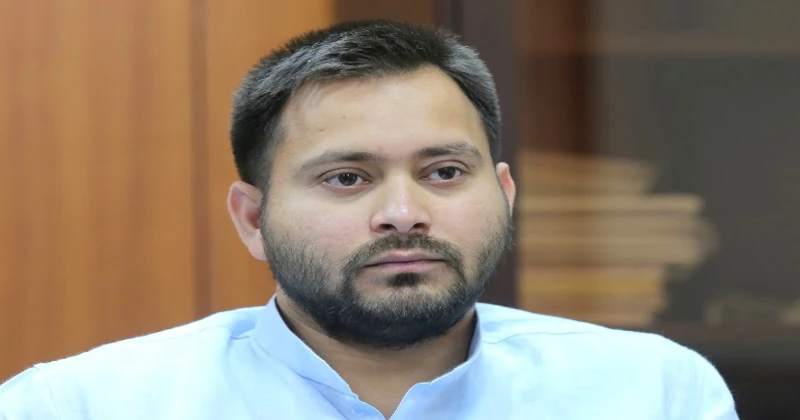
As Bihar gears up for the Assembly elections, the Rashtriya Janata Dal (RJD) leader Tejashwi Yadav has unleashed a political campaign steeped in false promises, divisive rhetoric, and economic illiteracy. His much-touted “Bihari versus Bahari” slogan a direct imitation of Mamata Banerjee’s “Bohiragata” (outsider) politics in West Bengal — is now being seen as a desperate attempt to distract voters from the RJD’s legacy of corruption, misrule, and “jungle raj.”
In speeches across Bihar, Tejashwi Yadav has repeatedly portrayed himself as a “proud Bihari” fighting external political forces. But beyond the rhetoric lies a worrying truth a politician trying to hide his incompetence with populist slogans and empty promises.
The Mahagathbandhan’s election manifesto, titled ‘Tejashwi Pran’ (Tejashwi’s Vow), claims to offer a government job for every family within 20 days and to implement a new employment law within 20 months of forming the government. However, the RJD leader’s understanding of Bihar’s economy is alarmingly shallow.
In a glaring gaffe, Tejashwi Yadav reportedly mistook Bihar’s Rs 3 lakh crore annual budget as a monthly allocation, revealing a shocking lack of basic economic awareness. This single misstep has exposed how little the RJD’s leadership understands about governance, public finance, or job creation.
Experts have slammed the manifesto as “fiscally absurd” and “mathematically impossible,” noting that even with Bihar’s entire annual budget, fulfilling such employment guarantees would be impossible without crippling the state financially. “Tejashwi’s promise is not just unrealistic it’s deceptive,” said a Patna-based economist. “It’s a deliberate attempt to mislead unemployed youth with fantasies of instant jobs.”
Tejashwi Yadav’s promise to provide a government job for every family within 20 days has drawn sharp criticism from political observers and voters alike. Bihar currently faces over 1.5 crore job seekers. Even if the RJD were to employ just one member from each family, the state’s entire budget would collapse under the financial burden.
Moreover, the manifesto conveniently ignores how the previous RJD regimes between 1990 and 2005 left Bihar crippled by unemployment, poverty, and lawlessness. During that period, educated youth were forced to migrate en masse for survival, while RJD leaders enriched themselves through scams and political patronage.
Today, under the NDA government led by Nitish Kumar with Prime Minister Narendra Modi’s support, Bihar has moved from darkness to development. PM Modi’s focus on Digital Bihar, Jan Dhan Yojana, and Startup India has empowered lakhs of young entrepreneurs. “When every rupee now reaches the beneficiary’s account, who needs a lantern?” the Prime Minister asked during his electrifying rally in Samastipur a jibe that summed up the transformation from RJD’s ‘lantern era’ to NDA’s ‘digital dawn’.
Tejashwi’s “Bihari vs Bahari” campaign is not original it’s a borrowed tactic from Mamata Banerjee’s “outsider” politics in West Bengal. Just as Mamata brands anyone opposing her as an outsider, Tejashwi is now labelling central leaders and the BJP as “baharis.”
However, the rhetoric collapses under scrutiny. The Representation of the People Act, 1951 clearly states that any Indian citizen can contest elections from any constituency in the country. Prime Minister Narendra Modi represents Varanasi, while Rahul Gandhi represents Rae Bareli neither from their birth states. In democracy, the idea of “outsider” versus “insider” is not just unconstitutional it’s divisive.
Tejashwi’s attempt to inject parochialism into Bihar’s politics shows the RJD’s desperation. Instead of addressing governance, jobs, or development, Tejashwi is weaponising regional identity to mask his party’s failures.
PM Modi, while addressing massive rallies in Muzaffarpur and Samastipur, tore into the RJD-Congress alliance, calling it a “sham partnership” of two power-hungry parties. “RJD and Congress are like water and oil they can never mix,” the PM said, describing the alliance as one formed only to “loot Bihar once again.”
PM Modi also reminded the people of Bihar about the RJD-Congress misrule, defined by what he called the five Ks, Katta (illegal guns), Kroorta (cruelty), Katuta (social bitterness), Kushasan (misgovernance), and Corruption. “Where there is katta, where cruelty reigns, there the law breaks down,” he said, echoing the memory of Bihar’s dark years under RJD’s rule.
Today, under the NDA government, Bihar has witnessed a surge in infrastructure projects, rail connectivity, digital inclusion, and entrepreneurship. The Darbhanga airport, Vande Bharat trains, new power plants, and record investment flow are transforming Bihar’s economy.
While Tejashwi Yadav continues to promise jobs without economic logic, PM Modi’s government has created systems that empower people not entrap them with fake guarantees. Schemes like Skill India, PM Mudra Yojana, Ujjwala Yojana, and Digital India have laid the foundation for a self-reliant Bihar.
The youth of Bihar no longer want slogans; they want stability and skills. They no longer believe in empty assurances but in visible progress roads, electricity, education, and opportunities that have become hallmarks of NDA’s governance.















Comments