





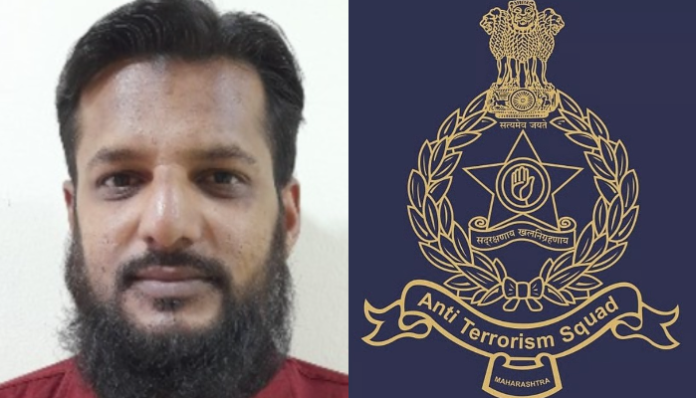
In a major anti-terror operation, the Maharashtra Anti-Terrorism Squad (ATS) on Monday (October 27) arrested a 33-year-old software engineer, Zubair Hangargekar, from Pune’s Kondhwa area for his connections with the banned Pakistan-based terror group Al-Qaeda and for his role in the radicalisation of Indian youth.
Hangargekar, a B.Tech graduate from Solapur, is a trained software tester and database developer employed at an IT company in Kalyani Nagar, Pune. He was arrested after being under ATS surveillance for over a month. Following his arrest, he was produced before a Special UAPA Court, which remanded him to police custody till November 4.
According to ATS officials, the accused had been promoting extremist ideologies and was in contact with handlers linked to global terror organisations. During the search operations at his residence, investigators seized Al-Qaeda literature, Osama Bin Laden’s speeches, and digital material suspected to be used for radicalisation and possible recruitment activities.
“Our initial findings suggest that the accused was actively consuming and sharing extremist content. We are verifying his communication channels to ascertain whether he was in direct contact with Al-Qaeda operatives,” said a senior ATS officer.
The ATS also recovered photos of the accused posing with an AK-47 rifle and making explosives, along with bomb-making manuals stored on his digital devices. Officials have sent multiple laptops, hard drives, and mobile phones for forensic analysis to trace communication patterns and potential links with overseas handlers.
Sources quoted in media said that the operation was connected to a larger ongoing investigation stemming from raids conducted on October 9 across Pune, during which officers seized 19 laptops and 40 mobile phones from various locations. The data obtained during those raids led to suspicions about Hangargekar’s involvement.
ATS teams reportedly tracked Hangargekar’s movements after he returned from a social event in Chennai. He and some associates were detained at Pune Railway Station on October 27 before being formally arrested.
Previous Raids and National Context
Earlier this month, Pune ATS had carried out raids at over 25 locations in the Kondhwa area as part of a probe into terror funding and radicalisation. Investigators believe that digital networks promoting extremist ideologies are expanding across India, leveraging social media and encrypted apps for communication.
This latest arrest comes amid a series of similar operations nationwide. In October, the Delhi Police and Bhopal ATS had arrested two radicalised youths, Md Adnan Khan alias Abu Muharib (19) from Delhi and Adnan Khan alias Abu Mohammad (20) from Bhopal, for links with the Islamic State (IS). The duo, according to intelligence sources, had been radicalised online and were reporting to a handler based in Syria.
Intelligence Bureau (IB) officials suggest that terror outfits like Al-Qaeda and ISIS, despite losing territorial control, have strengthened their digital propaganda networks. Their India-linked operations are reportedly coordinated from Syria and Pakistan, where handlers use encrypted platforms to communicate with potential recruits.
Data shows that ISIS carried out 115 global attacks this year, up from 72 last year, signaling a resurgence of transnational jihadist activity. Indian agencies remain on high alert as online radicalisation and lone-wolf-inspired extremism continue to pose significant threats.
ATS confirmed that forensic experts are examining the seized digital evidence, including encrypted messages, videos, and documents. Investigators are also probing whether Hangargekar was part of any larger recruitment or financing module linked to foreign-based handlers.
Authorities have not ruled out more arrests in the coming days as leads from the seized material are analysed. The case, registered under the Unlawful Activities (Prevention) Act (UAPA), continues to be one of the most significant counter-terror developments in Maharashtra in recent months.
“The nature of digital footprints and the extent of communication recovered so far suggest that this is not an isolated case. We are investigating whether he radicalised others or planned attacks,” the officer added.
Zubair Hangargekar’s arrest shows the deepening challenge of digital radicalisation in India, where educated youth are increasingly being drawn into extremist networks. As the ATS broadens its investigation, the focus remains on dismantling these online terror ecosystems that exploit social and technological vulnerabilities to spread global jihadist ideologies.
















Comments