





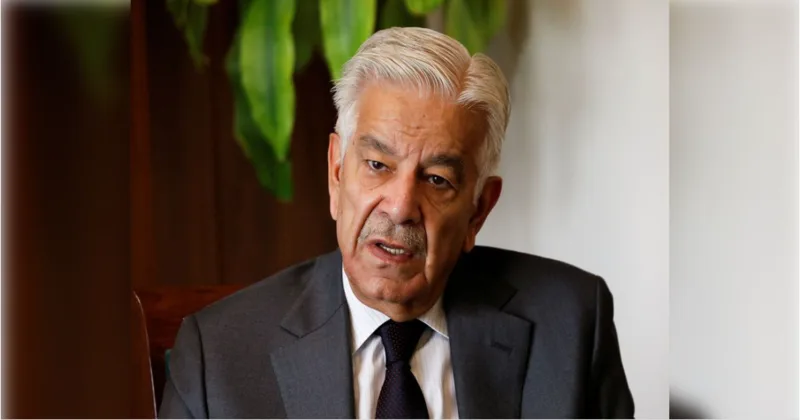
Pakistan Defence Minister Khawaja Asif has said that Islamabad would strike “deep into Afghanistan” if Afghan soil was used to launch terror attacks on Pakistan. His ultimatum and threat to the Taliban regime in Kabul came on Wednesday after the collapse of the peace parleys between Pakistan and the Afghan negotiators.
In a pre-dawn announcement, Pakistan’s Information Minister Attaullah Tarar said the latest round of talks between the two countries in Istanbul (Turkiye), which aimed to address cross-border terrorism emanating from Afghan soil “failed to bring about any workable solution”. Hours later, Pakistan’s Defence Minister Khwaja Asif said: “We will conduct strikes, we definitely will.” Asif was speaking to reporters at Parliament House who asked him about the options available for Pakistan in case of cross-border attacks from Afghanistan, according to a Dawn report.
The basic reason for the collapse of the talks was the strident rhetoric that the Pakistan used during the talks. Its negotiators gave their counterparts an ultimatum for “convening a Tehrik Taliban Pakistan (TTP) Shura within 72 hours or acting unilaterally’’. This was taken as an affront by the Taliban regime which responded: “You declare war and we retaliate. Islamabad is not safe.’’
It is being said that Islamabad’s negotiators provided a list of 47 TTP commanders who, they said, must be handed over to Pakistan by Kabul. As if these commanders all obeyed and were easily available to the Taliban regime! It all looks like that the coming days can see bloody clashes along over 2,600 km between the two nations. The Taliban negotiators, on the other hand, wanted guarantees that Afghanistan’s air space will not be violated, something Pakistan was not even willing to discuss.
Afghan Refugees
In the immediate reaction to the Taliban response, Pakistan has reactivated its counter insurgency Operation Azm e Istehkam (Phase II) and notified the United Nations of its plans to forcibly evict/repatriate 1.7 million (17 lakh) Afghan refugees by December 2025. The Taliban, in turn, deployed additional forces along the Durand Line which separates the two countries. The Taliban also issued a fatwa, describing Pakistan’s actions as a “jihad trigger’’.
Meanwhile, Taliban officials have said that the Afghans were not afraid of fighting and will teach Islamabad a lesson like never before.
“If their territory is used and they violate our territory, then, if we need to go deep into Afghanistan to retaliate, we surely will,” he added. Earlier, when the second round of talks had begun between the two sides on October 25, Asif had warned that failure to reach an agreement would mean “open war”.
Speaking about the collapsed talks, Asif said, “Kabul was not sincere at any level for any arrangement. On the directives of India and by becoming its proxy, Fitna al-Hindustan (official Pakistani name for Tehrik Taliban Pakistan or TTP) wants to leverage its position over Pakistan through Afghanistan.”
He added, “The entire leadership of Kabul is playing in the hands of India.” The minister noted that working groups from both Pakistan and Afghanistan were present in Istanbul. He added that despite an agreement being close, Kabul prevented it.
“Again and again, whenever something was finalised and an agreement was drafted — this happened three or four times I think — they contacted Kabul and a ‘no’ came from Kabul, because of which we could not reach an agreement with them,” Asif said giving reasons for the failed talks.
He further said that if those in Kabul had chosen the path of confrontation, then “so be it”. Speaking about the persistent issues during the recent dialogue, Asif said the other side acknowledged that the banned Tehreek-i-Taliban Pakistan (TTP) must be stopped from carrying out attacks and “that they use our (Afghan) soil”.
“They were agreeing with everything but were not ready to give in writing,” the defence minister said. Responding to a query, Asif stated that including TTP in the talks was not discussed. “Even if they had said so, it would have been a total refusal from us,” he asserted.
The minister went on to say that even the mediators — Qatar and Turkiye — now knew about Kabul’s intentions and insincerity. “We made this attempt with full sincerity so that Pakistan and Afghanistan can live in peace as good neighbours. But if they have handed over their reins to Delhi, then this will be difficult,” he added.
“It can only be prayed, [but] there’s no medicine,” Asif quipped, when asked about the likelihood of better sense prevailing.
Afghanistan Status
The minister said the legitimate status of the Afghan Taliban as the government was not clear and did not have international recognition, except for a few countries. “That government does not have its writ in the entire Afghanistan. Afghanistan is practically shattered into pieces, where one or the other influential terrorist group … there is a congregation of international terrorism there,” Asif said.
The defence minister said Afghanistan neither “fulfils the definition of a state” nor did the interim administration consider it so. “They are the ones who are involved in the killings, and they are taking financial benefits by being the rulers.”
Asked whether the Afghan Taliban were taking their country towards a similar situation as the United States’ military operation in Tora Bora in December 2001, Asif said, “It is definitely a possibility.”
Asif’s latest remarks come hours after he issued a strongly worded warning to the Taliban rulers in Kabul, telling them to test Islamabad’s resolve at their “own peril and doom” if they wished to do so. “We have borne your treachery and mockery for too long, but no more. Any terrorist attack or any suicide bombing inside Pakistan shall give you the bitter taste of such misadventures. Be rest assured and test our resolve and capabilities, if you wish so, at your own peril and doom,” Asif posted on social media platform X.
Threats, Warnings
The defence minister said that Pakistan had indulged in talks to give peace a chance on the request of brotherly countries, who were persistently being beseeched by the rulers in Kabul, however, “venomous statements by certain Afghan officials clearly reflect the devious and splintered mindset of Taliban regime”.
Asif said: “Let me assure them that Pakistan does not require to employ even a fraction of its full arsenal to completely obliterate the Taliban regime and push them back to the caves for hiding. If they wish so, the repeat of the scenes of their rout at Tora Bora, with their tails between the legs, would surely be a spectacle to watch for the people of the region.”
Asif further accused the Taliban rulers in Kabul of “blindly pushing Afghanistan into yet another conflict, just to retain its usurped rule and maintain the war economy that sustains them”.
He said: “Despite fully knowing their inherent limitations and hollowness of their war cries, they are beating the war drums to maintain their crumbling facade. If the Afghan Taliban regime is madly hell-bent upon ruining Afghanistan and its innocent people once again, then so be it.”
In his post, Asif also referred to the phrase “graveyard of empires” used for Afghanistan in connection with the historical instances of several nations failing to conquer the country. “As far as the narrative of ‘graveyard of empires’, Pakistan certainly doesn’t claim it to be an empire but Afghanistan is definitely a graveyard, surely for its own people. Never a graveyard of empires but certainly a playground of empires you have been throughout history,” Asif commented.
He said the “war mongers amongst the Taliban regime, who have vested interests in the continuation of instability in the region, should know that they have probably misread our resolve and courage”.
“If the Taliban regime wants to fight us, the world will Insha Allah (God willing) see that their threats are only circus!”
UN Concern
In a separate development, the United Nations (UN) voiced concern over the collapse of talks between Pakistan and Afghanistan, hoping that the “fighting will not renew”. UN spokesperson Stephane Dujarric was asked about the collapse of the negotiations and whether it was a concern for the UN.
“Yes, it is, of course. We very much hope that even if the talks are on pause, the fighting will not renew,” he said at UN Headquarters in New York.
After the initial skirmish on October 11, multiple others took place along the Pakistan-Afghanistan border. Meanwhile, strikes by Islamabad also targeted Gul Bahadur group camps in Afghanistan. Incidentally, Pakistan has consistently accused Afghanistan of sheltering Tehrik Taliban Pakistan (TTP) on its territory, an accusation constantly repelled by Kabul.











Comments