





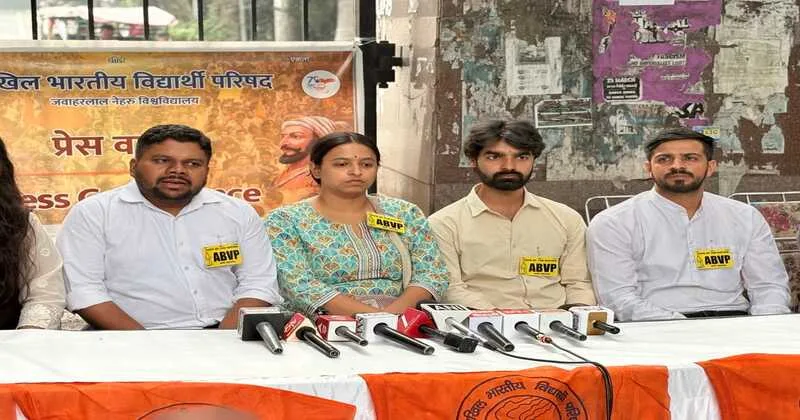
NEW DELHI: Akhil Bharatiya Vidyarthi Parishad (ABVP) has announced its candidates for the Jawaharlal Nehru University Students’ Union (JNUSU) elections. For the central panel, ABVP has nominated Vikas Patel for the post of President, Tanya Kumari for Vice President, Rajeshwar Kant Dubey for General Secretary, and Anuj for Joint Secretary. In addition, ABVP has declared its candidates for 42 councillor seats across the university’s 16 schools and various special centres, as well as for three IC positions, with special emphasis on women’s representation.
In this election, ABVP will reach out to students on key issues such as improvement of campus infrastructure, women’s safety, affordable and quality education, and the establishment of a more active and accountable students’ union — while also highlighting its constructive and issue-based activism during its previous tenure in the union.
Central Panel Candidates
President: Vikas Patel
Profile: Vikas Patel hails from Maharajganj district in Uttar Pradesh. He earned his Bachelor’s and Master’s degrees in Korean Language from Jawaharlal Nehru University (JNU). In addition, he holds a Master’s degree in Political Science. He is currently a third-year Ph.D. research scholar at JNU and has qualified the National Eligibility Test (NET). Vikas has been actively associated with the Akhil Bharatiya Vidyarthi Parishad (ABVP) since 2014. He contested the Councillor elections from the School of Language in 2016 and 2017. He has previously served as the Unit Secretary of ABVP, JNU, and is presently serving as the Vibhag Sanyojak at JNU and Joint Secretary of ABVP-Delhi.
Vice President: Tanya Kumari
Profile: Tanya Kumari hails from Munger district in Bihar and comes from a rural background. She completed her undergraduate studies in Philosophy from Miranda House, University of Delhi. Subsequently, she obtained her Master’s degree in Sociology from the Centre for the Study of Social Systems, Jawaharlal Nehru University (JNU). She is presently pursuing her Ph.D. in Sociology from the same centre. Tanya has been an active member of the Akhil Bharatiya Vidyarthi Parishad (ABVP) since 2019. In 2024, she contested the JNUSU elections as an ABVP candidate for the position of Councillor from the School of Social Sciences. She is an articulate speaker and a talented writer, who takes pride in representing and promoting the rich cultural traditions of Bihar.
General Secretary: Rajeshwar Kant Dubey
Profile: Rajeshwar Kant Dubey hails from Gorakhpur, Uttar Pradesh. He completed his Bachelor’s and Master’s degrees from the Centre of Russian Studies, School of Language, Literature and Cultural Studies, Jawaharlal Nehru University (JNU). He is currently pursuing his research at the Centre for Russian and Central Asian Studies, JNU. Rajeshwar represented India as a Cultural Ambassador at the World Youth Festival held in Sochi, Russia. In the past, he has also been an active member of the National Service Scheme (NSS) at JNU.
Joint Secretary: Anuj
Profile: Anuj hails from Jind district in Haryana. He completed his early education at Jawahar Navodaya Vidyalaya. Anuj earned his Bachelor’s degree in Physics from Ramjas College, University of Delhi, his Master’s degree from Maharshi Dayanand University, and a B.Ed. from Kurukshetra University. He has successfully qualified the CTET, HTET, and JRF examinations. At present, Anuj is pursuing his Ph.D. in Physics from the School of Physical Sciences, Jawaharlal Nehru University (JNU).
Among the 16 schools, ABVP’s councillor candidates have achieved unopposed victories in two schools. From the School of Life Sciences, Ayushi Bajaj and Himanshu, and from the Special Centre for Molecular Medicine, Govardhan Singh, have been elected unopposed. These victories reflect the deep trust of students in ABVP’s leadership and the growing acceptance of the organisation across the campus.
ABVP firmly believes that the Left-led JNUSU’s failures have severely affected the university’s academic quality, infrastructural development, and democratic discourse. During the past term, negligence of student interests, growing disorder in the campus, and the deterioration of the academic environment have raised serious concerns. In response, ABVP is presenting an alternative leadership — one that not only identifies the problems but also ensures practical solutions. ABVP had earlier won the post of Joint Secretary in the last JNUSU elections.
Speaking about the upcoming elections, Arun Srivastava, the Chief Campaign Coordinator of ABVP JNU, said, “Last year, ABVP made history by winning the post of Joint Secretary in the JNUSU and transformed that responsibility into a continuous struggle for student welfare. This year too, we are entering the elections with the spirit of dialogue, service, and organisation. Our goal is to strengthen JNU academically, ensure the safety of female students, and make quality education affordable for all. ABVP has always stood for constructive politics and responsible student leadership, and this remains our unwavering commitment in this election as well.”
Shalini Verma, National Secretary of ABVP, said, “The panel of Akhil Bharatiya Vidyarthi Parishad (ABVP) have been securing victories across universities in the country, including HCU, Guwahati, and Punjab. This is clear evidence that the student community of the nation now firmly stands with nationalist and constructive student politics. After Vaibhav Meena’s victory in JNU, the ABVP initiated several concrete steps such as the reopening of the railway reservation counter, improving student facilities, and upgrading campus infrastructure — whereas leftist organisations, despite years of political dominance, have failed to deliver anything meaningful for students. Today, the ABVP, strengthened by students’ faith and performance, is setting a new direction for student politics across India.”
Sarthak Sharma, State Secretary of ABVP-Delhi, said, “The ABVP continues to move forward with conviction on the ideology of nationalism, service, and positive student politics. Our politics is not of confrontation but of constructive nation-building — rooted in pride for the nation, a sense of duty, and unwavering commitment to student welfare. This very ideology has become the foundation of ABVP’s victories across other universities, and the same wave is now visibly rising in JNU. The growing enthusiasm and trust towards ABVP within the campus clearly indicate that this time, the ABVP will secure a historic 4–0 victory, sending a strong message to the Left that nationalist thought now defines the new direction of student politics.”
Vikas Patel, Presidential Candidate of ABVP stated, “JNU has long been regarded as a Leftist stronghold, but the campus atmosphere is rapidly transforming. Students have rejected the negative politics of the Left and have reposed their faith in ABVP’s nationalist, constructive, and student-centric approach. Today, the entire campus resonates with a common sentiment — of change, confidence, and decisive support for the ABVP.”
Tanya Kumari, Vice-Presidential Candidate, said, “The neglect of women’s representation and health facilities in JNU is deeply concerning. The absence of a regular gynaecologist at the Health Centre has caused serious difficulties for female students. The university must immediately appoint a full-time gynaecologist as a mark of accountability towards women’s health and dignity.”
Rajeshwar Kant Dubey, Candidate for Secretary said, “We strongly oppose authoritarian measures such as the CPO Manual, which attempt to suppress students’ democratic rights and freedom of dissent. The Vice-Chancellor’s decision to cancel nominations, coupled with rising cases of corruption within the university, exposes the administration’s biased and unethical approach. Such an assault on JNU’s democratic traditions will not be tolerated under any circumstances.”
Anuj Damara , Candidate for Joint Secretary, added, “The lack of sports facilities and the neglect of the sports quota are severely restricting students’ potential, while science students continue to struggle with inadequate laboratory resources and technical support. The university must modernise its infrastructure in both sports and science, integrating AI-supported technologies and creating greater opportunities for students.”















Comments