





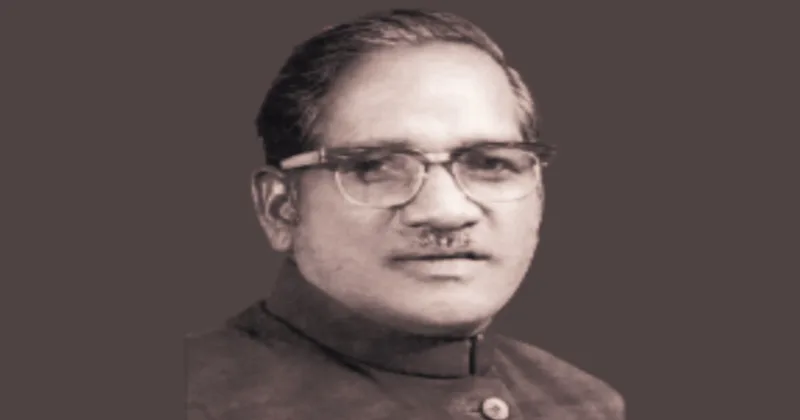
As India celebrates the centenary birth anniversary of Baba Kartik Oraon on October 29, the nation remembers a towering yet often forgotten leader — a man who rose from the heart of Jharkhand’s tribal belt to become the voice of India’s Vanvasis (forest-dwelling communities) in Parliament. A statesman, educationist, and nationalist thinker, Oraon dedicated his life to the upliftment of tribal society while championing the cause of cultural and spiritual continuity amid the turbulent politics of post-Independence India.
Though a senior leader of the Indian National Congress, Kartik Oraon’s commitment to dharmic and national ideals often placed him at odds with his own party’s leadership. His legacy lies not only in his developmental work for the tribals of central India but also in his bold resistance to religious conversion movements that he believed threatened the cultural fabric of India’s indigenous population.
From Gumla to Delhi: The Journey of a Trailblazer
Born in 1924 in a small village in present-day Jharkhand’s Gumla district, Kartik Oraon came from humble beginnings. At a time when very few from the tribal community even had access to basic education, he pursued higher studies with remarkable determination — eventually earning engineering degrees from the United Kingdom. This academic journey made him one of the first tribal Indians to study abroad, and he returned home with a deep conviction that education was the key to empowerment for his people.
Oraon’s rise in public life began in the 1950s, during the consolidation of India’s democracy. He emerged as a strong advocate for tribal welfare, contesting elections from Lohardaga in Bihar (now Jharkhand). He won multiple terms in the Lok Sabha — in 1967, 1971, and again in 1980 — and went on to serve as Union Minister for Civil Aviation and Communications. On December 8, 1981, he passed away suddenly in Parliament due to a heart attack, leaving behind a legacy of principled politics rooted in service and self-respect.
A Congress Leader with a Nationalist Soul
Though a lifelong Congressman, Kartik Oraon represented a stream of thought within the party that put nation before organization. He belonged to the same ideological lineage as Sardar Vallabhbhai Patel, Lal Bahadur Shastri, Madan Mohan Malaviya, and Purushottamdas Tandon — leaders who upheld India’s civilizational values while working within the Congress framework.
Yet, much like these figures, Oraon’s memory today receives little acknowledgment from the Congress itself. His centenary, like theirs, passes largely unnoticed in party circles — an omission that reflects the wider amnesia around nationalist Congressmen who refused to compromise their convictions for political expediency.
For Oraon, the Congress was a platform to serve India’s tribals, not an end in itself. He believed that mainstream participation was essential to bring development and dignity to forest communities, even as he remained vocal against the party’s growing indifference to issues of cultural erosion and forced religious conversions.
A Fierce Voice Against Religious Conversions
One of Kartik Oraon’s most courageous stands came in 1967, when he introduced a private member’s bill in Parliament — The Scheduled Castes and Scheduled Tribes (Orders) Amendment Bill, 1967. The bill sought to address a sensitive but pressing issue: the misuse of constitutional benefits meant for Scheduled Tribes by individuals who had converted to other religions.
The crux of the proposed amendment was simple yet far-reaching — that those who had renounced their traditional tribal faith and embraced Christianity or Islam should no longer be entitled to benefits reserved for Scheduled Tribes. In his view, affirmative action was designed to uplift socially and economically disadvantaged communities within the Hindu fold, not to perpetuate religious exploitation under the guise of equality.
The bill went through a Joint Parliamentary Committee, which, after two years of deliberation, submitted its report in November 1969 supporting Oraon’s position. The committee recommended that converts to other religions be excluded from the Scheduled Tribe list — a move that was both constitutionally sound and socially necessary, according to Oraon.
However, the proposal provoked an intense backlash from missionary organizations and their political allies. Reports suggest that more than fifty Members of Parliament influenced by Christian missions petitioned then Prime Minister Indira Gandhi to reject the amendment. Under mounting international and domestic pressure, the government hesitated.
The Battle in Parliament
On November 16, 1970, the Lok Sabha began debating Oraon’s bill. As the discussion gained momentum, even Congress MPs appeared sympathetic to his reasoning. The atmosphere grew charged — and for a moment, it seemed India was on the verge of taking a decisive step toward protecting the integrity of its tribal communities.
But the political establishment moved swiftly. The next day, the government introduced a counter-amendment deleting the Joint Committee’s recommendations. On November 24, when Oraon was to speak in defense of his bill, a Congress whip instructed MPs to vote against it. Defying the directive, Oraon delivered a stirring 55-minute speech that reportedly swayed several members toward supporting him.
Realizing the shifting tide, Prime Minister Indira Gandhi adjourned the debate, promising to take it up later. Before that could happen, Parliament was dissolved on December 27, 1970. The bill lapsed — and with it, one of the boldest legislative efforts to safeguard India’s tribal heritage from organized conversion campaigns.
“Bees Varsh Ki Kaali Raat”: A Testament to Resistance
Disillusioned but undeterred, Kartik Oraon chronicled his experiences in a powerful book titled Bees Varsh Ki Kaali Raat (“Twenty Years of Darkness”). In it, he exposed the systematic efforts of missionary organizations to alter the demographic and cultural identity of India’s tribal regions.
He wrote with clarity and conviction: “The definition of Scheduled Castes and Tribes has always been rooted in the Hindu social structure. Those who abandon the Hindu faith cease to belong to these groups. Granting them the same privileges is unconstitutional and unjust.”
Oraon warned that the scale of conversions in independent India had surpassed that of 150 years of British rule — citing that in Manipur, the proportion of Christian tribals had grown from 7 percent in 1947 to nearly 70 percent by the late 1960s. His arguments were not communal but constitutional — he viewed tribal identity as part of the greater Indic civilizational continuum, distinct yet inseparable.
Champion of Tribal Pride and Hindu Identity
Kartik Oraon’s nationalism was deeply spiritual. He maintained close ties with organizations like Vanvasi Kalyan Ashram, founded by Balasaheb Deshpande, which worked for tribal education and self-reliance. While Congress leaders viewed this association with suspicion, Oraon saw no contradiction — he believed tribal dharma and Hindu dharma were intertwined.
He often reminded his people that the tribal tradition of worshipping nature, ancestors, and local deities was part of the same civilizational stream that revered Lord Ram, Krishna, and Jagannath. To prove this, he once convened a gathering of traditional tribal priests — pahans, gaon budhas, tana bhagats — and asked them to recite the songs sung during births, marriages, and festivals. The verses, he noted, were filled with names from the Ramayana and Mahabharata — a living testament to the unity of faith and culture.
In his speeches, Oraon would say: “Long before the coming of Jesus, our communities had Nishadraj Guha, Mata Shabari, and Kannappa — the true symbols of devotion. We were Hindus then, and we remain Hindus today.”
Legacy of a Forgotten Leader
Kartik Oraon’s untimely death in 1981 silenced a rare and principled voice in Indian politics. He had combined modern education with indigenous wisdom, and political pragmatism with moral courage. For him, the empowerment of tribals meant not just economic upliftment but also protection of their spiritual roots.
Yet, four decades later, his contributions remain largely unacknowledged in mainstream political discourse. The Congress, to which he gave his entire career, seldom remembers him. His centenary year passes with quiet observance in Jharkhand’s villages, where people still revere him as Baba Kartik Oraon — a saintly figure who fought for their dignity and faith.
In an era when identity politics often divides rather than unites, Oraon’s life offers a profound lesson: that the assertion of tribal identity need not come at the cost of national unity. His was a vision of empowerment rooted in belonging — to the soil, the culture, and the civilizational spirit of Bharat.














Comments