





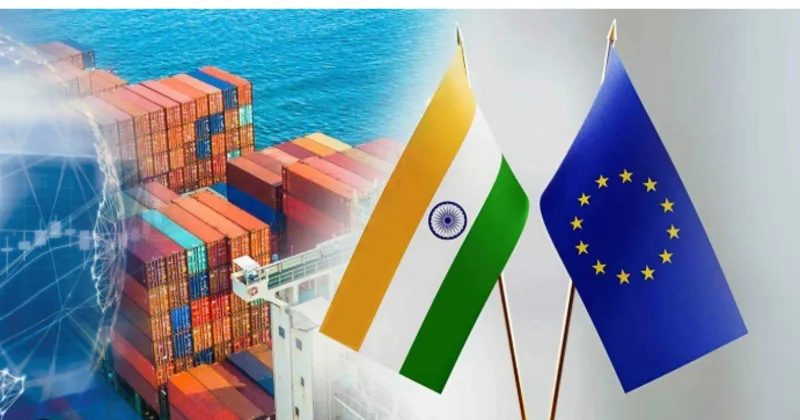
The negotiations between India and the European Union (EU) on a long-pending Free Trade Agreement (FTA) have entered a decisive phase, and recent engagements suggest that both sides are serious about delivering a win-win outcome. During his visit to Brussels on October 27–28, India’s Commerce and Industry Minister Piyush Goyal described the talks with EU Trade and Economic Security Commissioner Maros Sefcovic as “intense but very productive”, emphasising that both sides have significantly reduced the outstanding issues and created the framework that will help deliver a win-win for both the economies.
From the Indian side, this is a welcome turn-of-events. Political impetus has clearly increased; Prime Minister Narendra Modi and European Commission President Ursula von der Leyen have directed their teams to aim for a year-end conclusion of the deal.
In terms of progress, the Indian-EU team has logged several encouraging developments. In the recent 14th round of talks, held in early October, the negotiating teams worked through a number of issues and built momentum. Minister Goyal said that the talks have significantly reduced the outstanding issues and that an EU delegation will visit India next week to conclude the technical tariff negotiations. Further, a detailed statement noted that the upcoming EU technical team, led by DG Trade Sabine Weyand, will visit New Delhi to achieve a constructive conclusion based on the potential solutions identified over the past two days.
Among the key negotiation tracks currently being handled: tariffs on industrial goods, non-tariff measures (NTMs), rules of origin, investment protection, services market access and new regulatory requirements such as the EU’s Carbon Border Adjustment Mechanism (CBAM). On tariffs, sensitive sectors such as automobiles, steel and the auto-component ecosystem remain under discussion. The EU side has pushed for deeper liberalisation here; India is seeking preferential access for labour-intensive and export-oriented sectors such as textiles, leather, pharmaceuticals and steel. On non-tariff barriers, India has raised concerns about new EU regulations and insisted on safeguarding its labour-intensive sectors and services exports. The recent joint statement emphasised that both parties agreed to work closely to finalise non-sensitive industrial tariff lines while further dialogue is required on high-sensitivity items such as CBAM, autos and steel.
As for the pace of discussion, there is reason to be optimistic. India and the EU have clearly accelerated their engagement: three rounds of high-level talks in just 35 days earlier this year signalled political urgency. With the Brussels visit by Minister Goyal, the narrowing of outstanding issues and the scheduled follow-up by the EU technical delegation in New Delhi, the timeline towards year-end looks viable, though not without its challenges. Both sides remain committed to wrapping up the FTA by December 2025.
For India, the positive implications of concluding this FTA are significant. The EU is already its largest trading partner in goods. A balanced agreement would offer Indian exporters tariff relief and enhanced market access in high-value sectors, while deepening investment flows and technology collaborations. In particular, the deal promises to reinforce India’s strategy of “Make in India”, boost job-creation in manufacturing and services, and integrate Indian firms more systematically into global value chains anchored in Europe. On the flip side, Indian consumers and firms would gain from cheaper imports of key industrial equipment, advanced technologies and supply-chain diversification.
Moreover, achieving this FTA at this juncture has strategic value. With the global trade environment being reshaped by regional blocs and supply-chain shifts, India’s alignment with the EU bolsters its diversification from traditional markets and reduces over-dependence. The deal also signals India’s readiness to engage with developed-economy regulatory regimes and sustainability standards, enhancing its global trade credibility.
Importantly, beyond tariffs and trade flows, the discussions are creating structural frameworks for trade facilitation, investment protection, intellectual property rights (IPR), digital trade and sustainability. For instance, earlier rounds of negotiations had already finalised several chapters—such as those on IPR and customs/trade facilitation. This groundwork ensures that the eventual agreement will be more than just tariff cuts; it will create a modern trade architecture for bilateral economic engagement.
On measures being taken to glue the deal together: politically, senior-level engagements have ramped up, as evidenced by Goyal’s Brussels visit and his meeting with German Foreign Minister Johann Wadephul ahead of those talks. Technically, the negotiating teams have moved to sector-specific sessions, helping identify landing zones in sensitive sectors. For India, the emphasis on labour-intensive exports and ensuring that the agreement is robust and balanced, indicates a more pragmatic negotiating stance rather than purely concessional. On the EU side, the commitment of their technical team to visit India to conclude tariff discussions demonstrates operational follow-through. There is also clear transparency in acknowledging the remaining issues: the communiqué candidly states that sectors such as steel, autos and the CBAM framework still require further discussion.
The deadline set towards the end of 2025 requires focus on the imperatives, the current momentum suggests it is achievable, provided neither side allows sensitive issues to derail the deal. India will need to ensure that its requests on textiles, pharmaceuticals and other labour-intensive sectors are adequately addressed, while the EU will expect credible progress on items such as autos, dairy, and new regulatory frameworks. If the technical team in New Delhi can settle tariff lines and agree on the next steps for the remaining sensitive areas in the coming weeks, the pact could indeed be delivered by year-end.
The India-EU FTA negotiations are now in a promising phase: both sides have signalled commitment, most chapters are increasingly near landing, and the political impetus is strong. For India, the prospective benefits are manifold, from export expansion and value-chain integration to enhanced investment, technology access and global trade stature. The coming weeks will thus be crucial in converting this momentum into a concrete conclusion, and if the current pattern holds, India may well be on the cusp of securing one of its most significant trade agreements in recent history.












Comments