





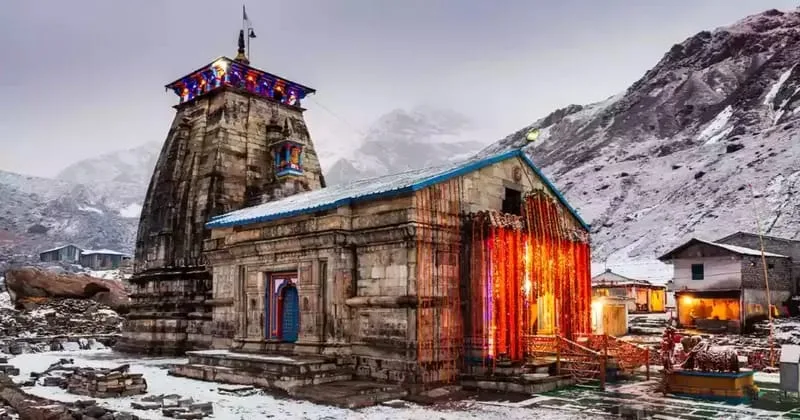
On the morning of October 23, 2025, as the first rays of sunlight touched the snow-dusted peaks of the Garhwal Himalayas, an emotional scene unfolded at the sacred Kedarnath Mandir. Over 10,000 devotees, wrapped in shawls against the morning chill, gathered to witness a tradition as old as time itself, the closing of Baba Kedar’s doors for the winter season. The air resonated with the chants of “Jai Baba Kedar” and “Om Namah Shivay” as the Indian Army band played devotional tunes, marking the end of what has been the most successful pilgrimage season in Kedarnath’s history.
The sacred portals closed at precisely 8:30 am on the auspicious occasion of Bhai Dooj, after 175 days of continuous worship and unprecedented devotion. This year’s Kedarnath Yatra shattered all previous records, welcoming 17.68 lakh pilgrims an increase of 1.25 lakh devotees compared to 2024’s count of 16.52 lakh. The Mandir, adorned with 1,200 kilograms of fresh flowers for the occasion, stood as a beautiful symbol of faith that continues to unite millions of hearts across the world.
As Chief Minister Pushkar Singh Dhami personally oversaw the ceremonial closure and the departure of the Panchmukhi Utsav Doli carrying Bhagwan Kedarnath’s murti to its winter abode in Ukhimath, there was a palpable sense of accomplishment mixed with emotional farewells. For the people of Uttarakhand, this moment represents far more than the end of a pilgrimage season; it consists of itself the culmination of years of dedicated effort, reconstruction, and a vision to restore Devbhoomi to its former glory while ensuring the livelihoods of thousands who depend on this sacred journey.
A record-breaking pilgrimage season
The 2025 Char Dham Yatra stands as a landmark achievement in Uttarakhand’s spiritual and economic history. With over 50 lakh pilgrims visiting the four sacred shrines of Kedarnath, Badrinath, Gangotri, and Yamunotri, this year’s pilgrimage season exceeded all expectations. The success is even more remarkable considering the challenges posed by natural calamities, including landslides in the Kedarghati region during the monsoon season. District Magistrate of Rudraprayag, Prateek Jain, confirmed that the yatra was highly successful and well-organised, with smooth operations maintained throughout the season despite occasional weather disruptions. The Badrinath-Kedarnath Mandir Committee President, Hemant Dwivedi, emphasised that “apart from the recent natural disaster, the yatra this season was smooth and safe,” highlighting the effectiveness of the comprehensive safety measures implemented by the state government. What makes these numbers truly inspiring is the human story behind each statistic. Every one of those 17.68 lakh pilgrims represents an individual who braved the challenging 16-kilometre trek from Gaurikund or took helicopter services to seek the blessings of Baba Kedar. From elderly devotees in their eighties fulfilling lifelong dreams, to young families introducing their children to their spiritual heritage, to foreign visitors seeking the mystical experience of the Himalayas, Kedarnath welcomed them all with open arms. The closing ceremony of Kedarnath Mandir is not merely an administrative ritual but a deeply spiritual experience that touches the hearts of everyone present. In the pre-dawn hours of October 23, as temperatures dipped and a gentle snowfall graced the sacred town, devotees who had travelled from across India gathered for one last darshan of the season.
Chief Pandit Bagesh Ling, along with other Acharyas and Mandir officials, entered the Garbhagriha (inner sanctum) through the eastern gate at around 5:00 am to perform the sacred Samadhi Puja. The ritual involved covering the self-manifested Shivling with a protective layer of local flora, including Kumja, Bukla, sacred ash, dried Brahma Kamal flowers, and leaves, a tradition that symbolises the deity entering a six-month period of meditation and spiritual rejuvenation. For the devotees present, witnessing this ancient ceremony was profoundly moving. Many had tears streaming down their faces as they realised this would be their last glimpse of Baba Kedar for six months. The atmosphere was charged with emotion—a beautiful mixture of gratitude for the blessings received, sadness at the parting, and reverence for the divine presence that permeates every stone of this sacred place.
As one pilgrim shared on social media, “At 5:30 am, under a gentle snowfall, we witnessed the last darshan of bhagwan Shiva before the Mandir closed for the winter season. The ancient shrine, glowing in the cold Himalayan dawn, felt like a moment suspended between heaven and earth pure divinity and calm”. Such testimonials from devotees capture the transformative spiritual experience that Kedarnath offers, an experience that goes beyond mere tourism to touch the very soul. The Panchmukhi Utsav Doli, carrying the five-faced idol of Baba Kedar, then began its traditional journey to the winter abode at Omkareshwar Mandir in Ukhimath, accompanied by the resonating sounds of the Army band and jubilant chants from thousands of devotees. The procession made its first halt at Rampur, followed by an overnight stay at the Vishwanath Mandir in Guptkashi, before arriving at Ukhimath on October 26, where it will remain for the next six months.
Government Initiatives: Building infrastructure for the divine
The unprecedented success of the 2025 Kedarnath Yatra is no accident but it is the result of years of systematic planning, infrastructure development, and visionary leadership under Chief Minister Pushkar Singh Dhami and Prime Minister Narendra Modi. The reconstruction and redevelopment of Kedarnath, following the devastating 2013 flash floods, stands as a testament to the government’s commitment to restoring the spiritual and economic heart of Uttarakhand.
After the 2013 disaster that killed thousands and destroyed much of Kedarnath town, Prime Minister Modi took a personal interest in the reconstruction of this sacred site. Chief Minister Dhami has repeatedly credited PM Modi’s vision for the successful completion of the grand reconstruction of Kedarpuri, which involved an investment of Rs 750 crores. The reconstruction wasn’t just about rebuilding structures but about reimagining Kedarnath as a model for sustainable pilgrimage tourism in the Himalayas. The Master Plan for Kedarnath Reconstruction and Redevelopment, currently in its second phase with 21 projects worth Rs 188 crores, focuses on creating a “forever open, clear and free” space around the shrine. This includes the development of retaining walls and ghats along the Mandakini and Saraswati rivers, construction of improved approach roads to the temple, development of the Adi Shankaracharya Kutir and Museum, and housing for the Kedarnath Teerth Purohits.
Governor Lieutenant General Gurmit Singh (Retd.), who visited Kedarnath just days before the closure, inspected the ongoing construction and development works and praised the collective efforts of the administration, Mandir committee, police officials, SDRF, and NDRF. The reconstruction has been carried out with sensitivity to the region’s ecological fragility while ensuring that pilgrims receive a safe, well-managed, and spiritually enriching experience.
The revolutionary Kedarnath ropeway project
Perhaps the most transformative infrastructure initiative is the Kedarnath Ropeway Project, approved by the Union Cabinet under Prime Minister Modi’s Parvatmala Pariyojana scheme. This Rs 4,081.28 crore project will construct a 12.9-kilometre ropeway from Sonprayag to Kedarnath using advanced 3S tri-cable Detachable Gondola technology. The impact of this project on accessibility cannot be overstated. What currently takes 8-9 hours of arduous trekking will be reduced to a comfortable 36-minute gondola ride. With a capacity to transport 1,800 passengers per hour in each direction, approximately 18,000 travellers daily, the ropeway will make the pilgrimage accessible to elderly devotees, differently-abled individuals, and families with young children who previously found the trek insurmountable.
Gautam Adani of the Adani Group, which is developing the project in partnership with National Highways Logistics Management Limited, announced on social media: “The difficult climb to Kedarnath Dham will now become easier. The Adani Group is constructing this ropeway to make the pilgrimage for devotees simpler and safer. It is a matter of pride for us to be a part of this pious endeavour”. The project, being developed under a Design, Build, Finance, Operate and Transfer (DBFOT) model, is expected to be completed in phases and will create significant employment opportunities during construction and operation.
Additionally, the government has approved another ropeway project worth Rs 2,730.13 crores, connecting Govindghat to Hemkund Sahib and covering 12.4 kilometres. Together, these projects represent a Rs 6,800 crore investment in improving pilgrim connectivity and experience across Uttarakhand’s sacred sites. Beyond the ropeway projects, the Uttarakhand government has implemented numerous infrastructure improvements to enhance the pilgrimage experience. These include the all-weather road project for Char Dham, which aims to ensure year-round accessibility to the shrines; improved helicopter services with better regulation and safety standards, allowing more pilgrims to access Kedarnath quickly; enhanced medical facilities with medical camps, rescue teams, and disaster response units stationed at strategic locations; upgraded trekking routes with better pathways, resting facilities, and weather monitoring systems; expanded accommodation options including guesthouses, homestays, and improved lodging facilities for pilgrims; and the establishment of the Chardham Yatra Authority to streamline pilgrimage management, safety, and crowd control. The ‘Green Chardham Yatra’ initiative launched for 2025 emphasises sustainability alongside development. This includes better waste management systems, control rooms for real-time yatra monitoring, enhanced water and electricity facilities, and environmental compliance measures. These initiatives reflect the government’s balanced approach to promoting pilgrimage tourism while protecting the fragile Himalayan ecosystem.
The Economic Lifeline: Why Kedarnath matters to Uttarakhand
For the people of Uttarakhand, Kedarnath is far more than a Mandir, it is the economic backbone that sustains entire communities and provides livelihoods to hundreds of thousands of families. The Char Dham Yatra contributes an estimated Rs 7,500 crores to the state economy annually, with Kedarnath alone generating revenues exceeding Rs 211 crores in 2022. This economic impact extends far beyond direct tourism revenue, creating a multiplier effect throughout the regional economy.
The economic ecosystem around Kedarnath is remarkably diverse and inclusive. The 16-kilometre trek from Gaurikund supports a network of tea stalls, eateries, and rest stops that provide income for local families throughout the pilgrimage season. Horse and mule operators, who transported over 2.27 lakh pilgrims till mid-June 2025, generated an income of Rs 66.73 crores. According to Chief Veterinary Officer Dr Ashish Rawat, approximately 8,000 horses and mules were registered for the 2025 season. Palanquin operators providing Dandi-Kandi (stretcher) services earned nearly Rs 2 crores this season, offering essential transportation for elderly or infirm pilgrims who cannot trek. Helicopter services have become a major revenue generator, with thousands of pilgrims opting for aerial darshan. Hotels and guesthouses in nearby towns like Sonprayag, Gaurikund, and along the pilgrimage route experienced full occupancy throughout the season. Ram Chandra Goswami, President of Gaurikund Vyapar Sangh, reported that with average pilgrim expenses ranging from Rs 1,500 to Rs 2,000 for lodging and food, local businesses generated approximately Rs 150 crores based on visitor numbers. Local artisans crafting religious items such as rudraksha beads, miniature lingams, and devotional souvenirs found ready customers among the millions of pilgrims. Women’s self-help groups running homestays and providing services saw significant income improvements. Guides from Garhwali communities earned livelihoods while sharing knowledge of the Mandirs history and the region’s terrain. Even environmental compliance contributed, with fines from littering and prohibited activities collecting Rs 4.17 lakh, demonstrating the administration’s commitment to preserving these sites.
The economic significance of Char Dham tourism extends well beyond the immediate pilgrimage season. The pilgrimage has created over 185,000 direct and indirect jobs across Uttarakhand, from helicopter pilots earning premium wages to local women running successful homestays. In remote mountain villages along the Char Dham routes, unemployment has dropped by 40 per cent since 2020. For every rupee spent directly on pilgrimage activities, approximately Rs 2.50 flows into the broader Uttarakhand economy through accommodation, transportation, food, shopping, and local services. This translates to a total economic impact exceeding Rs 8,000 crores, nearly double the state’s annual tourism revenue from just a decade ago. What makes Char Dham tourism particularly valuable is its sustained economic impact. Unlike seasonal beach destinations or ski resorts, Char Dham tourism creates a robust 6-month economy from April to October, with significant off-season benefits through planning, preparation, and infrastructure maintenance activities. Around 360 families of the Tirtha Purohit (Mandir pandits) from 55 villages and other nearby villages are entirely dependent on Kedarnath for their livelihood.
However, this economic dependence also highlights the vulnerability of local communities to both natural disasters and policy decisions. The 2013 floods demonstrated how a single catastrophic event could devastate the livelihoods of thousands. Similarly, when the Char Dham registration was stopped for five days in September 2025 due to bad weather and continuous rain, the economic impact on local businesses was immediate and severe. Chief Minister Pushkar Singh Dhami has recognised this reality, appealing to devotees to continue visiting the Char Dham Gaddi (winter) sites after the Mandir closures to sustain the livelihoods of local traders, homestay owners, and hoteliers during the winter months. The promotion of winter pilgrimage tourism to the deities’ winter abodes such as the Omkareshwar Mandir in Ukhimath for Kedarnath represents an effort to extend economic benefits beyond the traditional six-month season.
For the people of Uttarakhand’s mountain communities, the success of the Char Dham Yatra is not merely a tourism statistic it is the difference between prosperity and poverty, between staying in their ancestral villages and migrating to cities in search of work. This is why every infrastructure improvement, every safety measure, and every initiative to enhance the pilgrimage experience is not just about serving devotees it is about securing the economic future of Uttarakhand’s mountain communities.
A spiritual journey that transforms lives
Beyond the economics and infrastructure, Kedarnath remains fundamentally a place of profound spiritual transformation. For millions of Hindus, undertaking the Kedarnath Yatra is a once-in-a-lifetime pilgrimage that offers the possibility of moksha i.e liberation from the cycle of birth and death. The belief that visiting Kedarnath and seeking the blessings of Bhagwan Shiva can wash away sins and provide spiritual purification continues to draw devotees from across India and around the world. The spiritual significance of Kedarnath is rooted in ancient mythology and religious tradition. As one of the twelve Jyotirlingas and a part of the Panch Kedar pilgrimage, Kedarnath holds a unique position in Hindu spirituality. According to legend, the Pandavas came here seeking Bhagwan Shiva’s forgiveness after the Kurukshetra war. When Shiva eluded them by taking the form of a bull and disappearing into the ground, his hump remained visible at Kedarnath, which devotees worship today as the self-manifested Shivling. Devotees report experiencing spiritual healing at Kedarnath Dham, with the daily aartis at the temple accompanied by chants and bells echoing through the mountain valley, creating an atmosphere where they feel closer to Mahadev. The challenging trek itself is seen as a form of tapasya (penance), where physical hardship purifies the mind and prepares the devotee for divine communion.
Many pilgrims describe their Kedarnath experience as transformative. As one devotee reflected, “Kedarnath offers its devotees a profoundly mystical and deep experience, provided we approach Him with a surrendered mind and an open heart. The echoes of prayers and stunning views at Kedarnath transformed it into a transcendental experience”. Another pilgrim shared, “Every visit to Kedarnath brings a different experience, but this time in 2025, something truly divine happened. The journey itself transforms those who undertake it. It challenges physical limits while providing moments of reflection and peace”. This spiritual dimension gives meaning to all the other aspects of the Kedarnath pilgrimage. The infrastructure improvements, the economic benefits, and the government initiatives all ultimately serve the purpose of facilitating this profound spiritual encounter between the devotee and the divine.
Looking Forward: Preparing for 2026
Even as the doors of Kedarnath Mandir closed for winter 2025, preparations for the 2026 pilgrimage season have already begun. Chief Minister Dhami has directed officials to start advance planning to ensure even smoother arrangements for next year. The lessons learned from managing 17.68 lakh pilgrims in 2025, including crowd control measures, emergency response protocols, and infrastructure stress points, will inform improvements for 2026. The ongoing construction of the Kedarnath ropeway, with completion expected in phases, promises to revolutionise the pilgrimage experience within the next few years. Once operational, it will not only ease the physical burden on pilgrims but also extend the effective pilgrimage season by reducing weather-related access constraints. The state government’s emphasis on year-round tourism, including winter pilgrimage promotion, aims to transform Uttarakhand’s tourism economy from a seasonal to a more sustainable model. By encouraging devotees to visit the winter seats of the deities and developing winter tourism infrastructure, the government hopes to provide more consistent livelihood opportunities for local communities throughout the year. Environmental sustainability remains a key concern for future planning. While development is necessary to accommodate growing pilgrim numbers, it must be balanced with the need to protect the fragile Himalayan ecosystem. The ‘Green Chardham Yatra’ initiative represents recognition that long-term success requires environmentally responsible practices.
Faith, progress, and people united
The closing of Kedarnath Mandir for winter 2025 marks more than the end of a pilgrimage season; it represents a milestone in Uttarakhand’s journey toward balanced development that honours both spiritual tradition and economic necessity. The record-breaking 17.68 lakh pilgrims who visited Baba Kedar this year are a testament to the enduring power of faith and the effectiveness of systematic infrastructure development. For the people of Uttarakhand, Kedarnath’s success is deeply personal and profoundly necessary. It validates their ancestors’ choice to stay in these challenging mountain environments as guardians of sacred spaces. It provides economic opportunities that allow young people to remain in their villages rather than migrate to distant cities. It preserves cultural traditions and spiritual practices that connect modern India to its ancient heritage.
The emotional farewell witnessed on October 23, with thousands of devotees chanting “Jai Baba Kedar” as the Panchmukhi Doli began its journey to Ukhimath, encapsulated the deep bond between the people and this sacred place. As Chief Minister Dhami noted, “The Char Dham Yatra not only plays an important role in the economy of the state but also connects Devbhoomi Uttarakhand with Sanatan Dharma followers across the world”. The vision articulated by Prime Minister Modi and implemented by Chief Minister Dhami of a reconstructed, accessible, and well-managed Kedarnath that can serve millions of devotees while supporting local communities has begun to materialise. The Rs 4,081 crore ropeway project, the comprehensive infrastructure improvements, and the systematic planning for future seasons all point toward a future where the divine blessings of Baba Kedar can reach even more devotees more safely and sustainably.
As the snow begins to blanket the high Himalayas and Bhagwan Kedarnath enters his six-month samadhi at Omkareshwar Mandir in Ukhimath, the people of Uttarakhand can take pride in what has been accomplished. They can honour the memories of those lost in 2013 by showing that Kedarnath has not just recovered but has emerged stronger, more accessible, and more prepared to serve future generations of pilgrims.
The success of the 2025 Kedarnath Yatra is ultimately a story about people about devoted pilgrims who undertake challenging journeys seeking spiritual transformation, about local communities whose livelihoods depend on this sacred place, about administrators and security personnel who work tirelessly to ensure safety, about priests who maintain ancient traditions, and about political leaders who envision infrastructure that serves both divine purpose and human need. As Baba Kedar rests in his winter abode, the faith of millions remains undiminished, the work of reconstruction and improvement continues, and the anticipation builds for the day when the temple doors will open once again, welcoming devotees back to this most sacred of Himalayan shrines. Until then, the chant reverberates through the mountains and in the hearts of devotees everywhere: Jai Baba Kedar! Har Har Mahadev!















Comments