





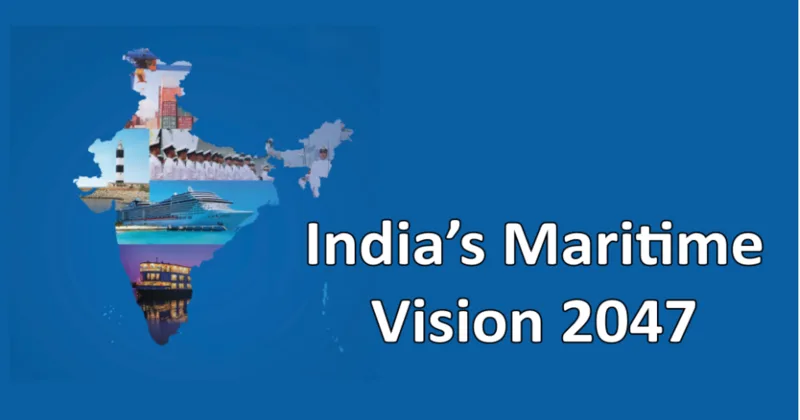
India’s recent calls to become a major maritime power by 2047 are not just political talk. They respond to a moment when geography, technology, and geopolitics come together to make the sea vital for economic security. Union ministers have set an ambitious goal: to manage about one-third of global seaborne trade by 2047, the year of India’s centenary. This goal reshapes national planning around ports, shipping, shipbuilding, logistics, and the broader “blue economy,” grounding these ambitions in solid infrastructure and policy commitments.
A credible plan must start with measurement. Global seaborne trade was around 12.7 billion tonnes in 2024, recovering after pandemic disruptions but facing slower, more unpredictable growth ahead. This situation highlights the need for scale and resilience to go hand in hand. Domestically, India’s maritime system already handles most of its foreign trade by volume. Major ports managed about 855 million tonnes in FY2024–25, showing a steady upward trend that points to both existing capacity and the pressing need to expand and modernize. These baseline figures illustrate why planners see a chance to grow faster than the underlying market, provided India improves ports, hinterland connections, and maritime services.
The articulated strategy combines major infrastructure projects with regulatory changes and industry incentives. Over the past decade, India has nearly doubled its declared port capacity—growing from about 871.5 million tonnes to roughly 1,629.9 million tonnes between 2014–15 and 2023–24. This increase shows that targeted investment can quickly enhance supply. Initiatives like Sagarmala (focused on port modernization, connectivity, and industrialization), a push for green shipping, inland waterway development under the National Waterways program, and incentives for domestic shipbuilding and recycling form the foundation for this growth. Public-private partnerships and corporate capital expenditure are now fueling regional development, from major gateway ports to planned transshipment and logistics hubs.
Projects with strategic goals, such as the USD 5 billion Great Nicobar development and port-linked industrial corridors, aim to do more than increase capacity. They seek to reposition India on important east-west and north-south shipping routes and offer alternatives for transshipment that currently go through foreign hubs. If executed with environmental protections and community approval, these projects could boost India’s share of higher-value maritime services like transshipment, bunkering, ship repair, and logistics, not just raw tonnage. Capturing this value chain is crucial: handling a larger share of global trade means more than moving goods—it involves providing the services that make trade efficient and successful.
The geostrategic context highlights the urgency. Growing tensions at key choke points, longer rerouted journeys, and tariff fluctuations have raised the importance of diverse, resilient supply chains. Global organizations and analysts warn of increasing shipping volatility, emphasizing that states which combine port scale with reliable hinterland connectivity and alternative routes will attract global shipping partners. India’s goal to be a resilient hub acts as a buffer against both commercial and geopolitical disruptions.
The 2047 maritime discussion is timely because the combination of scale, supply-chain vulnerabilities, and geopolitical changes makes ports and shipping strategically important in ways they weren’t a generation ago.












Comments