





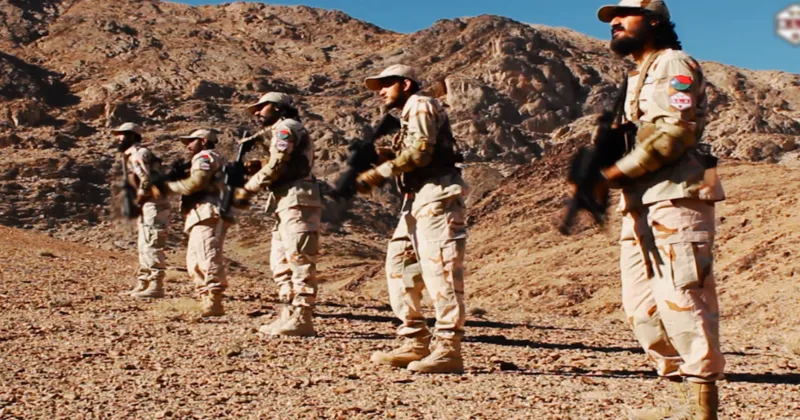
The Baloch Liberation Army (BLA) has become “South Asia’s most capable active insurgent group,” according to a detailed analysis published by the Washington-based Jamestown Foundation, an American Think Tank. The report attributes the group’s rise to expanding manpower, sophisticated tactics, and growing legitimacy among alienated Baloch youth, while warning that Pakistan’s security-first policies are fuelling, rather than containing, the insurgency.
Incidentally, BLA is centred on the idea of an independent Balochistan, free from Pakistan’s shackles and no sacrifice is deemed high much by the rebels owing allegiance to this group. During the last decade, its best trained fighters got together to set up Majeed Brigade, a dreaded name for Pakistani security personnel. The BLA is the pioneer militant group to start the tradition of suicide bombings in Balochistan. Most of its fighters are highly educated ideologues, including many women who are also recognised as potential suicide bombers.
The analysis about BLA, authored by Abdul Basit, a research fellow at Singapore’s S. Rajaratnam School of International Studies (RSIS), said the BLA’s rapid evolution has made it the most formidable insurgent organization in the region, surpassing other long-running movements in South Asia. The Jamestown Foundation report notes that on August 11, 2025, the US Department of State officially placed the Baloch Liberation Army (BLA) and its suicide unit, the Majeed Brigade, on its list of Foreign Terrorist Organizations (FTOs).
According to the report, the designation came in the aftermath of the Jaffar Express hijacking in March 2025, an incident that made the BLA only the second insurgent group in South Asia’s history to seize a passenger train — the first being India’s Maoist Naxalites in 2009. Incidentally, the BLA targeted this train many times after the March incident, despite enhanced security and deployment of more Pakistan armed personnel on its route and vulnerable points.
The analysis says the BLA has been listed as a Specially Designated Global Terrorist entity since 2019, but its recent inclusion on the FTO list underscores its expanding operational reach and influence. While the designation may strengthen US-Pakistan counter-terrorism cooperation, the Jamestown Foundation said it also “brings into focus the BLA’s rise as one of South Asia’s most formidable insurgent movements.”
The report notes that the FTO label will likely create legal and financial hurdles for the organization but is “unlikely to impede its momentum.” Instead, it warned, the move “may even enhance its legitimacy within its core constituency.”
Regional Context
According to the Jamestown Foundation, the BLA’s growing influence coincides with the decline or defeat of other insurgencies across South Asia. In the 1990s, Sri Lanka’s Liberation Tigers of Tamil Eelam (LTTE) dominated the regional insurgent landscape before being militarily defeated in 2009. Nepal’s Maoist insurgency ended in 2006 through a comprehensive peace settlement, while in Afghanistan the Taliban, now in power since the 2021 U.S. withdrawal, have transitioned from insurgents to a ruling entity.
Meanwhile, India’s north-eastern insurgencies have weakened due to leadership crises, financial constraints, and waning public support. Against this backdrop, the report said, the BLA stands out for maintaining a strong social base “rooted in alienated Baloch youth and grievances that resonate deeply across Baloch society.”
The analysis noted that unlike previous Baloch insurgent movements that relied on sporadic guerrilla strikes, the BLA has evolved into a “more organized and professional force” capable of mounting complex, coordinated assaults. The group’s shift from sabotage attacks on pylons and gas pipelines to large-scale assaults on military camps and convoys reflects what the report calls “a significant escalation in sophistication and ambition.”
Balochistan’s mountainous, sparsely populated terrain provides the BLA a natural advantage, the report added, allowing its small, mobile units to offset Pakistan’s conventional military superiority through local knowledge and mobility.
Populist Strategy
The Jamestown Foundation attributes much of the BLA’s success to its organizational restructuring and populist leadership model. Since its 2018 split from the faction led by Hyrbyair Marri, leadership has shifted from tribal elites to middle-class figures such as Ustad Aslam Baloch and Bashir Zeb, both former leaders of the Baloch Students Organisation – Azad (BSO-Azad).
“The transition from tribal to middle-class leadership,” the report said, “has democratised the Baloch movement and widened its social reach.” It described the BLA’s leadership as “semi-democratic and consultative,” noting that decisions are now taken by consensus rather than imposed through tribal authority.
This shift has enabled greater participation from educated Baloch youth, particularly in the Makran coastal belt, where the BLA has gained visible legitimacy. The report said that “by appealing to the middle class and students, the organization has repositioned itself as the political and military spearhead of the Baloch independence movement.”
The crackdowns on Baloch students by the Pakistani security forces in Karachi, Lahore and other cities have fuelled, rather than dampened, the BLA’s appeal among the educated people.
Recruitment & Operations
The Jamestown Foundation said the expansion of social media across Balochistan has helped the BLA dominate the “battle of narratives.” By using digital platforms to amplify its grievances and bypass state censorship, the group has “eroded the Pakistani state’s monopoly over information,” allowing it to connect directly with Baloch people and mobilise support.
The report noted that a surge in recruitment under the BLA’s new leadership has been instrumental in bringing the organisation to prominence. It said the leadership has made recruitment gender-inclusive, paving the way for women to join the insurgency in significant numbers, while its roots in the BSO-Azad have attracted educated middle-class youth. Traditionally, Baloch women were confined to the role of homemakers but that has changed drastically over the last decade or so.
Women have taken on roles not only as caregivers, recruiters, fundraisers, and propagandists, but also as militants — a development analysts describe as “unprecedented in the history of the Baloch movement.” The think tank noted that the group’s Operation Herof in 2024 marked “a turning point in operational sophistication,” showcasing its ability to conduct coordinated assaults and suicide attacks across multiple districts.
The 2025 Jaffar Express hijacking, the report said, further demonstrated the organization’s tactical boldness. Since then, hundreds of BLA fighters have, on several occasions, temporarily seized control of remote towns and blocked major highways across Balochistan — a show of strength that analysts say underscores “the state’s diminishing writ in parts of Balochistan.”
Pakistan’s Policy
The report criticised Pakistan’s continued reliance on military and legislative measures to address political dissent among the Baloch people, particularly youth. It cited Islamabad’s “security-first” approach as a key driver of militancy, arguing that the absence of political dialogue has deepened alienation among the Baloch population.
The Baloch youth’s disenchantment towards the Pakistani establishment has grown further after its behaviour and handling of peaceful protests led activists like Dr Mahrang Baloch. In June 2025, the Balochistan Assembly passed the Anti-Terrorism (Balochistan Amendment) Act, allowing security forces to detain individuals without charge or trial for up to six years. The report said this legislation “provides de facto legal cover for arbitrary arrests and enforced disappearances.”
According to the analysis, the new law will likely be used to suppress social movements such as the Baloch Yakjehti Committee (BYC), led by human rights activist Dr Mahrang Baloch, who was nominated for the 2025 Nobel Peace Prize.
“The over-militarization of an already draconian counterinsurgency,” the report warned, “is perpetuating a cycle in which repression fuels rebellion.”
CPEC, Geopolitics
The Jamestown Foundation report said the China–Pakistan Economic Corridor (CPEC) — a multibillion-dollar infrastructure initiative — has become a central pillar of the BLA’s narrative. The group views China as a “neo-colonial power” exploiting Balochistan’s resources in collusion with Islamabad while ignoring the rights of the local Baloch.
The BLA has claimed responsibility for several high-profile attacks on Chinese interests, including the assault on Chinese nationals at Karachi’s Confucius Institute, aimed at disrupting CPEC projects and drawing international attention. “For the BLA,” the report said, “CPEC represents both a symbol and an instrument of occupation.” Attacking CPEC-linked infrastructure, it added, “serves to internationalise the Baloch conflict and challenge both Pakistan’s and China’s regional ambitions.”
Analysts cited in the study noted that the US decision to designate the BLA as an FTO has paradoxically elevated the group’s profile, as supporters interpret the move as “recognition of its political legitimacy rather than rejection of its cause.”
The Jamestown Foundation concluded that the BLA’s rise reflects “genuine socio-political grievances” rooted in decades of marginalisation. It credited the organization’s endurance to its adaptability, populist strategy, and ability to embed itself within broader Baloch society.
“By blending resistance ideology with populist mobilisation,” the report said, “and by leveraging social media, public anger and geopolitical fault lines, the BLA has transformed itself from a local insurgency into a regional actor.”
It cautioned, however, that while the US designation marks a diplomatic success for Islamabad, it is “unlikely to decisively curb the insurgency.”















Comments