





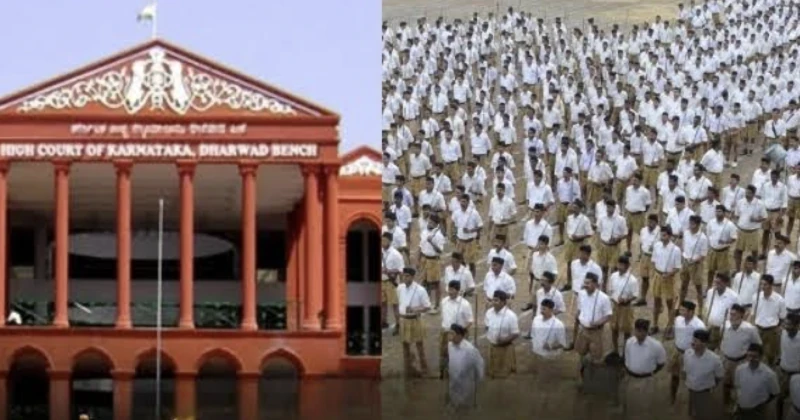
In a major embarrassment to the Congress government in Karnataka, the High Court has stayed the state’s controversial order banning Rashtriya Swayamsevak Sangh (RSS) activities and Path Sanchalan in public places and government premises. The interim order, issued by a bench headed by Justice M. Nagaprasanna, has exposed the government’s arbitrary approach and apparent political vendetta against nationalist organisations.
The Dharwad bench of the Karnataka High Court was hearing a writ petition filed by the RSS challenging the government’s October 18, 2025, order that prohibited any gathering of more than 10 people for RSS-related activities and labelled such assemblies as “illegal”. The High Court, taking serious note of the government’s overreach, observed that the Congress regime cannot curtail the fundamental rights guaranteed under Article 19(1)(a) and (b) of the Constitution, the rights to free speech and peaceful assembly.
The court’s intervention has not only provided relief to the RSS but has also triggered a wider debate on the Congress government’s growing intolerance toward organisations and ideologies it dislikes.
The government had invoked powers under the Karnataka Police Act to impose the sweeping restrictions, prohibiting entry and use of public roads, parks, grounds, lakes, and other open spaces for RSS activities and Path Sanchalan. The High Court noted that the order, in effect, stripped citizens of their constitutionally guaranteed freedoms and warned that no administrative or executive decision can override the rights enshrined in the Constitution.
Legal experts have also pointed out that the Congress government’s move reflects a dangerous trend of using administrative machinery to suppress opposing views. “The Constitution does not allow any government to act as a moral or ideological censor,” one senior lawyer commented. “The Congress order was not just arbitrary; it was unconstitutional and motivated by political animosity.”
The bench issued notices to the state government, the Home Department, and the Hubballi Police Commissioner, seeking a response. The interim stay means that until further orders, the ban on RSS Path Sanchalan and public activities cannot be enforced.
This judicial intervention is the latest in a series of setbacks for the Siddaramaiah-led Congress government, which has increasingly been accused of targeting Hindu organisations to appease its minority vote base. Political observers note that the government’s decision to impose a blanket ban on RSS activities while remaining silent on other communal processions or protests exposes its selective governance and divisive politics.
The move has also sparked intense criticism from opposition leaders, who have accused the Congress of treating the state police as an instrument of political control. “The High Court has once again shown that the Constitution stands above any government’s political agenda,” said a BJP spokesperson, adding that the Congress’s attempt to silence the RSS was a “direct assault on democracy.”
Meanwhile, the Kalaburagi bench of the High Court is separately hearing a case concerning an RSS procession in Chittapur, Kalaburagi district. The bench had earlier directed the authorities to file a report on the local situation by October 30 before making any final decision. However, with the Dharwad bench now issuing a stay on the government’s entire order, legal experts believe it could influence the outcome of the Kalaburagi case as well.
The stay order has effectively suspended the Congress government’s attempt to regulate or restrict RSS activities under the guise of maintaining law and order.














Comments