





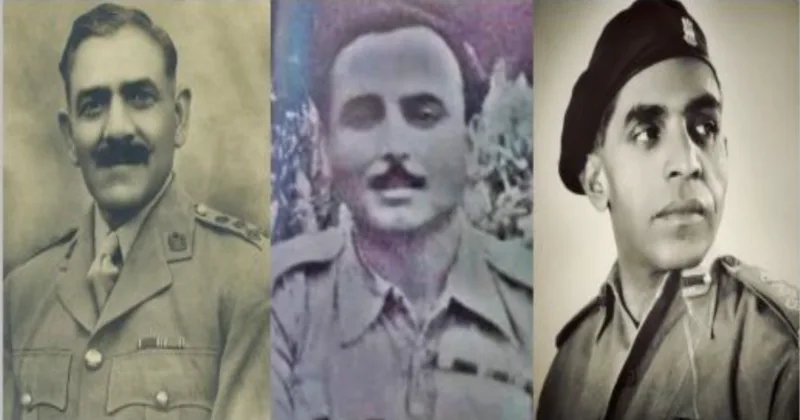
Sam Maneckshaw was a Lt Col in October 1947 when the Pakistan Army attacked Jammu and Kashmir. Though he did not lead troops on the front that opened once elements of 1 Sikh were airdropped in Srinagar on October 27, he was involved in all strategic planning at the Military Directorate in Delhi. Maneckshaw was in the first batch of the Indian Military Academy at Dehra Dun in 1932. On passing out of the IMA, he got commissioned into the Frontier Force Regiment.
After Independence in August 1947, the Frontier Force Regiment was assigned to Pakistan and he was reassigned to the 8th Gorkha Rifles. Manekshaw was deeply involved in planning role during the 1947-48 India-Pakistan war in Jammu & Kashmir. He remained so busy and involved in Delhi itself that he never got a chance of a field posting to command an infantry battalion. After getting promoted to the rank of a Brigadier, he was given the command of 167 Infantry Brigade in 1952. Later, he took over as the director of military training at the Army Headquarters.
When news regarding Pakistan tribal lashkars led by Pakistani regulars attacking Jammu & Kashmir started reaching Delhi, he was one officer who was the first to be informed. On August 25, accompanied by V P Menon, he flew to Srinagar to hold parleys with Maharaja Hari Singh who wanted to accede to India. During that trip, Maneckshaw did an air reconnissance of Kashmir and what he found left him very worried about the fate of J&K.
Grave Situation
On reaching Delhi in the evening, he reported to Home Minister Sardar Patel and Prime Minister Jawaharlal Nehru that the situation was grim. If an immediate order was not given to airlift Indian troops to defend Srinagar airport, there was an imminent danger of whole of Kashmir being overtaken by Pakistan. This grim situation and alarm that Maneckshaw sounded disturbed Sardar Patel who chided Nehru to issue necessary orders immediately. Even at this late an hour and amid such a grave danger to Kashmir, Nehru was not willing to come to the help of J&K. Nehru first wanted Maharaja Hari Singh to hand over power to his friend Sheikh Mohammad Abdullah.
Some of the military men involved in the operations at that time became household names in the later years and decades. Sam Maneckshaw rose to became Indian Army chief and was responsible for vivisection of Pakistan in December 1971 war. Another man who was very involved in all events connected to J&K at that time was Captain S K Sinha who authorised the use of civilian aircraft, mostly Dakotas, for the airlift of troops. Years later, perhaps in 1964, an audit team flagged the flying of troops saying this was an unauthorised mode of transport!
The audit team then decided to take it to the next level and ordered Sinha to deposit a few lakhs into an official designated account or face being court marshalled. It was by explaining the urgency of the situation that prevailed in October 1947, and intervention of senior officers that Sinha was left off the hook. Sinha went on to become a Lieutenant General and was in line for being the next Army chief. However, he was superceded by his immediate junior, Lt Gen A S Vaidya, who was made the chief instead of Sinha. This was ordered by then Prime Minister Indira Gandhi and Lt Gen Sinha tendered his resignation in protest.
On October 26, 1947, when the news regarding Maharaja Hari Singh having signed the Instrument of Accession (IoA) reached Delhi, Sardar Patel heaved a sigh of relief. This news was given to PM Nehru, Home Minister Sardar Patel and others by Lt Col Maneckshaw. It was at this juncture that Sardar Patel said that there was no technical issue left to resolve with J&K having joined India officially. PM Nehru, under the influence of Lord Mountbatten, still remained undecided but Sardar Patel intervened effectively telling Maneckshaw that as PM of India, Nehru was bound to assist J&K, a part of India now. As such, Maneckshaw should start working immediately for mobilising troops to be sent to Srinagar by air.
It was around 4 am on October 27 that Lt Col Maneckshaw got the orders he had been waiting for and by 7.30 am, in less than four hours, the first flight of Dakota carrying Indian soldiers had taken off from Delhi for Srinagar. The pilots were given instructions to play safe and return to Jammu, from Srinagar, if the airfield had been captured by the Pakistanis then. Fortunately, the Pakistani marauders were kept at bay from their planned march to Srinagar by gallant action of Brigadier Rajindra Singh four four days from October 22 to 26. The civilian aircraft carrying Indian military personnel then made countless sorties from Delhi to Srinagar, thereby enabling its effective defence.
Extraordinary Men All
The troops of 1 Sikh were led by their Commanding Officer (CO) Lt Col Dewan Ranjit Rai who went far beyond the call of duty, and the orders he had been given. It was providential that 1 Sikh was chosen to be airlifted to Srinagar. The unit was then placed at Gurgaon making arrangements for refugees arriving in Delhi and its vicinity. As such, this was the unit located closest to Delhi from where the soldiers were to be airlifted to Srinagar for its defence.
The CO had been asked to stay at Srinagar airfield and strengthen its periphery to thwart any enemy advances and its capture. However, contrary to these orders, he took initiative on his own and asked to be driven towards Baramula as far as he could go so that he could make an assessment regarding the enemy movements. Outside Baramullah, a Pakistani hiding in the paddy fields fired at Lt Col Rai and he was killed almost instantly. From dawn to dusk, the 1 Sikh CO was active far away from where he was supposed to be as per orders.
This initiative on his part and the extraordinary gallantry of moving out and taking on the enemy as far away from the airfield as possible led to Lt Col Ranjit Rai being awarded the Maha Vir Chakra (MVC) posthumously. The citation read: Lieutenant Colonel Dewan Ranjit Rai was the Commanding Officer of 1 Sikh. Immediately on landing at Srinagar, on 27 October 1947, he appreciated that it was imperative to hold and oppose the raiders as far away as possible from the vital city of Srinagar and its adjacent airfield.
As very little time was at his disposal, he personally conducted reconnaissance and operations at such personal risk that he was eventually killed. By his complete disregard of personal danger and his determined and inspired leadership, the raiders were stopped sufficiently far away to enable a build-up for the eventual decisive defeat.
The officer gave his life in a successful endeavour to save Srinagar by displaying courage of the highest order.
Incidentally, he was the first recipient of the Maha Vir Chakra in independent India. On October 27, when 1 Sikh men were being flown to Srinagar, one of the pilots doing the sorties was Biju Patnaik, who became famous as Chief Minister of Orissa decades later. His son Naveen Patnaik also remained CM of Orissa for a long time, stepping down in late 2024.
Muslim Betrayal
One of the most momentous events of October 1947 was the betrayal by Muslim companies which were part of State Forces led by Lt Col Narain Singh Sambyal guarding Muzaffarabad. This betrayal was led by Captain Aslam Khan, son of Brigadier Rehmatullah Khan of Jammu. Aslam Khan was won over by the British and made a Major (GSO-Intelligence) at Ranchi! There, he was tasked to prepare the ground for the invasion of Jammu & Kashmir under the code name Operation Gulmarg.
When this operation was launched on October 21/22 night, a massive force of 10,000 armed Pakistanis advanced towards Muzaffarabad and an equal number towards Jammu from Sialkot, barely 40 km away. The fall of Muzaffarabad tragically came swiftly because of the Trojan Aslam Khan’s betrayal. Lt Col Sambyal tried to hold his ground at the Domel bridge to halt and delay the advance of the enemy comprising over 300 vehicles. Supporting him was a Medium Machine Gun (MMG) section under Havaldar Nar Dev Singh of 8 J&K Rifles, who was left behind by his unit which was proceeding to Poonch as no adequate transport was available.
The MMG section had been positioned on a nearby hillock bringing effective fire at the Domel bridge. This proved to be invaluable as the firing throughout the day stopped the invaders who wanted to advance beyond the bridge. It was near Garhi that Brigadier Rajindra Singh engaged the enemy column on October 23 and halted their advance by holding defensive positions and disabling the front vehicle which led to a road blockade. Later, he withdrew to another position along with whatever men had been left at his disposal. The Battle of Garhi, which Brigadier Rajindra Singh and his men fought with extraordinary courage and fortitude, is considered the real turning point of the 1947 invasion.











Comments