





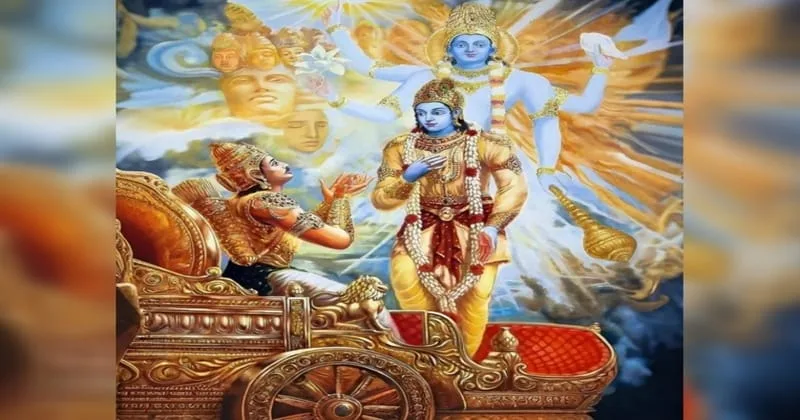
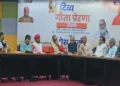
The Bhagavad Gita is a “nectar of wisdom” and a “miniature history of Indian civilisation,” offering profound insights into the moral and spiritual dilemmas of modern life, according to leading Chinese scholars who spoke at a symposium organised by the Indian Embassy in Beijing.
At the event titled ‘Sangamam – A Confluence of Indian Philosophical Traditions’, scholars described the Gita as a philosophical encyclopaedia that continues to illuminate the balance between material pursuits and spiritual growth.
The keynote speaker, Professor Zhang Baosheng, 88, who translated the Bhagavad Gita into Chinese, called the text a “spiritual epic” that reveals India’s timeless values of duty, action, and detachment, principles that still shape Indian life today.
Recalling his travels across India between 1984 and 1986, from Cape Comorin (Kanyakumari) to Gorakhpur, Prof. Zhang said he could “feel Bhagwan Krishna’s living presence” throughout the country, a moral and spiritual force embedded in daily life. He described the Gita as not merely a scripture, but a living expression of India’s soul, “a cultural anthropology” of its civilisation and a dialogue that encapsulates its ethical crises, philosophical synthesis, and spiritual renewal. He also noted that the Bhagavad Gita has resonated globally, inspiring translations into every major language, including Chinese.
Professor Wang Zhi-cheng, Director of the Centre for Oriental Philosophy Research at Zhejiang University, said the Bhagavad Gita, a dialogue from a battlefield more than 5,000 years ago, transcends time and continues to address the anxieties of the modern world. Calling it the “nectar of wisdom,” he said Krishna’s teachings in 700 verses serve as “spiritual keys” that remain relevant across millennia.
Prof. Wang explained the Gita’s three paths to resolve life’s challenges, Karma Yoga (the path of selfless action), Sankhya Yoga (the path of knowledge), and Bhakti Yoga (the path of devotion), as timeless guides for achieving balance and clarity in modern life.
Quoting Krishna’s famous declaration, “Whenever dharma declines and adharma prevails, I manifest myself on earth,” he added, “The wisdom of the Gita is the light that manifests when we are lost. When you feel anxious, let go of attachment to results; when you feel lost, recognise your true self; when you feel empty, give more.”
Professor Yu Longyu, Director of the Centre for Indian Studies at Shenzhen University, emphasised that India’s profound philosophical and cultural heritage deserves deeper engagement from Chinese scholars. “In modern times, China’s greatest thinkers have embraced threefold learning, Chinese, Western, and Indian. I call upon our scholars to study Indian philosophy sincerely, fostering China’s rejuvenation, India–China harmony, and world peace,” he said.
In his opening remarks, Indian Ambassador to China Pradeep Kumar Rawat said the symposium builds on last year’s conference on the Ramayana and reflects India’s enduring philosophical dialogue with the world.
“For millennia, India’s philosophical traditions have sought to answer the most fundamental questions: What is truth? What is the nature of reality? How do knowledge and action lead to ultimate freedom?” he said. “From Nyaya’s logic to Yoga’s discipline, from Vedanta’s introspection to Buddhism’s compassion, India’s darsanas offer diverse yet harmonious paths toward wisdom and self-realisation.”











Comments