





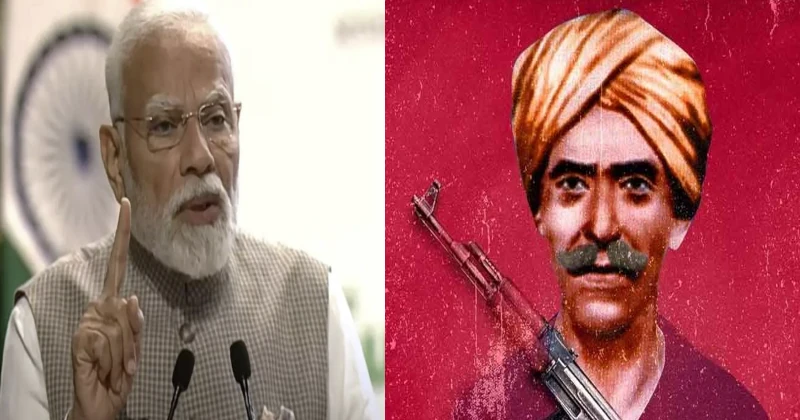
During his monthly radio programme Mann Ki Baat on October 26, Prime Minister Narendra Modi turned the nation’s attention toward one of Bharat’s most valiant yet under-recognised Janjati revolutionaries Komaram Bheem, the Gond leader who fought relentlessly against the twin tyrannies of the British Empire and the despotic Nizam of Hyderabad.
Referring to the freedom fighter’s birth anniversary celebrated on October 22, the Prime Minister described Bheem’s short but fiery life as a “symbol of unyielding courage and sacrifice,” calling upon the youth to study and draw inspiration from his legacy. “Komaram Bheem did not live a long life; he lived only 40 years, but during his lifetime, he left an indelible mark on the hearts of countless people, especially the Janjati community,” PM Modi said.
कोमरम भीम… अभी 22 अक्टूबर को ही उनकी जन्म-जयंती मनाई है। कोमरम भीम की आयु बहुत लंबी नहीं रही, वो महज 40 वर्ष ही जीवित रहे लेकिन अपने जीवन-काल में उन्होंने अनगिनत लोगों, विशेषकर आदिवासी समाज के हृदय में अमिट छाप छोड़ी।
1940 में निज़ाम के लोगों ने उनकी हत्या कर दी थी। युवाओं से… pic.twitter.com/4ncW18Nkdi
— BJP (@BJP4India) October 26, 2025
Taking listeners back to the early 20th century, the Prime Minister painted a grim picture of life under the British and Nizam’s rule. “At that time, there was no hope of freedom anywhere in sight. The British had crossed all limits of exploitation, and in Hyderabad, people also faced the atrocities of the cruel and merciless Nizam,” PM Modi recalled.
He spoke of how lands were seized, back-breaking taxes imposed, and those who dared to protest often mutilated or executed. Amid this climate of fear, a young man from the Gond tribe barely twenty decided to defy tyranny.
“During that era, when even uttering a word against the Nizam was a crime, that young man openly challenged an officer of the Nizam named Siddiqui,” the Prime Minister said, narrating the story of how Bheem killed the oppressive officer sent to confiscate farmers’ crops and evaded arrest by fleeing to Assam.
Born on October 22, 1901, in Sankepalli (present-day Telangana), Komaram Bheem hailed from a humble Gond family deprived of formal education but rich in courage and resolve. His life’s course changed after his father was killed by forest officials, a tragedy that instilled in him an unrelenting hatred for injustice.
Fleeing persecution, Bheem found refuge in Assam, where he worked on tea plantations, learnt English, and absorbed the spirit of organised resistance from labour union movements. He escaped imprisonment there and returned to Hyderabad, more determined than ever to fight for his people.
By the late 1920s, Bheem had begun organising the Janjati community across the Gond heartland of Jodeghat, Babejhari, and Bhabejhari, forming a council of Janjati chiefs to demand autonomy, land rights, and the expulsion of oppressive zamindars and forest officials.
In 1928, Komaram Bheem launched a guerrilla campaign against the Nizam’s administration one of the earliest organised Janjati resistances in the Deccan. Operating from the forests of Jodeghat, he commanded nearly 300 fighters, disrupting the Nizam’s control across Asifabad and the surrounding districts.
When emissaries of the Nizam approached him with offers of land and concessions, Bheem rejected them outright, declaring that the movement was not for alms but for justice for “Jal, Jangal, Zameen” (Water, Forest, Land), the eternal rights of the Janjatis.
“We are not begging for mercy. We demand what is rightfully ours our land, our forests, and our freedom,” Bheem reportedly told the Nizam’s agents. This uncompromising defiance turned Bheem into a symbol of Janjati self-determination, and a thorn in the side of the Nizam’s administration.
In 1940, after more than a decade of sustained resistance, Bheem’s movement was betrayed by local informants. Acting on a tip-off, the Nizam’s police, led by Asifabad’s talukdar Abdul Sattar, surrounded Bheem’s base at Jodeghat.
A fierce gunfight ensued. Bheem and 15 of his comrades were killed. Though official records place his death in October 1940, Janjati memory honours his martyrdom on Aswayuja Pournami (April 8, 1940).
His blood may have soaked the soil of Jodeghat, but his spirit became immortal. In the decades that followed, Bheem’s name lived on through Gondi ballads, Telugu folklore, and the worship of Bheemal Pen, a deity form that the Gonds revere as the embodiment of resistance.
Every year, thousands of Janjatis gather at Jodeghat to commemorate his martyrdom, transforming the once-obscure forest hamlet into a sacred symbol of Janjati pride and rebellion.
PM Modi’s tribute in Mann Ki Baat marked a significant recognition of a leader long confined to the margins of recorded history. Komaram Bheem’s rebellion not only inspired the Telangana armed struggle of 1946 but also remains central to contemporary debates about Janjati rights, land autonomy, and the exploitation of indigenous communities.
“Komaram Bheem’s story continues to inspire generations and symbolises the spirit of resistance and courage that defines India’s freedom struggle,” the Prime Minister affirmed. Bheem’s slogan “Jal, Jangal, Zameen” continues to echo through Bharat’s Janjati heartlands a timeless reminder of the rights, dignity, and self-respect of indigenous peoples who have long fought for justice against imperial and feudal chains.















Comments