





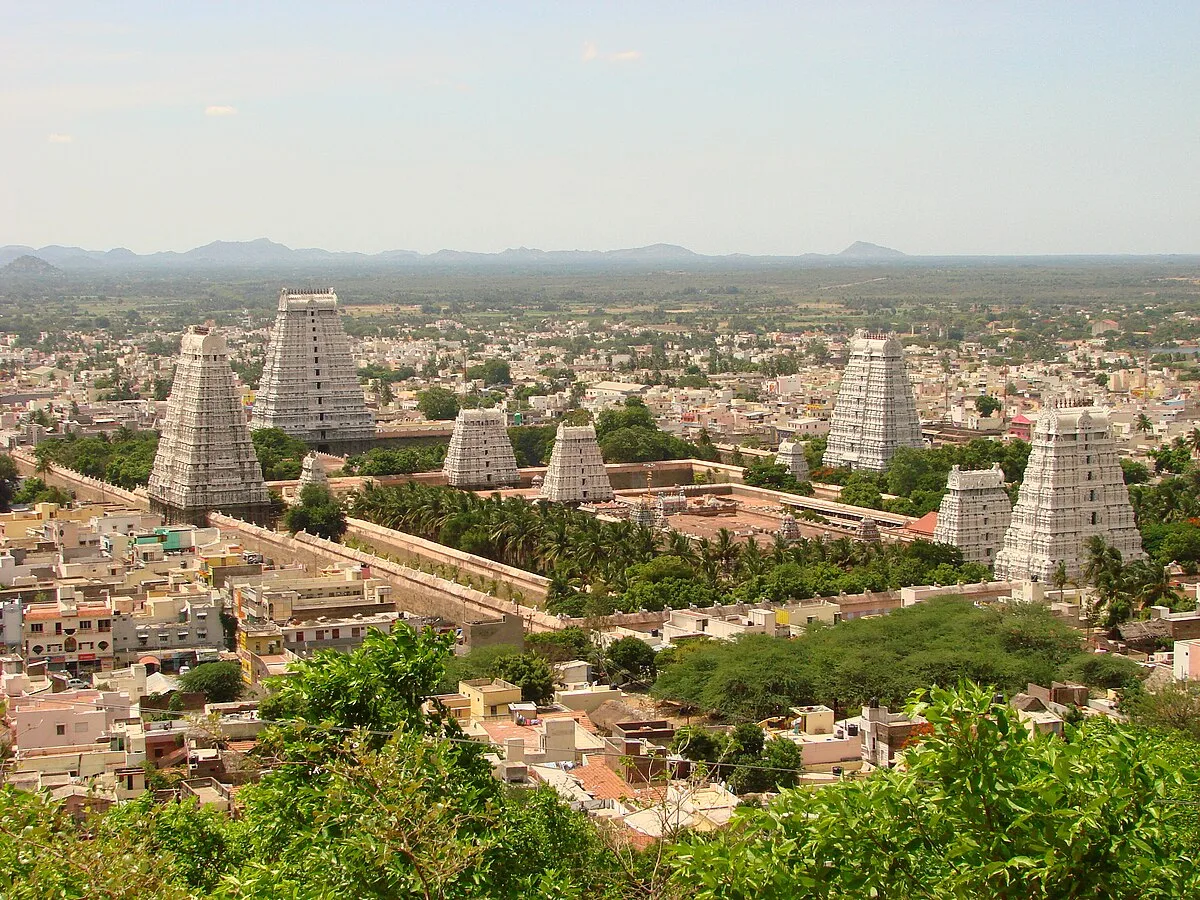
The first bench of the Madras High Court, comprising Chief Justice Manindra Mohan Shrivastava and Justice G. Arul Murugan, has directed the authorities concerned to submit a list of all persons who have encroached upon land on the slopes of Tiruvannamalai hills and surrounding water bodies.
The bench was hearing a PIL filed by advocate Elephant Rajendran seeking the removal of illegal constructions and encroachments on natural water bodies, including the historic Tamarai Keni and hill streams in Tiruvannamalai. During the hearing on October 24, the Tamil Nadu government informed the bench that notices had been served to identify encroachments and that follow-up action was in progress.
The petitioner argued that the authorities were acting only against those who had encroached upon the hill slopes, while no action was being taken against those who had occupied streams, ponds, and other water bodies.
Recording the submissions, the first bench directed the Tamil Nadu government to take swift and comprehensive action against all categories of encroachments and to submit a detailed list of encroachers in both the hill and waterbody areas of Tiruvannamalai. The hearing was adjourned to November 6. The court ordered that, on the next date, a list of all those identified as encroachers on the slopes and water bodies should be filed before it.
The court also directed the Tamil Nadu Power Distribution Corporation Limited (formerly TANGEDCO), which is a respondent in the case, to file a separate status report on the action taken. The judges observed, “We expect the authorities to act expeditiously and take appropriate action against those who, according to the official report, are found to be encroachers and to free up the land at the earliest. If private parties herein claim to hold patta, that would be an issue for consideration.”
A study conducted by the Revenue Department found around 3,535 illegal settlements in the hills, particularly along the Girivalam path (parikrama route), that have existed for many years. Of these, 1,535 illegal structures were identified as houses built on government land. The remaining 2,000 structures are located on disputed land in the hills, for which the Revenue Department has been unable to trace land records. In total, around 576 acres of land in the hills are under encroachment, mostly by residential structures. Additionally, about 20 acres of forest land in the hills are also under illegal occupation.
Initially, 1,535 illegal structures in the hills will be demolished in phases. Revenue officials have issued eviction notices to at least 400 houses in the hills.
During a meeting chaired by the District Collector in September, the Tiruvannamalai Corporation informed that a portion of the Arunachala Hills along the 14-km-long Girivalam Path near the Arunachaleswara Temple would soon be declared a Reserve Forest (RF), as the eviction of illegal settlers in the hills has been initiated.
Earlier, on June 6, another bench of the Madras High Court comprising Chief Justice K.R. Shriram and Justice Sunder Mohan had directed the Tiruvannamalai District Collector to submit a detailed report on the measures taken to remove 1,535 unauthorised constructions on the sacred Arunachala Hill. The bench noted, “Notwithstanding the fact that on 12.2.2025 it was recorded that steps are being taken to remove 1,535 unauthorised structures on or before 31.3.2025, there is nothing on record to indicate that these structures have been removed… Moreover, there is no indication of what steps have been taken to remove the remaining 3,634 buildings.”
The district Collector was asked to file an affidavit explaining the status of the first batch of removals and, if they had not been completed, the impediments faced and reasons for non-compliance. He was also directed to specify the progress in removing the remaining 3,634 illegal buildings and to serve a copy of the affidavit to the petitioner within a week.
In his petition, Rajendran stated, “Adjacent to this holy Siva Temple is the Girivala Mountain (parikrama or circumambulation path). This is said to be older than the Himalayas. The sacred mountain of Arunachala rises to an elevation of 2,669 feet. The road encircling the mountain, where devotees undertake circumambulation, is 14 km long. Geologists estimate the age of this mountain at 2.6 billion years, while the Geological Survey of India claims it to be 3.5 billion years old. The Arunachaleswarar Temple dedicated to Lord Shiva is located at the foot of the mountain. Devotees walk the 14 km during Pournami (full moon) nights for spiritual blessings, passing eight Shivalingams along the Girivalam route.”
He further submitted that the total area of the hill is 718 acres and 35,719 sq. ft., under Survey No. 520, Ward No. 3. Several oodais (brooks) bring rainwater to the city’s tanks, but many of these have been obstructed by illegal constructions, preventing the natural flow of rainwater. “This holy hill is now in a dangerous condition, with ruthless persons constructing huts and houses up to about 400 feet on the slopes. These encroachments must be removed to restore the hill’s past glory,” he added.
The monitoring committee’s report, submitted to the court on February 12, 2025, stated: “The committee considers it fit to bring to the notice of this Hon’ble Court that no patta shall be issued to any encroachers in S.F. No. 10, Block No. 1, classified as Kallankuthu Annamalaiyar Malai, extending to 574 acres and 28 cents, as it poses serious danger to human lives. Another Wayanad-type incident should not be repeated.”
















Comments