





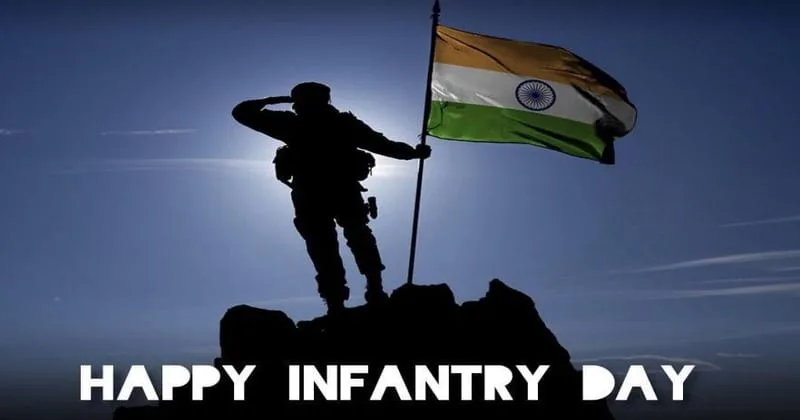
Infantry Day is celebrated today to honour the courage, sacrifice, and unmatched contribution of the Infantry, the largest fighting arm of the Indian Army. On this day, on October 27, 1947, 1 SIKH Battalion was airlifted from Delhi, and the troops were landed at Srinagar airport. Maharaja Hari Singh signed the Instrument of Accession for J&K with the Indian dominion on October 26, 1947, and thus India now was in an official position to defend J&K from the Pakistani Army and their backed tribal invasion. But time was critical, and only the Infantry could salvage the situation.
On October 26, the enemy had already reached the outskirts of Srinagar, and they were heading to capture Srinagar airport. In military parlance, once you lose an airport, you lose the war. Thus, the Indian Army had to react swiftly to save the airport. The Sikh troops, hailing from the Infantry, not only secured Srinagar airport but also pushed the enemy away from the airport. This gallant action, which saved the state of J&K from the evil designs of Pakistan, is also remembered as the first official engagement of the Indian Army post-independence. Major Somnath Sharma of the Kumaon Regiment made the supreme sacrifice while defending Srinagar airport, and he was the first recipient of India’s highest gallantry award, Param Veer Chakra.
Infantry is not a common word in normal conversation. Infantry refers to soldiers who fight on foot, or to a branch of the Indian Army that consists of these foot soldiers. In earlier times, most of the wars were fought by foot soldiers or by horsemen. The majority of any traditional army, then obviously, were Infantrymen. Even today, the Infantry is the largest component of the Indian Army, accounting for more than one-third of the total manpower. But today, the Indian Infantry is a modern battle-ready force with the latest lethal weapon systems and multiple equipment, including drones.
Infantry comprises of 27 regiments, most of them having pre-independence origin. The Indian public is very familiar with regiments like the Sikh, Rajput, Garhwal Rifles, Dogra, Kumaon, Assam, Jat, Grenadiers, Gurkha, etc. My own J&K Light Infantry Regiment (JAK LI in short) is one of the few raised after independence in 1948 to fight the invasion from Pakistan. Many of our historical accounts call the 1947-48 war with Pakistan a tribal invasion, but it was a full-fledged war by Pakistan against India to annex J&K forcibly. It was the Infantry that took the decisive action to repel the Pakistani offensive with their grit, determination and raw courage. That is why Infantry is also called “Queen of Battle,” much like a queen, which is the most powerful piece in a chess game.
The beauty of the Infantry is its system of regimentation. Each Infantry regiment comprises more than 15 battalions and has troops from a similar background. Most of the troops have a rural orientation, and they are naturally fit. Infantry soldiers have tremendous resilience to operate in all types of terrain, be it riverine plains, mountains, snow-capped peaks, jungles or deserts. They can reach anywhere and ultimately capture enemy territory to provide a decisive victory to the nation. Each regiment is like a large family, with exceptional bonding between the serving and the ex-servicemen.
Infantrymen have supreme adaptability, which makes them most suitable to guard India’s land borders. Their ability to operate in small teams makes them very effective in Counter-Terrorist Operations, be it in J&K or India’s North East. Even our Rashtriya Rifles Battalions are part of Infantry regiments, and these battalions are the backbone of our effective operations to neutralise terrorists in J&K. The battalions which carry out special operations of the type of Uri surgical strike are also from the Infantry (Parachute Regiment). Thus, the Infantry continues to play the lead role as far as the Indian Army is concerned.
In the line of duty, Infantrymen have made maximum sacrifice, in wars, conflicts and counter-terrorist operations. Infantry has the proud privilege of receiving maximum gallantry awards including Param Vir Chakra (PVC), many of them posthumously. The senior leadership of the Indian Army has the highest representation from the Infantry. Maximum Chiefs of Army Staff (COAS) have been from the Infantry. Our current chief, General Upendra Dwivedi, belongs to the J&K Rifles Regiment (JAK RIF, in short).
The soldiers who gave a bloody nose to the Chinese in Galwan, Eastern Ladakh, on June 15, 2020, were from the Bihar Regiment. During Operation Sindoor in May this year, Infantrymen thwarted the evil designs of Pakistan on the Line of Control in J&K. The soldiers who eliminated three Lashkar-e-Toiba terrorists who were responsible for the dastardly Pahalgam terror attack on April 22 were also from the Infantry. This is another precise intelligence-based operation by the Infantry that took place on July 28, this year, as part of Operation Mahadev. Thus, the Infantry continues to serve the national security interests in peacetime conditions, conflicts and in conventional wars.
Infantry is progressive and has always attuned itself to the challenges of modern warfare. There is a plethora of new military equipment that an Infantry battalion uses today. Infantry also has maximum Made in India weapons, ammunition and equipment and is the epitome of self-reliance in defence as propagated by Prime Minister Narendra Modi many times. Another example of the ability to quickly transform to meet the new challenges is the raising of specialised ‘Bhairav Light Combat Battalions’ under the aegis of the Infantry. Five such battalions ready for high-impact operations opposite Pakistan and China are already functional. Balance 16 such battalions will be ready in the next six months.
On the proud occasion of the Infantry Day, I pay homage to the Fallen Heroes of Infantry and salute their supreme sacrifice in the cause of the nation. It is my proud privilege and honour to extend my greetings to serving and retired Infantrymen. Infantry remains dedicated to the core values of bravery, sacrifice, selfless devotion to duty and exceptional professionalism. The indomitable spirit of the Infantry is the backbone of the Indian Army in its resolve to defend the territorial integrity and sovereignty of the nation.












Comments