





India’s national identity is celebrated through the principle of unity in diversity—a mosaic of cultures, languages, cuisines, attire, and festivals stretching from Kashmir to Kanyakumari. This diversity, however, is not fragmented; it is held together by a deeper, enduring ethos: Sanatan Dharma. In this context, dharma transcends religious categorization. It represents the civilizational conscience of Bharat—a framework of ethical, spiritual, and cultural continuity that has guided the subcontinent for millennia.
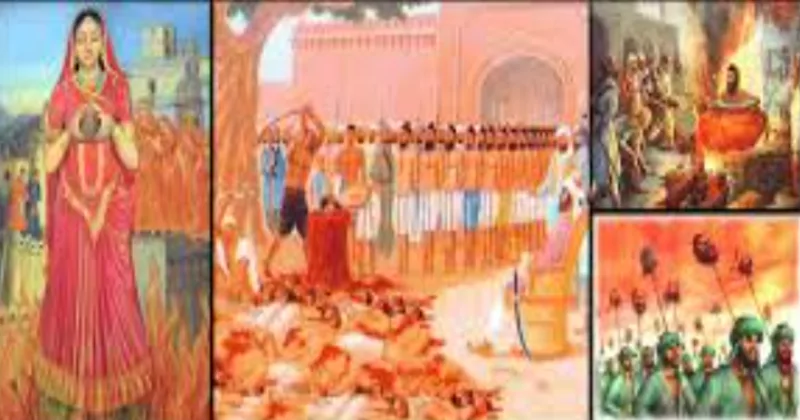
For over a millennium, the land of Bharat has witnessed the rise and fall of foreign powers—each seeking not merely dominion over territory, but a deeper conquest: the erosion of its cultural and spiritual identity. Despite these sustained efforts, the civilizational essence of Bharat, rooted in Sanatan Dharma, has endured with remarkable resilience.
From the early medieval period through the colonial era, Bharat came under the sway of various foreign regimes. These powers, while differing in method and ideology, shared a common objective: to reshape the cultural landscape of India in service of their political and religious ambitions.
The Mughal empire, spanning from the 16th to the 19th century, introduced a complex blend of imperial governance and religious imposition. While some rulers like Akbar experimented with syncretism, others—most notably Aurangzeb—pursued aggressive policies aimed at Islamic expansion:
- Imposition of jizya and other discriminatory taxes on Hindus
- Destruction of temples and suppression of indigenous rituals
- Forced conversions, often under threat or coercion
These measures were not isolated acts of zeal but part of a deliberate strategy to weaken the dharmic foundation of Bharat and replace it with imperial orthodoxy
The advent of European colonial powers, particularly the British, marked a shift from overt coercion to institutional and psychological subversion. Christian missionary efforts, often cloaked in humanitarian outreach, employed more cunning and calculated methods:
- Establishment of schools, hospitals, and orphanages that doubled as platforms for religious indoctrination
- Targeted proselytization among tribals as and they are Adivasis and nature worshipers not belonging to Hindu religion, economically and socially vulnerable communities, with calculated propaganda stating that they are the saviours of those oppressed by the complex caste system prevalent in the country.
- Promotion of Western cultural superiority, subtly undermining indigenous traditions, gods and belief systems
This approach sought to alienate Indians from their ancestral heritage, not through force, but through gradual reconditioning of identity and values.
“All these exercises were primarily aimed at cementing their power and establishing dominion over Bharat. The rulers understood that the most effective way to sustain control was by dismantling the nation’s identity and eroding its civilizational self.”
In independent India, the policy of minority appeasement has manifested through the creation of special institutions and commissions—such as the National Commission for Minorities—that confer privileges and protections at the national level, because of there collective bargaining power in electoral politics. However, a troubling asymmetry persists in the treatment of Scheduled Castes (SCs), Scheduled Tribes (STs), and Other Backward Classes (OBCs).
While religious minorities are granted national minority status, irrespective of their demographic strength in individual states, SCs, STs, and OBCs are recognized only at the state level. This means that even if a religious minority forms a numerical majority in a particular state, it continues to enjoy the benefits of minority status. In contrast, SCs and STs must rely on state-specific recognition, which limits their access to constitutional safeguards and affirmative action across jurisdictions.
This structural imbalance has led to ongoing injustices, particularly against Hindu communities, many of whom belong to these constitutionally recognized backward classes. The disparity not only undermines the principle of equality before law but also raises critical questions about the uniformity and fairness of minority policies in India.
Conversion Networks and Insurgent Financing: A Nexus of Subversion
In earlier years, Naxal-dominated regions actively resisted the presence of Christian missionaries, viewing them as external agents of influence. However, over time, a strategic nexus emerged wherein missionary organizations allegedly began funding Naxal groups to gain access and operate within their strongholds—particularly in Chhattisgarh, Jharkhand, and Odisha. Missionaries were permitted to carry out conversion activities in these regions under the protection of anti-national elements, where even the government lacked operational access. The brutal murder of Swami Laxmanananda stands as a stark example of this nexus—he was assassinated by Naxals for resolutely opposing missionary-led conversions.
Through this arrangement, foreign and institutional missionary funds are believed to have indirectly reached anti-Indian forces, including Naxals and armed insurgent groups in the Northeast. This covert channel of support has raised serious concerns about the intersection of conversion lobbies and anti-national activities.
Moreover, these lobbies—operating under the protective umbrella of minority status—have acquired significant political leverage. Their collective bargaining power in vote-bank politics has ensured patronage from across the political spectrum, shielding them from scrutiny and enabling continued operations even in sensitive regions.
This dynamic calls for a critical re-evaluation of minority protections, especially when such networks potentially undermine national security and constitutional integrity.
The Constitutional Ambiguity and Cultural Erosion of Tribal Identity
One of the gravest injustices faced by India’s tribal communities stems from the ambiguity surrounding Article 342 of the Constitution. This Article empowered the President to specify the Scheduled Tribes (STs) through a formal notification, resulting in the enactment of the Constitution (Scheduled Tribes) Order, 1950 (CO 22). However, the Indian Constitution remains silent on the status of tribes who convert to other religions, creating a vague and porous definition of tribal identity.
This constitutional silence has had far-reaching consequences. Tribal communities possess distinct cultural traits, customs, rituals, and spiritual practices. Once a tribe abandons its indigenous faith—particularly through conversion to Christianity—its rituals (such as pooja and prayer methods), festivals, and marital customs undergo significant transformation. The influence of church institutions often replaces traditional tribal structures, leading to a complete reconfiguration of tribal identity.
This transformation is not merely cultural—it has legal and political implications. The ambiguity in the 1950 Order has been systematically exploited by converted tribes and conversion lobbies, who continue to enjoy the constitutional benefits and privileges originally intended for legitimate tribal communities that have preserved their ancestral faith and practices.
To address this issue, a comprehensive Bill was introduced in Parliament in 1967, with the Lok Sabha resolving to refer it to a Joint Parliamentary Committee (JPC) comprising members from both Houses. The 22-member Committee held 22 sittings over 11 months, and in 1969, submitted its report recommending an amendment to the Constitution (Scheduled Tribes) Order, 1950. The proposed amendment included a new clause:
“2A. Notwithstanding anything contained in paragraph 2, no person who has given up tribal faith or faiths and has embraced either Christianity or Islam shall be deemed to be a member of any Scheduled Tribe.”
On November 10, 1970, Shri Karthik Oraon, a Lok Sabha MP and member of the JPC, submitted a memorandum signed by 348 Members of Parliament, including 332 from the Lok Sabha, to Prime Minister Indira Gandhi, urging the adoption of the proposed amendment.
The Bill was scheduled for discussion in the Lok Sabha on November 16, 1970, but due to political pressures from newly formed northeastern states such as Meghalaya and Nagaland, the debate was repeatedly postponed. Eventually, on December 24, 1970, the Lok Sabha was dissolved, and the Bill lapsed.
Since then, the constitutional ambiguity remains unresolved, and the cultural and legal disenfranchisement of legitimate tribal communities continues. The erosion of tribal identity through unchecked conversions, coupled with the misuse of constitutional privileges, has left many indigenous tribes in a state of darkness and dejection—a struggle that persists to this day.
In earlier times, missionaries exerted indirect influence, but today in Kerala, they are actively intervening to prevent legal action against their exploitative conversion of tribal communities—leveraging their collective electoral bargaining power to shield themselves from scrutiny
Misuse of Article 25: “Propagate” Misinterpreted as a License to Convert
One of the most misinterpreted provisions of the Indian Constitution in the context of religious conversion is Article 25. This Article guarantees every individual the freedom of conscience and the right to freely profess, practice, and propagate religion. However, conversion lobbies have consistently distorted the term “propagate”, treating it as a blanket license to convert individuals—often through inducement, coercion, or exploitation.
This misreading was categorically addressed in the landmark judgment of Rev. Stainislaus v. State of Madhya Pradesh (1977), where the Hon’ble Supreme Court held that Article 25 does not include the right to convert another person. The Court clarified that while one may propagate their faith, this does not extend to forcibly or fraudulently converting others.
Further judicial affirmation came in Bijoe Emmanuel v. State of Kerala (1986), where the Court once again emphasized the limits of religious freedom, particularly when it conflicts with public order or infringes upon the rights of others.
In the seminal case of Commissioner, Hindu Religious Endowments v. Sri Lakshmindra Thirtha Swamiar of Shirur Mutt (1954), the Supreme Court laid down the “essential religious practices” doctrine, affirming that religious freedom under Article 25 is subject to public order, morality, health, and other fundamental rights.
Despite these authoritative interpretations, the term “propagate” continues to be misused by conversion lobbies as a legal shield for activities that often undermine the cultural and spiritual fabric of indigenous communities.
This persistent distortion not only violates the spirit of constitutional safeguards but also raises urgent questions about the need for legislative and judicial clarity to protect vulnerable populations from exploitative religious conversions.
Anti-Conversion Laws in India: Legal Landscape and Ground Realities
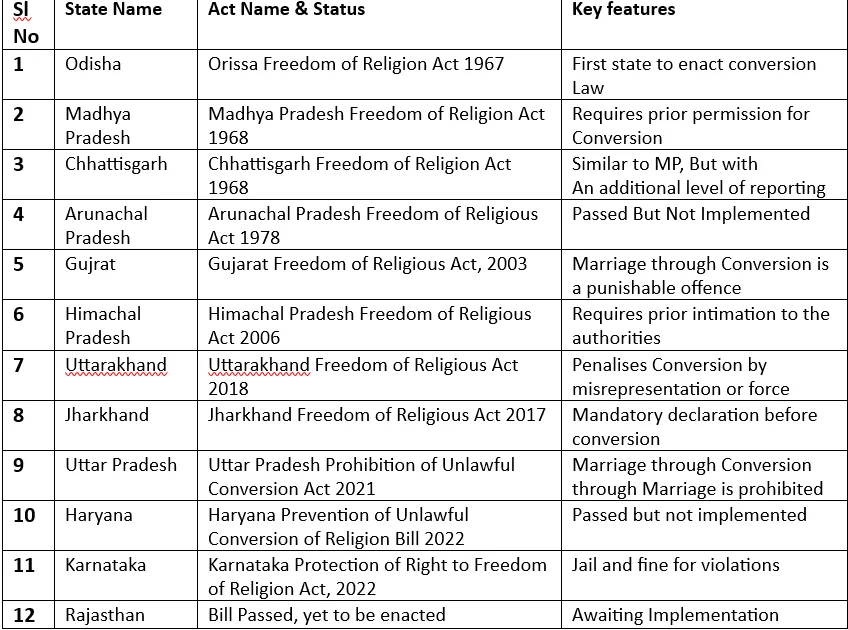
Twelve Indian states have passed anti-conversion laws, aimed at preventing religious conversions through force, fraud, or inducement. Of these, nine states have implemented the laws, while three states have passed them but have yet to enforce them.
Odisha was the first state to enact and implement such a law in 1967. However, convictions under the Act remain extremely rare. Most legal proceedings end in acquittals, often due to lack of evidence or procedural lapses.
Currently, the constitutional validity of these state laws is under challenge before the Supreme Court, with several NGOs filing petitions. The Court has also transferred all related cases pending in various High Courts for a consolidated hearing. Key Allegations Against Anti-Conversion Laws are Misuse of provisions to harass interfaith couples and minority communities. Vague definitions of terms like “force,” “fraud,” and “inducement,” leading to arbitrary arrests. Violation of privacy and dignity, especially in cases of consensual interfaith marriages or conversions
It is noteworthy that Odisha, the first state to enact such a law, has also witnessed significant conversion activity in its tribal regions—raising questions about the effectiveness of the legislation.
India’s model of state-level intervention in religious matters, while commendable in principle for promoting religious harmony, often struggles in practical implementation. The gap between legal intent and ground realities continues to challenge the protection of both religious freedom and cultural integrity.
Safeguarding Bharath’s Cultural Identity: Urgent Legal Reforms to Counter Conversion Lobbies
To preserve India’s cultural identity, uphold the principle of unity in diversity, and protect the civilizational self of Bharat, it is imperative to regulate and dismantle exploitative religious conversion networks. These lobbies, which often operate with foreign funding and political protection, pose a serious threat to national cohesion and indigenous traditions. Their actions must be recognized as anti-national when they undermine constitutional harmony and tribal integrity.
The following legal and constitutional reforms are urgently required:
1. Legislative and Judicial Clarity on Article 25: The scope of the right to propagate religion under Article 25 must be clearly defined through judicial interpretation and legislative amendment, ensuring that propagation does not extend to coercive or fraudulent conversion.
2. Amendment to Article 342: Protecting Tribal Identity. A long-pending amendment to the Constitution (Scheduled Tribes) Order, 1950 must be enacted, adding the following clause:
“2A. Notwithstanding anything contained in paragraph 2, no person who has given up tribal faith or faiths and has embraced either Christianity or Islam shall be deemed to be a member of any Scheduled Tribe.”
This will prevent converted individuals from claiming tribal status and constitutional benefits, thereby preserving the authentic cultural and spiritual identity of tribal communities.
3. Enactment of a National Anti-Conversion Law: India must pass a comprehensive national law that criminalizes religious conversion by force, fraud, or inducement, with precise definitions of these terms. The law must be robust and enforceable, with stringent penalties to deter violators and protect vulnerable communities from exploitation.















Comments