





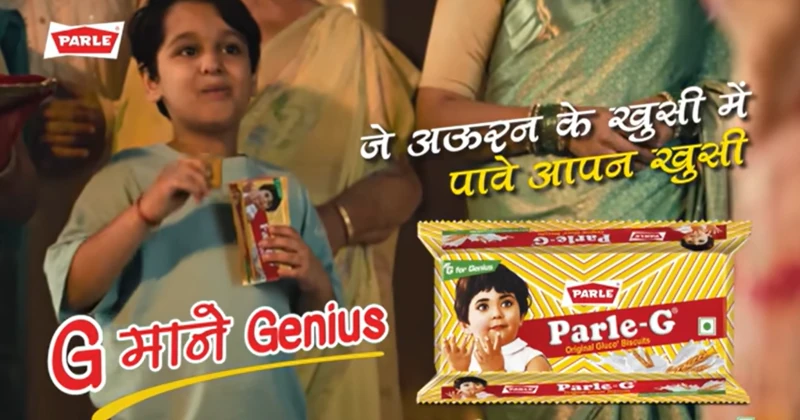
At a time when mainstream advertising often sidelines Bharat’s traditional festivals in favour of modern consumer narratives, Parle-G has stepped forward with a campaign that touches both the heart and the soul. The biscuit brand, synonymous with Indian family life for over eight decades, has launched a deeply moving Chhath Puja film “G Maane Genius” that beautifully captures the essence of Hindu devotion, empathy, and familial love.
The ad, released ahead of Chhath Puja celebrations on October 25, has gone viral across social media platforms, resonating with millions across Bihar, Jharkhand, and Eastern Uttar Pradesh the regions where this ancient Hindu festival holds divine significance.
The story unfolds in a modest Bharatiya household preparing for Chhath Puja one of the most rigorous and spiritually charged Hindu festivals dedicated to Surya Bhagwan (the Sun God) and Chhathi Maiya. As women in the family ready themselves to visit the ghat for the sacred arghya, one expectant mother is advised by her family to stay home due to the heavy crowds.
Her face falls a quiet yet powerful depiction of longing and devotion. For countless Hindu women, Chhath is not just a ritual but an act of gratitude, discipline, and deep emotional connection to nature and divinity. Missing it feels like missing the rhythm of the cosmos itself.
Sensing her pain, her young nephew takes it upon himself to bring the festival home. With innocence and ingenuity, he collects mud, sugarcane, flowers, and water to recreate a miniature Chhath Ghat in their courtyard. When his aunt steps outside, she finds her nephew’s creation a humble yet sacred space where she can offer her prayers to the setting sun, surrounded by family.
The scene closes with the child sharing Parle-G biscuits with his aunt, their joy illuminating the household. The film’s final line — “Genius is finding happiness in the happiness of others” encapsulates the festival’s true spirit.
Chhath Puja is among the most ancient Vedic festivals still observed in Bharat, dedicated to the worship of the Sun God and Chhathi Maiya, believed to be the sister of Surya. Unlike most other festivals, Chhath is marked by purity, austerity, and environmental reverence. Devotees fast, take holy dips in rivers, and offer arghya to the setting and rising sun, symbolising gratitude for sustenance and life energy.
The rituals embody Bharatiya ecological wisdom, reflecting a unique harmony between human beings and nature. Women, often the central participants, undertake the fasts selflessly for the wellbeing of their families a living example of devotion through endurance.
Parle-G’s film subtly weaves these layers of meaning into its narrative, presenting the festival not through grandeur or spectacle but through the quiet sanctity of love and care within a Hindu family.
In an age where most ad campaigns focus on metropolitan festivals and Westernised celebrations, Parle-G’s Chhath Puja campaign stands out as a heartfelt tribute to regional Hindu traditions that form the cultural spine of Bharat.
Social media users have flooded X with praise. One user wrote, “No Gyaan, only pure Love.” Another posted in Bhojpuri, “Ab se ham bas Parle-G ke hi biscuit khaib.” Yet another commented, “Favourite biscuit brand doing ads for favourite festival. Absolute cinema.”
Kudos to Parle for a heartwarming Chhath Puja ad. What an amazing way to promote our regional Hindu festivals ❤️ pic.twitter.com/pC4jvLMrmu
— Alpaca Girl (@Alpakanya) October 23, 2025
This overwhelming response speaks to a growing cultural awakening a renewed pride in regional Hindu heritage and a demand for authentic representation in mainstream media.
Parle-G has long been woven into the social fabric of India a biscuit that accompanied generations through life’s simple joys. From classrooms and train journeys to temple offerings and family kitchens, Parle-G has symbolised familiarity, affordability, and warmth.
Speaking about the new campaign, Mayank Shah, Vice President of Parle Products, said, “Parle-G has always been part of India’s festivals and family traditions, not just as a biscuit, but as a companion to the moments that truly matter. This Chhath Puja, our campaign celebrates empathy, thoughtfulness and the small gestures that bring immense joy to loved ones.”
He added, “Every festival, Parle-G aims to inspire families to celebrate love, care and togetherness, reflecting our vision that true genius lies in spreading happiness and creating meaningful moments that strengthen bonds.” The statement echoes the deeper philosophy that genius lies not in intellect alone, but in seva (service), shraddha (faith), and prem (love) the timeless values that have guided Bharatiya culture for millennia.
What makes the “G Maane Genius” campaign particularly remarkable is its authentic portrayal of Hindu festivals without distortion, dilution, or caricature. The visuals, music, and emotional pacing stay true to the spirit of Chhath: simplicity, sincerity, and spiritual devotion.
It was the year 1929 a time when the air in Bharat was thick with the spirit of Swadeshi. Across the country, Indians were beginning to reject foreign goods and dream of building something their own. Amid this wave of self-reliance, a visionary silk merchant from Mumbai, Mohanlal Dayal Chauhan, decided to turn patriotism into enterprise.
In the quiet lanes of Vile Parle, he purchased an old, abandoned factory and repurposed it to produce confectionery. Having once travelled to Germany, Mohanlal had learned the art of confectionery making and brought home a machine he bought for Rs 60,000 a huge investment at the time. With just 12 family members by his side, he started what would one day become a household name across Bharat Parle.
At the time, the company didn’t even have a name. The family was so deeply engrossed in their work that the brand naturally took the name of its birthplace Parle. What began as a small Swadeshi dream would soon revolutionise India’s food industry and become an emotion spanning generations.
In the early years, Parle’s focus was on producing confectionery sweets, candies, and treats made with the idea of “Made in India, for Indians.” But a decade later, in 1939, Parle took a bold leap the launch of its first biscuit.
At that time, biscuits were an imported luxury. Brands like United Biscuits, Huntley & Palmers, Britannia, and Glaxo dominated the Indian market. Biscuits were expensive — something only the elite could afford. Parle changed that forever.
By introducing affordable, Indian-made biscuits, Parle gave the common man a taste of quality at a price they could pay. The brand quickly gained popularity across India and even found its way into the British-Indian Army’s rations during World War II. Soldiers relied on Parle biscuits for energy and taste a proud moment for a Swadeshi dream born in a small Mumbai suburb.
When Bharat gained independence in 1947, the joy of freedom was shadowed by a nationwide wheat shortage following Partition. Since wheat was the key ingredient in its Gluco biscuits, Parle had to halt production.
But rather than shutting down, Parle innovated creating barley-based biscuits and urging Indians through advertisements to adapt and support the nation’s recovery. The company paid tribute to freedom fighters in its messaging, reminding Indians that self-reliance was the true flavour of freedom.
This commitment to both country and consumer laid the foundation for Parle’s enduring legacy. By the 1960s, the Indian market was flooded with other glucose biscuit brands, confusing consumers and affecting Parle’s sales. In response, the company decided to reinvent its image.
A new yellow wax-paper packaging appeared simple yet iconic. On it, a little girl with curly hair and innocent eyes smiled beneath the bold red Parle logo. This unforgettable design was created by Maganlal Daiya of Everest Brand Solutions.
Still, the company wanted to stand apart from its imitators. In 1982, Parle made a defining move: Parle Gluco was officially rebranded as Parle-G, with the “G” symbolising Glucose — and later, Genius. The shift to printed plastic wrappers was another stroke of innovation, making the packaging more durable and affordable.
From that moment, Parle-G became more than a biscuit it became an identity. Once the new branding was in place, Parle-G entered the golden era of Indian advertising. The brand’s television commercials became cultural moments.
One early TV ad featured a grandfather singing “Swad Bhare, Shakti Bhare, Parle-G” with his grandchildren instantly memorable. By 1998, Parle-G roped in India’s first television superhero, Shaktimaan, whose presence turned the humble biscuit into a child’s symbol of strength and goodness.
Over the decades, the brand rolled out a series of heartfelt campaigns:
- “G Maane Genius” celebrated intelligence rooted in kindness.
- “Hindustan ki Taakat” reflected national pride and energy.
- “Roko Mat, Toko Mat” spoke to free-spirited creativity.
- “Woh Pehli Wali Baat” and “Tomorrow’s Genius” evoked nostalgia and progressive parenting.
Parle-G’s advertisements didn’t just sell biscuits they sold values, love, intelligence, empathy, and the spirit of Bharat.
For over eight decades, Parle’s strategy has been both simple and powerful. The company has always maintained a low-profit margin on its main product, making Parle-G affordable to every Indian. Instead of raising prices, Parle cleverly adjusted packet weights to ensure accessibility for all income groups. The company also diversified its product range — launching Crack Jack, 20-20, Hide & Seek, Monaco, and candies like Mango Bite and Melody while ensuring Parle-G remained the flagship product.
Today, Parle-G stands as a global phenomenon. With over 130 factories across Bharat, 5 million retail outlets, and exports to more than 21 countries, it produces over 1 billion biscuit packets every month making it one of the most consumed biscuits on the planet.
















Comments