





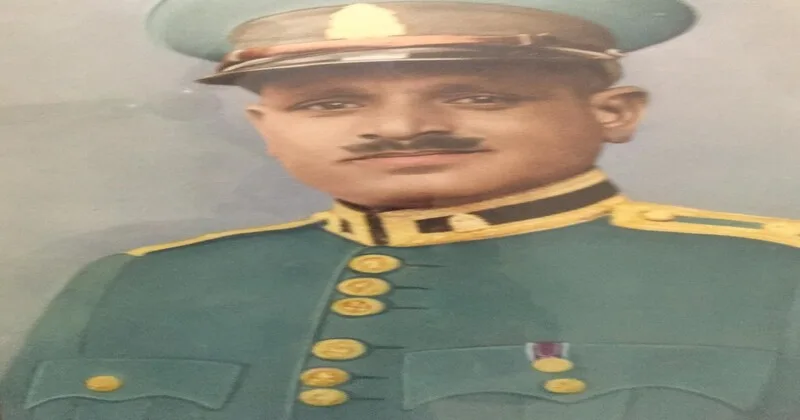
A couple of days ago, at the National War Memorial in New Delhi, an Air Warrior, Group Captain U S Sambyal, laid a wreath at the Amar Jawan Jyoti, paying homage to a legacy etched in courage and unparalleled sacrifice. Not only was he remembering countless unnamed men who laid down their lives defending India but also his grandfather Lt Col Narain Singh Sambyal who sacrificed his life at Muzaffarabad fighting Paistani invaders in October 1947. Eight decades later, the flame of his valour still burns bright and the hills he once defended still whisper his name in reverence.
Lt Col Narain Singh Sambyal, OBE, fought till his last breath to defend Kashmir in the face of betrayal by his own Muslim troops whom he trusted completely. Outnumbered a hundred to one, Lt Col Sambyal fought bravely and in the face of sure death as he understood the value of every minute, hour and day his men could hold the enemy. His sacrifice delayed the enemy’s advance towards Srinagar, where Maharaja Hari Singh was staying. The invaders had plans to take the Maharaja into captivity but Lt Col Sambyal’s efforts saved the state of Jammu & Kashmir from falling into the hands of these Pakistani invaders.
Lt Col Sambyal received a cautionary note from the Srinagar headquarters regarding the chances of some of his troops betraying him. He was also advised to disarm the troops of C and D companies which were Muslim companies while A and B companies of the unit he was commanding comprising mostly Dogra Rajputs. Lt Col Sambyal then asked a Company Commander stationed at Lohara Gali, to check the facts on ground. He wanted to secure and prepare his own position to get battle ready to take on the invading Pakistani troops.
Lt Col Sambyal’s Company Commander, Captain Azam Khan, filed a false report that there was nothing alarming happening under his watch. This false report from Lohara Gali, which was a key point for the defence of Muzaffarabad, is what Lt Col Sambyal took as gospel truth and disregarded the second cautionary note sent by the headquarters that some Muslim men and officers of his unit were meeting inimical agents, people from Muslim League of Pakistan. It was to prove his undoing later.
“We will fight for the Flag of our Maharaja till our last breath. Should we fall, the road to Srinagar shall still not open easily,” he told the handful of men, including his Adjutant Captain Ram Singh, who were still on his side. To his last breath, he kept his word and honour, not for a moment flinching and succumbing to fear. Lt Col Sambyal embodied the finest soldierly virtues the Dogras are known the world over. Right through two world wars and much before that Gulab Singh, a young soldier who fought the Sikhs at Gumat in Jammu at the age of only 17 in 1812, had showed true grit and determination.
The hallmark of Dogra soldiers, hardy hill men, has been virtues like discipline, loyalty and quiet courage. Lt Col Sambyal was commissioned into the J&K State Forces in 1924 at the age of 21, some years before Maharaja Hari Singh became the king. His rise through the ranks was quick as Lt Col Sambyal distinguished himself in tasks assigned to him. Those who fought by his side remembered Lt Col Sambyal him as “a Commanding Officer (CO) who led by example, and who would never send men where he would not go himself”.
During World War II, Lt Col Sambyal led his men through the jungles of Burma, where mosquito bites leading to malaria proved as deadly as enemy’s bullets and swords. His unit, the 4 J&K State Forces, assigned by Maharaja Hari Singh to fight on the side of the British when they asked him to lend troops. Lt Col Sambyal’s men fought with distinction at Kennedy Peak and Meiktila.
In fact, those who are familiar with Indian Army’s traditions know that the Battle of Meiktila which the Indian troops fought under FM Bill Slim in WW II is one of the most famous battles of that era. The Indian troops gave a wonderful account of themselves fighting the Japanese forces they defeated and the Japanese had to suffer very heavy casualties. In the Indian Military Academy (IMA) at Dehradun, as also Officers Training Academy (OTA), Chennai, Meiktila is the name of a company for training young men and women.
The personnel of the Meiktila company are known to wear green which is the colour assigned to the company. The war cry of these men/women is MMM (Mighty Mighty Meiktila) and they are also known as “The Mighty Mustangs’’.
In one such operation, Lt Col Sambyal reportedly carried a wounded sepoy on his shoulders for several kilometres to ensure he received treatment, an act that made him a living legend among his men who were ever ready to lay down their lives at his command. His calm leadership under relentless Japanese fire and his compassion in command earned him the Order of the British Empire (OBE) in 1946. He was one of the earliest J&K officers to be so honoured.
In October 1947, when Pakistan launched Operation Gulmarg, Lt Col Sambyal was ordered to defend Muzaffarabad– Domel– Kohala, the lifeline to Srinagar. As thousands of Pak tribal kabalis led by Pakistani Army regular soldiers and officers poured in, betrayal struck from within. Two Muslim companies in his battalion, swayed by separatist sentiment (egged on by Two Nation Theory of Ali Mohammad Jinnah) and divided loyalties, mutinied and joined the invaders.
Cut off from reinforcements and surrounded on all sides, Lt Col Sambyal refused to withdraw and turn back to safety. He rallied his remaining men, organised a desperate rear- guard action to shield fleeing civilians, and resolved to delay the enemy at any cost. Leading from the front, he moved to destroy the Kohala Bridge, the only route the raiders could use to reach Srinagar. It may be mentioned here that the Jhelum Valley Road to Srinagar ran via Muzaffarabad and this bridge was a vital link to cross the Jhelum river
As the enemy columns, comprising tribal lashkars, Pakistani Army personnel, advanced, they were aided by mutineers of his own unit who gave away details regarding positions of Lt Col Sambyal’s men. When the attackers all closed in near Domel, Lt Col Sambyal personally manned a Bren gun to cover his men’s withdrawal. His last orders, shouted over the gunfire, were: “Hold your ground, men! Blow the bridge if I fall!” Moments later, he was overpowered and killed — pistol in hand, fighting to the end. The three survivors later recounted how their commander’s stand delayed the enemy by two crucial days.
That delay allowed Brigadier Rajinder Singh, called the Saviour of Kashmir, to form the Uri–Baramulla line of defence and gave the Maharaja time to sign the Instrument of Accession which he did on October 26, 1947. The Indian Army personnel, of the 1 Sikh unit, were airlifted to Srinagar in civilian aircraft on urgent basis on October 27, 1947, saving Jammu and Kashmir. The troops of the 1 Sikh were led by Lt Col Dewan Ranjit Rai, who died in action in the initial days of enemy hostility while his troops guarded the airport and its periphery.
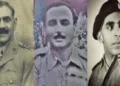
Lt Col Sambyal’s name stands beside Brig Rajinder Singh as one of the first Heroes of independent India’s defence of J&K —a soldier who faced mutiny, invasion and death, yet held fast to honour.










Comments