





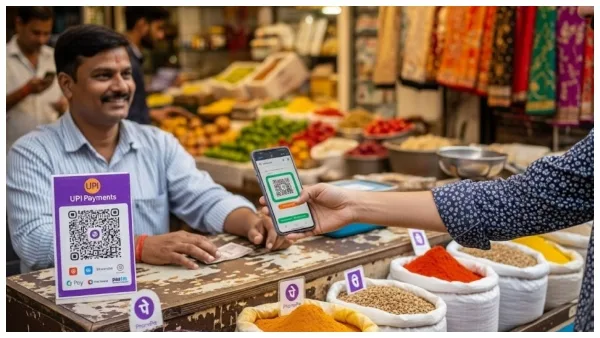
The Unified Payments Interface (UPI), India’s flagship digital payments platform, is witnessing one of its strongest months ever. According to data from the National Payments Corporation of India (NPCI), the average daily transaction value in October has surged to Rs 94,000 crore, marking a 13 percent jump over September.
With more than a week still left in the month, many predict that October will become UPI’s best-performing month in history, fuelled by Diwali shopping, festive bonuses, and GST rate cuts on several consumer goods.
The UPI network, which facilitates real-time bank to bank transfers, is expected to surpass Rs 28 lakh crore in total transaction value this month, breaking the previous record of Rs 25 lakh crore.
Diwali Boost and Changing Consumer Behaviour
The festive season has always served as a major catalyst for UPI growth. Last year, both Dusshera and Diwali falling in October had significantly boosted digital payment volumes.
This year, despite Dusshera celebrations taking place in September, the lead-up to Diwali on October 20 has triggered another surge in cashless payments. By October 20 alone, UPI had crossed the Rs 1 lakh crore daily transaction mark six times, double the number of days compared to September.
Typically, payment activity spikes at the start of each month due to salary credits, EMI payments, and bill settlements, followed by a mid-month dip. However, October’s sustained momentum indicates a structural shift toward habitual digital spending.
Transaction Volumes Hit New Peaks
In addition to value growth, UPI has also achieved record-breaking daily volumes. On the eve of Diwali, UPI recorded an all-time high of 740 million transactions in a single day, showing its massive adoption across urban and rural India.
The average daily volume for October has stood at 695 million, up over 6 percent from September’s 654 million. The combination of convenience, trust, and incentives offered by fintech apps has made UPI the go-to mode of payment even in smaller towns and Tier-II cities.
UPI Now Powers 85% of India’s Digital Payments
At a recent dialogue hosted by the Reserve Bank of India (RBI) on the sidelines of the World Bank and IMF Annual Meetings in Washington, RBI Governor Sanjay Malhotra revealed that UPI now accounts for nearly 85 percent of all digital payment transactions in India, a milestone that places the country at the forefront of global digital finance.
“About 85 per cent of the digital payment transactions in India today take place through UPI. Nearly 20 billion transactions are made using UPI every month, representing a value of over USD 280 billion,” Malhotra said.
He described UPI as not merely a technological innovation, but a “social and economic equaliser” that has transformed how Indians transact, particularly for small vendors, self-employed individuals, and rural citizens.
‘UPI is a Catalyst for Financial Inclusion’: RBI Governor
Governor Malhotra emphasised that the success of UPI demonstrates how digital public infrastructure (DPI) can drive financial inclusion and economic resilience.
“Small vendors and micro enterprises can now accept digital payments, build transaction histories, and access formal credit at much lower costs,” he explained.
UPI’s open-access model allows public and private players to innovate collaboratively, creating one of the world’s most vibrant fintech ecosystems. The RBI’s approach, building platforms as public goods rather than profit-driven enterprises, has ensured trust, privacy, and inclusivity in India’s financial system.
Part of a Larger Digital Public Platform (DPP) Ecosystem
During his address, Malhotra also highlighted India’s broader Digital Public Platform (DPP) architecture, which includes Aadhaar (digital identity), UPI (real-time payments), and DigiLocker (data sharing infrastructure).
These interoperable systems, he said, demonstrate how developing countries can leapfrog traditional financial barriers by creating scalable, open-source digital frameworks.
“In the true spirit of Vasudhaiva Kutumbakam, the world is one family, India is committed to sharing these platforms globally,” Malhotra said, positioning India’s DPP ecosystem as a template for global digital inclusion.
UPI’s Growing International Footprint
UPI’s success is no longer confined within Indian borders. The platform has been integrated or is under collaboration with Singapore, the UAE, Bhutan, Nepal, Sri Lanka, and France, enabling cross-border real-time payments.
These partnerships mark the beginning of a global digital payment network that prioritises transparency, affordability, and interoperability over profit motives. Analysts believe this model could allow other developing nations to fast-track financial inclusion without heavy infrastructure costs.
India’s Digital Model as a Global Blueprint
Malhotra further noted that digital trust infrastructure, when developed as a public good, can coexist with innovation and profitability. “Public and private sector entities can then leverage these platforms to rapidly develop applications across credit, health, agriculture, and social protection,” he said.
This model, he added, ensures long-term sustainability by keeping the digital economy inclusive and accessible, preventing monopolistic control by private tech giants.
By the Numbers: India’s UPI Revolution
Rs 94,000 crore: Average daily transaction value in October 2025
740 million: Record one-day transactions on Diwali eve
20 billion: Monthly transactions via UPI
Rs 28 lakh crore+: Expected total transaction value for October 2025
85 percent: Share of UPI in India’s digital payments
10+: International markets where UPI is now accepted
The Cornerstone of India’s Digital Economy
Since its launch in 2016, UPI has redefined India’s digital payments ecosystem, enabling instant, secure, and interoperable bank transfers through smartphones. What began as a government-backed initiative has evolved into a global model of digital empowerment, empowering millions across socio-economic segments.
With Diwali spending still underway and growing global adoption, UPI’s October performance reaffirms India’s leadership in digital financial innovation, one that blends scale, inclusivity, and trust to power a cashless future.
















Comments