





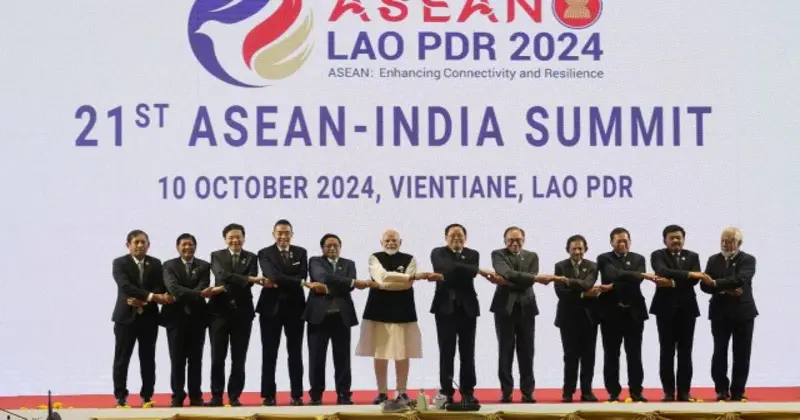
New Delhi has made a firm strategic move by deciding to attend the upcoming ASEAN summit virtually. Thus, Prime Minister Narendra Modi has chosen not to travel to Kuala Lumpur, Malaysia for the ASEAN summit held from October 26-28. PM Modi announced his decision in a post on the X social media platform, in the aftermath of a telephonic conversation with his Malaysian counterpart Prime Minister Anwar Ibrahim.
With this strategic decision, the prospect of a Modi-Trump meet is yet again derailed amidst fluctuating New Delhi-Washington ties. Prime Minister Modi has consistently attended the ASEAN summit since 2014. ASEAN grouping is deemed as a key stakeholder in India’s foreign policy due to the geographical proximity, economic vitality and geopolitical importance of the nations. Despite that, India has decided to not make an in-person attendance for the upcoming summit. Thus, geopolitical experts consider this deliberate choice of New Delhi as a much-needed strategic decision to uphold the strategic autonomy and sovereign dignity of India, amid chilling India-US ties.
“Had a warm conversation with my dear friend, Prime Minister Anwar Ibrahim of Malaysia. Congratulated him on Malaysia’s ASEAN Chairmanship and conveyed best wishes for the success of upcoming summits. Look forward to join the ASEAN-India Summit virtually to further deepening of the ASEAN-India Comprehensive Strategic Partnership”, PM Modi wrote on his X platform.
Had a warm conversation with my dear friend, Prime Minister Anwar Ibrahim of Malaysia. Congratulated him on Malaysia’s ASEAN Chairmanship and conveyed best wishes for the success of upcoming Summits. Look forward to joining the ASEAN-India Summit virtually, and to further…
— Narendra Modi (@narendramodi) October 23, 2025
New Delhi decides to deter meeting Trump as a symbol of sovereign dignity
If Prime Minister Modi travels to Kuala Lumpur for the upcoming ASEAN summit, the probability and compulsion to have a conversation or meeting with the US President Donald Trump on the sidelines of the summit will be high. However, this won’t be prudent for India, given the ongoing chilling and oscillating phase of New Delhi-Washington relations.
Donald Trump has repeatedly criticized India for purchasing the Russian oil. He has also accused India for fuelling the Russian war machine in Ukraine by purchasing the oil from Moscow. US President also makes baseless claims by stating that PM Modi promised him on cutting down the energy purchases from Russia.
For example, in the earlier week, Trump claimed that PM Modi has personally assured him on drastically reducing the energy purchases from Russia. Later, he also threatened that if New Delhi doesn’t cut down the energy sourcing from Moscow, massive tariffs imposed on India will be further escalated. Apart from the baseless accusations and tariff tussle by the US President, loud trade negotiations are underway between New Delhi and Washington, where the latter is accusing India of being too stringent on trade norms. However, India is seeking for a balanced, fair and mutually beneficial trade pact.
Most importantly, US President Donald Trump has repeatedly made headwinds claiming that he has mediated between India and Pakistan to halt the hostilities and the conflict. He has also demanded for a Noble Peace Prize on those lines. However, India has substantially refuted these illogical assertions by Trump and exclaimed that no third party mediation is entertained as India-Pakistan issue is completely bilateral in nature.
Thus, India-US strategic relations are suffering from a multi-front agility due to the misplaced trade and geopolitical priorities of Donald Trump. Meanwhile, Washington foreign policy is highly tilted towards Islamabad lately. With these thorn and upheavals in the bilateral relations, it would not be prudent for the Prime Minister of India to have a cordial talk with the US President on the sidelines of the ASEAN summit. In these lines, PM Modi didn’t attend the Gaza peace summit as well held in Sharm el-Sheikh in the previous week, which was co-hosted by US President Donald Trump.
Thus, New Delhi’s decision to virtually attend the ASEAN summit is a symbol of strategic prudence and not a missed opportunity. Until, India-US relations regains stability and legitimate traction it would be vigilant to avoid global encounters or unwanted discomforts that predominantly acts against India’s strategic autonomy, sovereign dignity, national security and foreign policy priorities.
ASEAN: Key pillar of India’s Act East policy
Leaving aside the US factor, ASEAN multilateral forum has immense vitality in India’s foreign policy priorities. The Association of South East Asian Nations(ASEAN) is 10-member group of Southeast Asian countries, which is a key pillar of India’s Act East policy and the Indo-pacific agenda.
India has a summit level strategic partnership with ASEAN since 2002. ASEAN is the only grouping with whom India has a full-fledged and long-standing Free Trade Agreement(FTA). The India-ASEAN trade relations is worth more than USD 110.39 billion and accounts for more than 11 per cent of India’s global trade. ASEAN economies also render India huge prospects in the markets of Southeast Asian nations and there is considerable scope for enhanced technology, trade, investment and people-to-people ties. The potential of this strategic relation is been regularly furnished and upgraded by both the sides.
ASEAN is also a key partner of India in its Indo-pacific strategy, as the group of Southeast Asian nations, help India to restore the balance of power in the region against any illegitimate aggression. Given this high-stake economic and geopolitical importance, India-ASEAN relations were elevated to Comprehensive Strategic Partnership in 2022 and the Prime Minister has been very consistent in attending the ASEAN summit and thereby ensuring that New Delhi-ASEAN ties will always be in a upward trajectory.











Comments