





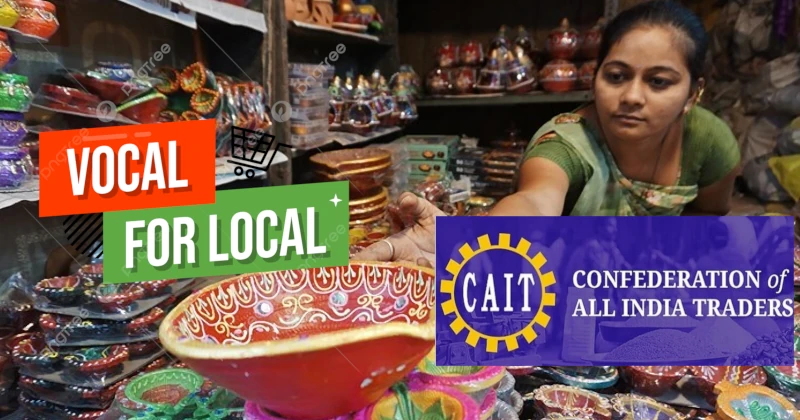
While Rahul Gandhi mocked “Made in India”, laughed at “Vocal for Local”, and dismissed India as a “dead economy”, the ground reality this Deepawali tells a very different story one of roaring economic resurgence, self-reliant confidence, and record-breaking prosperity.
According to a nationwide survey by the Confederation of All India Traders (CAIT), Deepawali 2025 recorded the highest-ever festive business in India’s history, touching an unprecedented Rs 6.05 lakh crore, with Rs 5.40 lakh crore in goods and Rs 65,000 crore in services. This marks a 25 per cent year-on-year growth over last year’s Rs 4.25 lakh crore, reaffirming that Bharat’s economic engine is not only alive but thriving.
এই বছরের দীপাবলি ভারতের অর্থনীতিকেও আলোকিত করেছে। @CAITIndia-এর সমীক্ষা অনুযায়ী এ বছর ইতিহাসে সর্বোচ্চ দেশে ₹৫.৪০ লক্ষ কোটি টাকার পণ্য ও ₹৬৫,০০০ কোটি টাকার পরিষেবার লেনদেন হয়েছে। এই দীপাবলি আত্মনির্ভর ভারতের শক্তি ও স্বদেশি চেতনার প্রতীক হয়ে উঠেছে। pic.twitter.com/O041hTm8DR
— PIB in West Bengal (@PIBKolkata) October 21, 2025
CAIT’s survey, conducted across 60 major distribution hubs, including state capitals and Tier-2 and Tier-3 cities, reveals a powerful economic surge rooted in the spirit of ‘Vocal for Local’ and ‘Swadeshi Deepawali’. The organisation’s Secretary General, Praveen Khandelwal, who also serves as BJP MP from Chandni Chowk, credited this record-breaking performance to the resurgent confidence in India’s domestic manufacturing and a strong preference for indigenous goods.
“Prime Minister Narendra Modi’s call for ‘Vocal for Local’ resonated deeply with the public. Nearly 87 per cent of consumers preferred Indian-made goods over imported products, resulting in a sharp decline in demand for Chinese items,” said Khandelwal. “Sales of Indian-manufactured products rose by 25 per cent compared to last year.”
Unlike global trends driven by large e-commerce platforms, India’s festive success story was written largely by non-corporate and traditional markets, which contributed 85 per cent of total trade, signalling a remarkable comeback for small traders and physical marketplaces across Bharat.
Sector-wise, the festive sales showed wide participation:
- FMCG (Grocery): 12 per cent
- Gold & Jewellery: 10 per cent
- Electronics & Electricals: 8 per cent
- Consumer Durables: 7 per cent
- Ready-made Garments: 7 per cent
- Gift Items: 7 per cent
- Home Décor & Furniture: 10 per cent combined
- Sweets & Namkeen: 5 per cent
- Textiles & Fabrics: 4 per cent
- Pooja Articles, Fruits & Dry Fruits: 6 per cent combined
The report highlighted that rural and semi-urban India accounted for 28 per cent of the total trade, underscoring the growing purchasing power and consumer confidence beyond metropolitan centers. The surge in demand across smaller towns reflects deeper economic participation and Bharat’s expanding middle class.
A major factor behind this economic momentum was the recent reduction in Goods and Services Tax (GST) rates on daily-use items, garments, home décor, and consumer durables. 72 per cent of surveyed traders attributed the increase in sales directly to lower GST rates.
CAIT’s Trader Confidence Index stood at 8.6/10, while the Consumer Confidence Index reached 8.4/10, reflecting widespread optimism supported by stable inflation, higher disposable incomes, and trust in India’s economic direction.
The services sector added a substantial Rs 65,000 crore, driven by heightened demand across packaging, hospitality, travel, event management, cab services, manpower supply, and delivery logistics. The report estimates that 5 million temporary jobs were created during this Deepawali season alone, highlighting how the festive economy ripples across multiple industries.
CAIT National President B. C. Bhartia emphasised that this growth is a “reflection of Bharat’s resilient small business ecosystem and the awakening of economic nationalism among consumers.”
Building on this record Deepawali, CAIT announced plans to hold a national conclave to discuss challenges from quick commerce and e-commerce giants, which many traders believe are undercutting local kirana businesses. The body also hinted at reviewing trade relations with Turkey and Azerbaijan, in light of recent geopolitical concerns.
The report recommends a set of reforms to sustain growth momentum, including:
- Simplifying GST compliance for small traders
- Improving credit access to MSMEs
- Developing logistics and warehousing hubs in Tier-2 and Tier-3 cities
- Promoting local manufacturing ecosystems through targeted government support
This year’s record-breaking Deepawali has become more than just an economic milestone it’s a symbol of Bharat’s self-reliant spirit. From local artisans to national distributors, the collective embrace of Indian-made products has transformed the festival into a celebration of economic independence.
“This Deepawali has proven that Bharat’s economy is not only resilient but self-driven,” said Khandelwal. “When 140 crore Indians choose local, they illuminate not just their homes, but the future of the nation’s economy.”















Comments