





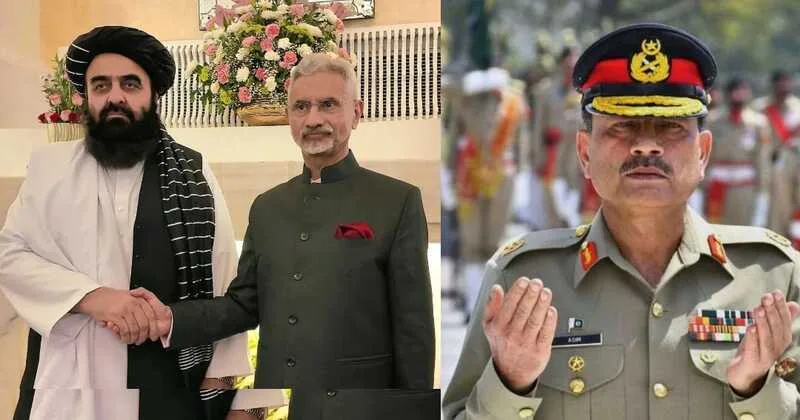
When India invoked the Chanakya principle of “the enemy’s enemy is a friend,” Islamabad found itself unsettled. Pakistan, the land of fostering terrorism, is now reeling from the strategic consequences of India’s growing engagement with Afghanistan. Despite multiple defensive manoeuvres, Pakistan has been left fatigued both militarily and diplomatically after feeling the impact of India’s assertive operations, including Operation Sindoor.
For months, Pakistan had hoped that warming relations between New Delhi and Kabul could somehow serve its own interests. In pursuit of this, Islamabad sought support from the United States. However, with China maintaining closer ties with Afghanistan, Pakistan received little meaningful backing. Its efforts to reshape South Asian geopolitics through Washington have since collapsed. The strengthening partnership between India and Afghanistan, combined with Taliban hostility toward Pakistan, has dealt a severe blow to Islamabad’s fragile position, particularly given its ongoing military and economic dependence on the US.
Muttaki’s visit signals diplomatic shift; Pakistan’s balancing act backfires
Afghan Foreign Minister Amir Khan Muttaki’s six-day visit to India, beginning on October 9, marked a turning point. His arrival in New Delhi followed a high-profile visit to Russia. The Afghan delegation received a notably positive reception from India, reflecting New Delhi’s pragmatic approach that prioritises national interest and security. In the spirit of Chanakya’s Arthashastra, India’s decision underscored the view that Dharma must yield to strategic necessity when it comes to safeguarding national interest. The visit was especially significant for India’s economic and military calculations in the region. It reaffirmed India’s long-standing commitment to Afghanistan while subtly marginalising Pakistan, which has sought to exploit Afghan instability for its own geopolitical leverage.
In recent years, Islamabad has attempted to counter India’s military and diplomatic weight by leaning more heavily on China. But the geopolitical landscape changed dramatically with Donald Trump’s return to power in the United States. The Trump administration, embroiled in trade disputes with both Beijing and New Delhi, sought to draw Pakistan into its orbit as part of a broader regional strategy. However, this alignment has backfired. As Washington’s confrontation with China deepened, Pakistan’s role as a strategic intermediary diminished. The Taliban government in Kabul, once nurtured by Pakistan, now finds itself under simultaneous pressure from both Islamabad and Washington. Facing isolation, the Taliban turned toward India, recognising it as the principal regional power capable of balancing competing global influences. Although Russia maintains ties with Kabul, its preoccupation with the war in Ukraine has limited its regional engagement. China, despite offering rhetorical support, lacks the leverage that New Delhi holds with Washington. For Afghanistan’s rulers, India has emerged as the indispensable bridge to navigate relations with the Trump administration, particularly as Washington seeks greater control over Afghanistan’s Bagram airbase.
Pleased to meet FM Mawlawi Amir Khan Muttaqi of Afghanistan today in New Delhi.
This visit marks an important step in advancing our ties and affirming the enduring India-Afghanistan friendship.
Discussed India’s support for Afghanistan’s development, our bilateral trade,… pic.twitter.com/OLBOiv3gZZ
— Dr. S. Jaishankar (@DrSJaishankar) October 10, 2025
The Taliban leadership understands that an improved relationship with India would unsettle Pakistan. Islamabad, already troubled by increasing cross-border attacks along the Durand Line, fears deeper cooperation between Kabul and New Delhi. Pakistan’s own internal threat from the Tehrik-i-Taliban Pakistan (TTP), a group that has received tacit support from Afghan factions and Iran, has further weakened its security calculus.
India’s ties with Afghanistan, by contrast, rest on decades of developmental engagement. Since 2001, New Delhi has invested over three billion dollars in Afghan infrastructure, including the construction of the national parliament building in Kabul. Though relations waned following the Taliban’s 2021 return to power, India has gradually recalibrated its approach. It temporarily halted visa services for Afghans and closed its embassy during the regime change, yet maintained humanitarian assistance and diplomatic outreach through indirect channels. Historically, India supported the Northern Alliance, which fought the Taliban during the late 1990s with backing from Iran and Russia. Today, New Delhi has once again demonstrated strategic flexibility, upholding the Chanakyan precept that in politics, there are no permanent friends or foes, only enduring national interests. India’s current engagement with the Taliban reflects this pragmatic realism.
The Taliban, too, has signalled its willingness to reset relations. In 2021, its spokesperson declared that the Kashmir dispute between India and Pakistan was a bilateral issue, distancing itself from Islamabad’s long-standing anti-India rhetoric. The group also condemned the terrorist attack in Pahalgam earlier this year, supported by Pakistan. India, meanwhile, continued providing humanitarian assistance to Afghan citizens. It quietly allowed the Taliban to assume control of Afghan consulates in Mumbai and Hyderabad following a series of informal meetings between Indian diplomats and Taliban representatives abroad. One such significant meeting occurred in Dubai in January, when Foreign Secretary Vikram Misri met Amir Khan Muttaki to discuss avenues for cooperation.
These developments point to a deeper thaw in relations. For India, closer engagement with Afghanistan offers immense strategic advantages, particularly amid Western sanctions on Iran, one of New Delhi’s key partners. Afghanistan’s geographic position makes it a critical gateway to Central Asia. Renewed ties could help advance long-pending energy and connectivity projects, including transnational gas pipelines. During his recent visit, Muttaki described India as a “close friend” and expressed confidence that bilateral cooperation would expand significantly. The Afghan delegation also held discussions with Indian business leaders, encouraging investment in key sectors such as mining, infrastructure, and agriculture. External Affairs Minister S. Jaishankar later announced that India’s “technical mission” in Kabul would soon be upgraded to a full-fledged embassy, a move widely interpreted as a step toward normalising ties.
Islamabad’s waning influence;Port politics deepen the rift with Beijing
For Pakistan, these developments represent a sharp decline in its influence over Afghanistan. In the 1990s, the Taliban functioned as a proxy of Pakistan’s intelligence establishment. Many of its leaders were educated in Pakistani madrassas that had supported the Mujahideen against the Soviet Union. The Taliban’s dependence on Islamabad was near-total.
Today, that relationship has deteriorated beyond repair. Taliban leaders resent Pakistan’s attempts to dictate their domestic and foreign policies, while Islamabad accuses Kabul of harbouring anti-Pakistan militants. The two sides now face frequent armed clashes along the border. Jaishankar’s recent reaffirmation of India’s “commitment to the sovereignty, territorial integrity and independence of Afghanistan” was widely viewed as a veiled message to Pakistan. His remarks underscored New Delhi’s stance that Afghanistan should remain free from external interference, a pointed reference to Pakistan’s historical manipulation of Afghan affairs. In response, the Taliban Foreign Minister assured that Afghan soil would not be used for any activity hostile to India. The statement reflected a major shift in regional alignments, signalling the Taliban’s willingness to accommodate Indian concerns while limiting Pakistan’s leverage.
🚨Afghanistan has initiated an offensive against Pakistan from seven distinct border points, according to the Afghan Ministry of Defence; Huge battles underway.
Pakistani jets have gone airborne in the east of the country.#Afghanistan #Pakistan pic.twitter.com/n5gwjaicYs
— Jahangir (@jahangir_sid) October 11, 2025
Complicating matters further, Pakistan Army Chief General Asim Munir has sought to revive Islamabad’s relevance by proposing a new port project to Washington. Munir reportedly presented the Trump administration with plans to develop a port in Pasni, a coastal town in Balochistan, offering the US operational freedom in the region. This move has raised eyebrows in both Beijing and Islamabad. For China, Pakistan’s so-called “all-weather friend”, the proposal represents a direct challenge. The new Pasni port would lie barely 112 kilometres from Gwadar, the flagship site of the $60 billion China-Pakistan Economic Corridor (CPEC). If Washington approves the Pasni project, it would drastically reduce China’s strategic foothold in the Arabian Sea and further strain Sino-Pak relations.
For the United States, a Pasni port would provide a crucial foothold near Afghanistan and Iran, enabling renewed influence in a region where its presence has waned. But for Pakistan, this attempt to please both Washington and Beijing risks alienating both. It also exposes Islamabad’s growing dependence on its military leadership for political and economic decision-making. Munir’s port proposal underscores how Pakistan’s internal divisions and geopolitical miscalculations have left it vulnerable on multiple fronts. The army chief’s increasing control over national policy, coupled with deteriorating ties with both the Taliban and China, has deepened Pakistan’s strategic isolation.
India’s calculated advantage
Amid these shifting equations, India’s renewed engagement with Afghanistan represents a carefully calibrated success. New Delhi’s outreach, rooted in the timeless Chanakyan doctrine of strategic realism, has advanced its interests without direct confrontation.
By fostering ties with Kabul, India not only strengthens its influence in Central Asia but also undercuts Pakistan’s long-standing use of Afghan territory for proxy operations. The development also offers India an alternative regional route in light of sanctions on Iran and geopolitical competition involving China and the United States. In essence, the growth of Indo-Afghan relations has dealt Pakistan a double blow, weakening its historical control over the Taliban while exposing rifts within its alliances with both Washington and Beijing. As New Delhi consolidates its presence in Kabul, Islamabad faces the stark reality of a diminished role in the region.













Comments