





Kashi known to the modern world as Varanasi, which is often described as the oldest living city on earth. Its existence flows through both history and prehistory and its story carries echoes of faith, civilization and continuum that stretch across millennia. Few cities have sustained such an unbroken link between the ancient and the present as Kashi has.
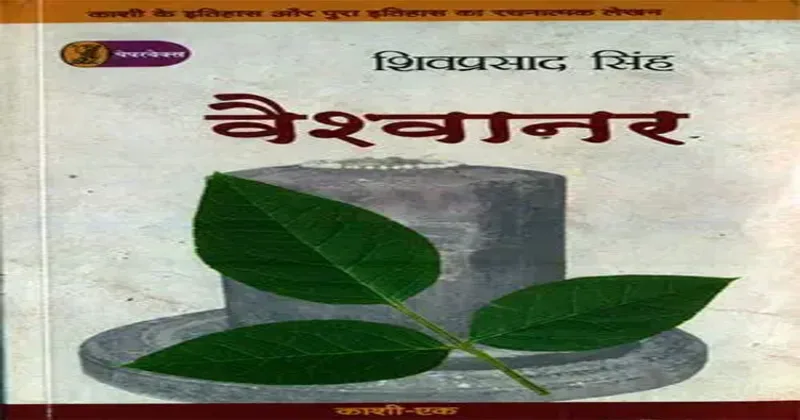
Among the many works that illuminate Kashi’s cultural depth, book by Dr. Shivprasad Singh novel Vaishwanar holds a special place. It is the first volume of his celebrated Kashi Trilogy, followed by Neela Chand (The Blue Moon) and Gali Aage Mudti Hai (The Lane Turns Ahead). Together these novels explore the soul of Kashi from different ages from mythical beginnings to contemporary life.
On the occasion of Deepawali celebration, reading this book Vaishwanar is fruitful in understanding the Bhartiya culture. This book is centred on Lord Dhanvantari, the divine physician revered as the founder of Ayurveda, Bhartiya ancient science of healing. The story unfolds during the period when the Saraswati River was drying up, a geological and cultural event that led several Aryan groups to migrate eastward. One such branch settled in the fertile land where the rivers Ganga and Varuna meet, the site that would one day be known as Kashi. Their leader was Dhanvantari and their clan deity was Agni the sacred fire, worshipped as Vaishwanar.
During this time, a severe epidemic struck Kashi. The sage-physician Dhanvantari devoted himself of discovering a cure, experimenting with herbs and meditative insight to understand the nature of disease and illness. While he struggled to save his people, danger approached from another front i.e. Sahasrarjuna, a ruler from the powerful Haihaya dynasty, thinking to conquer the city. With time Dhanvantari’s strength declined with age, the defense of Kashi fell upon his great-grandson Pratardan, who faced the deadly task of protecting the city with a small army.
This novel weave two threads together, one is of the courage and the other is wisdom. It is a tale of a warrior’s bravery and a healer’s intelligence, and their love for both country and knowledge. The story combines mythic scale with profound human feeling. While the book length is quite large, its narrative does not fade across. Dr. Singh incorporates a few Vedic hymns and Sanskrit verses, he also gave them their meanings in the course of the text, so that readers do not get confused between poetry and philosophy.
A luminous presence in the novel is Madalasa, the beloved of Pratardan. The narrative gains emotional warmth and poetic tenderness of love. The role balances the gravity of war and philosophy with the softer hues of affection and sacrifice. As per parts of characters, the novel celebrates the eternal feminine force that nurtures resilience even in turmoil and hardship.
Vaishwanar is not only a tale of gods and heroes but also it acts as literary bridge between myth and history. It reflects humanities passage from primitive life toward organized society, moral understanding, and scientific thought. Dr. Singh weaves symbolic and historical elements to show how the search for knowledge whether medical, spiritual or moral has always guided civilization forward.
Just as Kashi itself is located at the intersection of the Ganga and Varuna, so the novel stands at the junction point of legend and reality. It shows us that Kashi greatness is not just in its mandirs or its traditions, but lies in its timelessness in reconciling past and present. Through Vaishwanar, the readers can experience the flow of continuity of Kashi, that remind the journey of eternal city, which is old yet ever-living.
















Comments