





The ancient Indian education system was not merely a repository of knowledge, but a sophisticated intellectual ecosystem where reasoning, debate, and dialogue were central to the pursuit of truth. From the earliest Vedic period to the classical era of philosophy and medicine, the Indian approach to learning emphasised the active engagement of the mind, rigorous reasoning, and systematic methods of argumentation. Discussions and debates were not mere academic exercises; they were essential pedagogical tools that reflected the intellectual maturity and methodological depth of Indian scholarship.
At the heart of this system was the understanding that knowledge is not static but dynamic, unfolding through interaction, questioning, and refinement. The Nyaya school of philosophy, one of the six orthodox schools of Indian thought, formalised this principle by developing a structured framework for logical argument and debate. Nyaya scholars were deeply concerned with the correct methods of reasoning (तर्क) and the valid sources of knowledge (प्रमाण). They codified the rules of discourse to ensure that debates were rigorous, evidence-based, and oriented toward discovering truth. This formalisation indicates not only an advanced understanding of epistemology but also a recognition that education is most effective when students actively participate in inquiry rather than passively receive information.
Philosophical debates, or Shastrartha (शास्त्रार्थ), were diverse in form and purpose, reflecting a nuanced understanding of the nature of dialogue. The Vada (वाद), for instance, was an honest and cooperative debate in which participants sought mutual understanding and the discovery of truth. Whether between teacher and student or scholars of the same school, Vada relied on strong evidence and logical reasoning to establish a position. The emphasis was not on defeating the opponent but on illuminating knowledge, which cultivated intellectual humility and respect for evidence.
In contrast, Jalpa (जल्प) represented a competitive style of debate, where the primary objective was victory. While these debates allowed for the application of quick reasoning and rhetorical skills, they often prioritised persuasion over truth. Vitaṇḍa (वितण्ड), a further variant, was a destructive form of argumentation, aimed solely at refuting the opponent without proposing a constructive thesis. The distinction between these forms of debate reveals a sophisticated awareness of the ethical and cognitive dimensions of discourse. Students were trained not only in reasoning but also in the appropriate use of intellectual tactics depending on the context, balancing competitive skills with moral and philosophical responsibilities.
Structured dialogue was not limited to formal debates but extended to traditional teaching methods. Samvada (सम्वाद), as seen in the Upanishads, exemplifies the ideal of teacher-student discourse, where inquiry was rooted in respect, curiosity, and intellectual engagement. In this format, the student approached the teacher with humility and trust, posing questions and exploring concepts under the guidance of a knowledgeable mentor. This dialogical method promoted critical thinking and ensured that learning was a participatory process rather than a one-way transmission of knowledge.
Another hallmark of Indian intellectual tradition was the method of Purva Paksha (पूर्वपक्ष) and Uttara Paksha (उत्तरपक्ष). Here, a student or scholar would first study the opponent’s position in depth (Purva Paksha), striving to understand it from the opponent’s perspective before formulating a reasoned response (Uttara Paksha). This two-step approach not only enhanced comprehension but also cultivated empathy, intellectual rigour, and fairness. By encouraging the study of diverse perspectives before constructing an argument, this methodology fostered a culture of informed and ethical debate, a practice that resonates with modern principles of critical thinking and dialogue.
The Ayurvedic texts, particularly the Charaka Samhita, provide further evidence of the centrality of debate in professional and scholarly training. Charaka outlined rules for sambhasha (संभाषा), or scholarly discussions, distinguishing between Anuloma sambhasha (अनुलोम संभाषा), a congenial and cooperative debate, and Vigrihya sambhasha (विग्रिह्य संभाषा), a hostile and contentious one. These classifications underscore the recognition that debates could serve multiple purposes, fostering knowledge and insight, testing arguments under pressure, and training practitioners to think clearly and respond effectively in real-world situations.
Beyond individual interactions, debates were institutionalised in learned assemblies and public forums. Parishads (परिषद), or scholarly councils, provided a platform for philosophers and scientists to discuss metaphysical, ethical, and scientific questions. Aspiring debaters received systematic training in sambhasha (संभाषा) or vada vidhi (वाद विधि) to prepare for these intellectual gatherings. Royal courts (Sabha – सभा) also served as venues for high-level discussions, with kings and patrons supporting philosophical contests and rewarding exemplary scholarship. King Janaka’s court, described in the Brihadaranyaka Upanishad, famously hosted debates attended by renowned scholars, including women such as Gargi, highlighting the inclusivity and societal value placed on intellectual engagement.
The educational philosophy of ancient India extended even to broader societal forums. Samiti (समिति), the early Vedic folk assembly, not only deliberated on political and social matters but also engaged in discussions on moral and philosophical questions. This integration of debate into civic life reflects an understanding that the development of reasoning skills and ethical discernment was crucial not only for scholars but also for responsible citizenship.
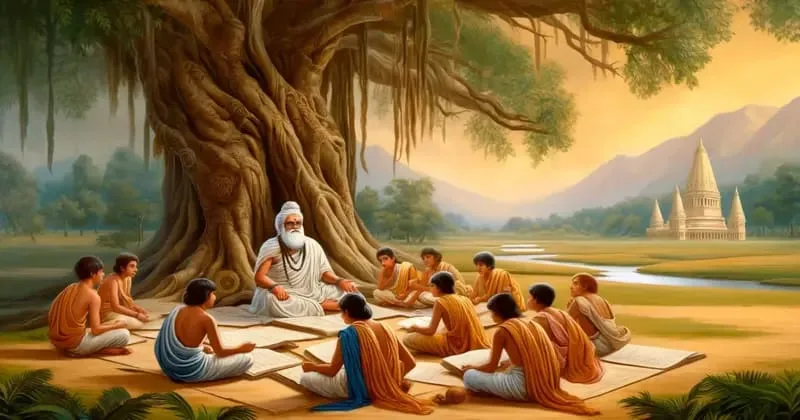
At the level of daily teaching, the gurukul system reinforced the culture of dialogue. Students lived with their teachers, learning through personal interaction, observation, and Socratic-style questioning. Oral transmission, repetition, and memorisation ensured the preservation of knowledge while fostering critical engagement. Teachers encouraged students to question, challenge, and debate concepts, promoting independent thought and intellectual resilience. The combination of debate, dialogue, and disciplined practice illustrates the holistic nature of education, emphasising both knowledge acquisition and cognitive development.
Thus, the structured debates, dialogues, and assemblies of ancient India reveal an education system of remarkable sophistication. The practices of Vada, Jalpa, Vitaṇḍa, Purva Paksha-Uttara Paksha, and Samvada demonstrate a nuanced understanding of logic, ethics, and pedagogy. By integrating competitive and cooperative debate with formalised methods of inquiry, ancient Indian education nurtured critical thinking, ethical reasoning, and intellectual maturity. This emphasis on dialogue and debate ensured that learning was not merely rote memorisation but an active, participatory process aimed at cultivating wisdom. The maturity of this system, its ethical considerations, and its systematic approach to knowledge making continue to offer valuable lessons for contemporary education, demonstrating that the pursuit of truth and the development of reasoning skills have long been at the heart of India’s intellectual heritage.











Comments