





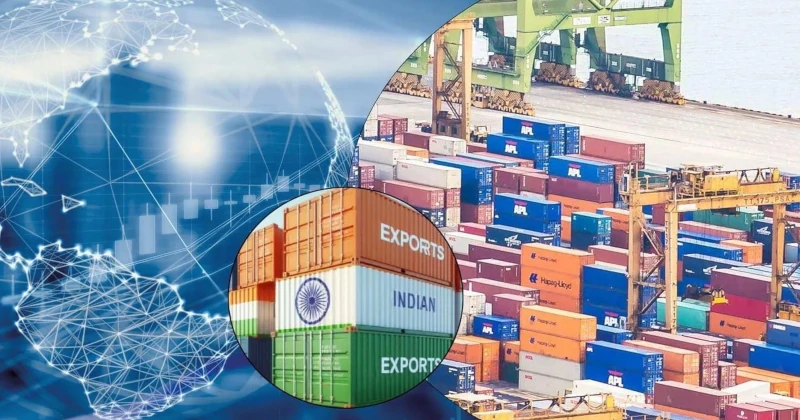
Despite a sharp decline in exports to the United States, India’s strategic diversification of its export markets has helped maintain overall export stability. Exports to countries such as the UAE, Spain, China, Brazil, and Germany have offset much of the loss caused by the US tariffs, keeping India’s overall exports largely under control. In the three months from July to September, since the new US tariffs came into effect, exports to the United States fell by 31 per cent. However, India’s total exports declined by only 2 per cent during the same period, a manageable fall considering the scale of the US market. Compared to August, when the double-dip tariff was partially implemented, total exports in September increased by 3.64 per cent. This rise was largely driven by higher export volumes to several other countries, defying earlier predictions of a steep decline.
Compared to July, when there were no tariffs in place, exports to the US saw a sharp drop of 31 per cent. Yet, India’s exports to the UAE recorded a 19.79 per cent increase, an additional $590 million in just three months. Exports to Spain also saw an impressive surge, with an increase of $439.6 million, marking an 80 per cent growth. Shipments to China rose by an additional $120 million, while exports to Germany grew by $74 million during the same period. Even Bangladesh, which is currently facing internal economic challenges, imported goods worth an additional $50 million from India.
According to trade experts, the ongoing trade war between the United States and China could eventually work in India’s favour. With China imposing restrictions on the export of essential minerals, the US may look to India as an alternative strategic partner. This possibility was hinted at by US Treasury Secretary Scott Besant, who recently stated that Washington is seeking India’s support in its dispute with Beijing. In response to the steep US tariffs, the Indian government and the country’s exporters have intensified efforts to identify and expand into new markets. The strategy aims to offset the impact of lost business with the United States by boosting trade with countries such as the UAE, Australia, members of the ASEAN bloc, Japan, South Korea, and Mauritius, all of which have trade agreements with India. Officials believe this diversification will strengthen India’s resilience to future external shocks.
Global Oil Prices Slide Amid Hopes of Trump–Putin Ceasefire Talks and Russian Supply Prospects
Meanwhile, international crude oil prices have fallen to a five-month low, following an announcement that US President Donald Trump and Russian President Vladimir Putin plan to meet to discuss ending Russia’s war in Ukraine. If a ceasefire agreement is reached during the Trump–Putin talks, sanctions and restrictions on Russian oil imposed by the United States and the European Union could be lifted. Such a move would increase the flow of Russian oil into the global market, easing supply constraints and putting downward pressure on prices. Market analysts suggest that prices are already declining on expectations of a potential surplus in global supply. The OPEC+ alliance’s recent decision to raise oil production has also contributed to this downward trend. As a result, West Texas Intermediate (WTI) crude prices have fallen to $57 per barrel, compared to $60 last week and $77 at the beginning of the year. Brent crude has similarly dropped to $60 from $63 last week, well below the $80 mark seen in January.
The European Union has significantly reduced its imports of Russian crude and petroleum products since the onset of the Ukraine conflict. Many Russian refineries have suffered heavy production losses due to drone and missile attacks launched by Ukraine, further straining the country’s energy sector. If the conflict eases, Russia is expected to increase oil production and make concerted efforts to reclaim its lost markets. Within Russia itself, fuel shortages have become acute, forcing petrol pumps to ration supplies, with many limiting sales to 30 litres per customer. The shortage has also affected Central Asian countries such as Tajikistan, Kyrgyzstan, Uzbekistan, Kazakhstan, and Turkmenistan, which rely heavily on Russian petroleum imports.
At the same time, tensions between the United States and China have spilled over into maritime trade. Both countries have recently raised port fees for each other’s ships, further complicating global oil transport logistics. Starting October 14, China began charging US ships a port fee of $56, prompting the US to impose a retaliatory $50 fee. Beijing has announced that its port fees will rise to $157 by 2028, raising concerns about higher tanker costs and disruptions in the global oil supply chain. Despite these global uncertainties, the fall in crude oil prices comes as a major relief for India, which imports around 90 per cent of its crude oil consumption. In the previous financial year, India spent approximately Rs 13.5 lakh crore on crude oil imports. Lower global prices will help reduce the country’s trade and current account deficits, stabilise foreign exchange reserves, and ease inflationary pressures.
For the Indian economy, the dual development, a measured export performance despite US tariffs and the fall in international oil prices, offers a temporary cushion against global volatility. Policymakers hope that continued diversification in trade and stable energy costs will strengthen India’s economic fundamentals in the months ahead.











Comments