How the British distorted an Indian game of morality
December 5, 2025
  • Read Ecopy
  • Circulation
  • Advertise
  • Careers
  • About Us
  • Contact Us
Android AppiPhone AppArattai
Organiser
  • ‌
  • Bharat
    • Assam
    • Bihar
    • Chhattisgarh
    • Jharkhand
    • Maharashtra
    • View All States
  • World
    • Asia
    • Europe
    • North America
    • South America
    • Africa
    • Australia
  • Editorial
  • International
  • Opinion
  • RSS @ 100
  • More
    • Op Sindoor
    • Analysis
    • Sports
    • Defence
    • Politics
    • Business
    • Economy
    • Culture
    • Special Report
    • Sci & Tech
    • Entertainment
    • G20
    • Azadi Ka Amrit Mahotsav
    • Vocal4Local
    • Web Stories
    • Education
    • Employment
    • Books
    • Interviews
    • Travel
    • Law
    • Health
    • Obituary
  • Subscribe
    • Subscribe Print Edition
    • Subscribe Ecopy
    • Read Ecopy
  • ‌
  • Bharat
    • Assam
    • Bihar
    • Chhattisgarh
    • Jharkhand
    • Maharashtra
    • View All States
  • World
    • Asia
    • Europe
    • North America
    • South America
    • Africa
    • Australia
  • Editorial
  • International
  • Opinion
  • RSS @ 100
  • More
    • Op Sindoor
    • Analysis
    • Sports
    • Defence
    • Politics
    • Business
    • Economy
    • Culture
    • Special Report
    • Sci & Tech
    • Entertainment
    • G20
    • Azadi Ka Amrit Mahotsav
    • Vocal4Local
    • Web Stories
    • Education
    • Employment
    • Books
    • Interviews
    • Travel
    • Law
    • Health
    • Obituary
  • Subscribe
    • Subscribe Print Edition
    • Subscribe Ecopy
    • Read Ecopy
Organiser
  • Home
  • Bharat
  • World
  • Operation Sindoor
  • Editorial
  • Analysis
  • Opinion
  • Culture
  • Defence
  • International Edition
  • RSS @ 100
  • Magazine
  • Read Ecopy
Home Bharat

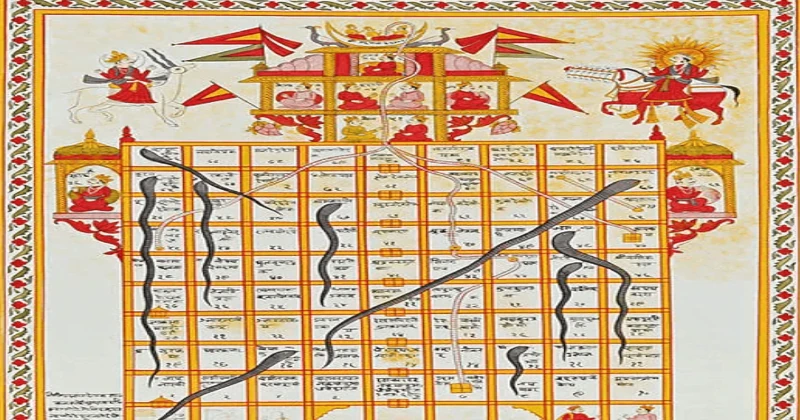
From Moksha Patam to Snakes and Ladders: How the British distorted an Indian game of morality and spirituality

Once a moral and spiritual teaching tool created by sant Gyandev in the 13th century, Moksha Patam was turned into a mere game of chance by the British, renamed Snakes and Ladders, and stripped of its profound Indian philosophical roots.

WEBDESKWEBDESK
Oct 18, 2025, 05:00 pm IST
in Bharat
Follow on Google News
FacebookTwitterWhatsAppTelegramEmail

Long before the British renamed and repackaged it as Snakes and Ladders, India had a deeply philosophical board game known as Moksha Patam, a creation of the 13th-century sant and poet Gyandev. Far from being a mere pastime, it was originally designed as a spiritual and moral teaching tool for children that reflected India’s ancient wisdom and belief in karma, virtue, and the path to salvation.

In its earliest form, Moksha Patam was a symbolic journey of the soul toward moksha i.e., liberation from the cycle of birth and death. Each square on the board represented a moral lesson, a virtue, or a vice. It taught that one’s actions in life determine their progress or downfall. Ladders stood for virtues such as faith, generosity, and knowledge that elevated one toward enlightenment, while snakes symbolized vices such as greed, arrogance, and lust that pulled one down into misery.

A Game of Values, Not Chance

The Moksha Patam board contained 100 squares. Every ladder and snake carried a meaning tied to moral conduct. For instance, the 12th square stood for faith, the 51st for reliability, the 57th for generosity, and the 76th for knowledge. Climbing a ladder meant moral advancement which is moving closer to the 100th square, which represented Moksha or spiritual liberation.

In contrast, landing on squares associated with disobedience, arrogance, vulgarity, or theft brought one face-to-face with a snake. The 41st square represented disobedience, the 52nd theft, and the 99th lust, each leading the player downward, much like moral decay leads to spiritual regression in life.

The game’s final destination i.e. the 100th square symbolised Nirvana, or freedom from worldly cycles. The ladders often ended at squares depicting divine realms such as Kailash, Vaikunth, or Brahmalok, reinforcing that virtue leads one closer to the divine.

Colonial Appropriation and Cultural Dilution

When the British encountered Moksha Patam during their colonial rule in India, they recognized its popularity but stripped it of its profound spiritual and cultural roots. The game underwent major modifications when it was transported to England in the late 19th century and was renamed Snakes and Ladders.

In this Western adaptation, all elements of karma, morality, and spiritual growth were erased. The game was reduced to a child’s pastime focused solely on luck, a sharp contrast to the original, which linked every move to moral choices and their consequences. Even the number of snakes and ladders was altered, eliminating the deliberate imbalance that once reflected life’s moral challenges.

The British version diluted the essence of Indian philosophy, reshaping it to suit Victorian sensibilities. In the process, it lost its true purpose, a moral guide meant to show that good deeds uplift and elevate the soul, while bad deeds lead to downfall.

Historians view the transformation of Moksha Patam into Snakes and Ladders as one of many examples of how British colonialism diluted and rebranded India’s indigenous traditions. A game once rooted in moral and spiritual teaching was reduced to mere entertainment, reflecting how colonial influence often replaced India’s profound philosophies with simplified Western versions.

The game, which once taught lessons about karma (actions and results) and kama (desire), was turned into simple entertainment by the British. Its deeper message about destiny and moral choices, the heart of Sanatan philosophy was completely lost.

The true brilliance of Moksha Patam lay in its reflection of human life. Every move represented one’s journey through moral choices, where virtues led to progress and vices led to setbacks. It taught children that life was not governed by mere chance, but by one’s own actions and intentions.

Unlike other Indian games like Pachisi, which celebrated skill and luck, Moksha Patam highlighted moral destiny, that one’s path to liberation depended on righteous conduct. It was both a game and a spiritual guide, echoing the philosophy that life is a moral ladder, where every rise or fall depends on the choices one makes.

Today, as India works to revive and protect its cultural heritage, Moksha Patam stands as a reminder that even simple creations once carried deep wisdom and values. Understanding how this ancient game was altered is not just about looking back, it’s about reconnecting with the moral strength that once shaped Indian society.

The story of Moksha Patam and its transformation into Snakes and Ladders symbolizes more than just a lost game; it represents how colonial forces often repackaged Indian knowledge systems, erasing their spiritual essence to suit Western narratives.

To revive Moksha Patam and preserve India’s heritage, the Indian government can reintroduce it in schools to teach values, promote it through cultural campaigns, and support artisans to make traditional boards. Promoting the game through public awareness and tourism can show its true history, and international recognition can highlight its importance worldwide. These steps will keep Moksha Patam alive as a game that teaches values and India’s timeless wisdom.


 

Topics: spiritualityMoksha PatamSnakes and LaddersGyandevIndian gameCultural Dilution
ShareTweetSendShareSend
✮ Subscribe Organiser YouTube Channel. ✮
✮ Join Organiser's WhatsApp channel for Nationalist views beyond the news. ✮
Previous News

Nine top Chinese generals loyal to Xi Jinping dismissed in historic military purge ahead of communist party plenum

Next News

Cow smuggling racket busted across Odisha: 59 cattle rescued from 7 pickup vans, 11 arrested

Related News

Living the Vivekananda Way:
Practical Spirituality for Modern India

Living the Vivekananda Way: Practical spirituality for modern India

India-US Relations: Holding the Future of Humanity

President Droupadi Murmu launches Brahma Kumari’s ‘Spiritual Empowerment’ campaign at Mount Abu

‘Spirituality is India’s only Politics, the fulfillment of Sanathana Dharma is the only Swaraj’ – Sri Aurobindo

Divya Gyan Sabha at Kashi proposes a widespread campaign for Yoga & Spirituality

Load More

Comments

The comments posted here/below/in the given space are not on behalf of Organiser. The person posting the comment will be in sole ownership of its responsibility. According to the central government's IT rules, obscene or offensive statement made against a person, religion, community or nation is a punishable offense, and legal action would be taken against people who indulge in such activities.

Latest News

Petitioner S Vignesh Shishir speaking to the reporters about the Rahul Gandhi UK citizenship case outside the Raebareli court

Rahul Gandhi UK Citizenship Case: Congress supporters create ruckus in court; Foreign visit details shared with judge

(L) Kerala High Court (R) Bouncers in Trippoonithura temple

Kerala: HC slams CPM-controlled Kochi Devaswom Board for deploying bouncers for crowd management during festival

Fact Check: Rahul Gandhi false claim about govt blocking his meet with Russian President Putin exposed; MEA clears air

Union Minister for Road Transport and Highways Nitin Gadkari (Right)

India set for highway overhaul as Union Minister Nitin Gadkari unveils nationwide shift to MLFF electronic tolling

RSS Akhil Bharatiya Prachar Pramukh Shri Sunil Ambekar

When Narrative Wars result in bloodshed, countering them becomes imperative: Sunil Ambekar

Ministry of Civil Aviation mandates emergency action: IndiGo ordered to stabilise flight operations by midnight

Chhattisgarh CM Vishnu Deo Sai at Panchjanya Conclave, Nava Raipur, Image Courtesy - Chhattisgarh govt

Panchjanya Conclave: Chhattisgarh CM Sai shares views on development projects in Maoist hotbed, women empowerment

Union Finance Minister Nirmala Sitharaman

‘TMC is holding Bengal back’: Sitharaman slams Mamata govt over industrial & healthcare setbacks

Karnataka: Muslim youth Mohammed Usman accused of sexual assault, blackmail & forced conversion in Bengaluru

Social Justice Is a cover; Anti-Sanatana dharma is the DMK’s real face at Thirupparankundram

Load More
  • Privacy
  • Terms
  • Cookie Policy
  • Refund and Cancellation
  • Delivery and Shipping

© Bharat Prakashan (Delhi) Limited.
Tech-enabled by Ananthapuri Technologies

  • Home
  • Search Organiser
  • Bharat
    • Assam
    • Bihar
    • Chhattisgarh
    • Jharkhand
    • Maharashtra
    • View All States
  • World
    • Asia
    • Africa
    • North America
    • South America
    • Europe
    • Australia
  • Editorial
  • Operation Sindoor
  • Opinion
  • Analysis
  • Defence
  • Culture
  • Sports
  • Business
  • RSS @ 100
  • Entertainment
  • More ..
    • Sci & Tech
    • Vocal4Local
    • Special Report
    • Education
    • Employment
    • Books
    • Interviews
    • Travel
    • Health
    • Politics
    • Law
    • Economy
    • Obituary
  • Subscribe Magazine
  • Read Ecopy
  • Advertise
  • Circulation
  • Careers
  • About Us
  • Contact Us
  • Policies & Terms
    • Privacy Policy
    • Cookie Policy
    • Refund and Cancellation
    • Terms of Use

© Bharat Prakashan (Delhi) Limited.
Tech-enabled by Ananthapuri Technologies